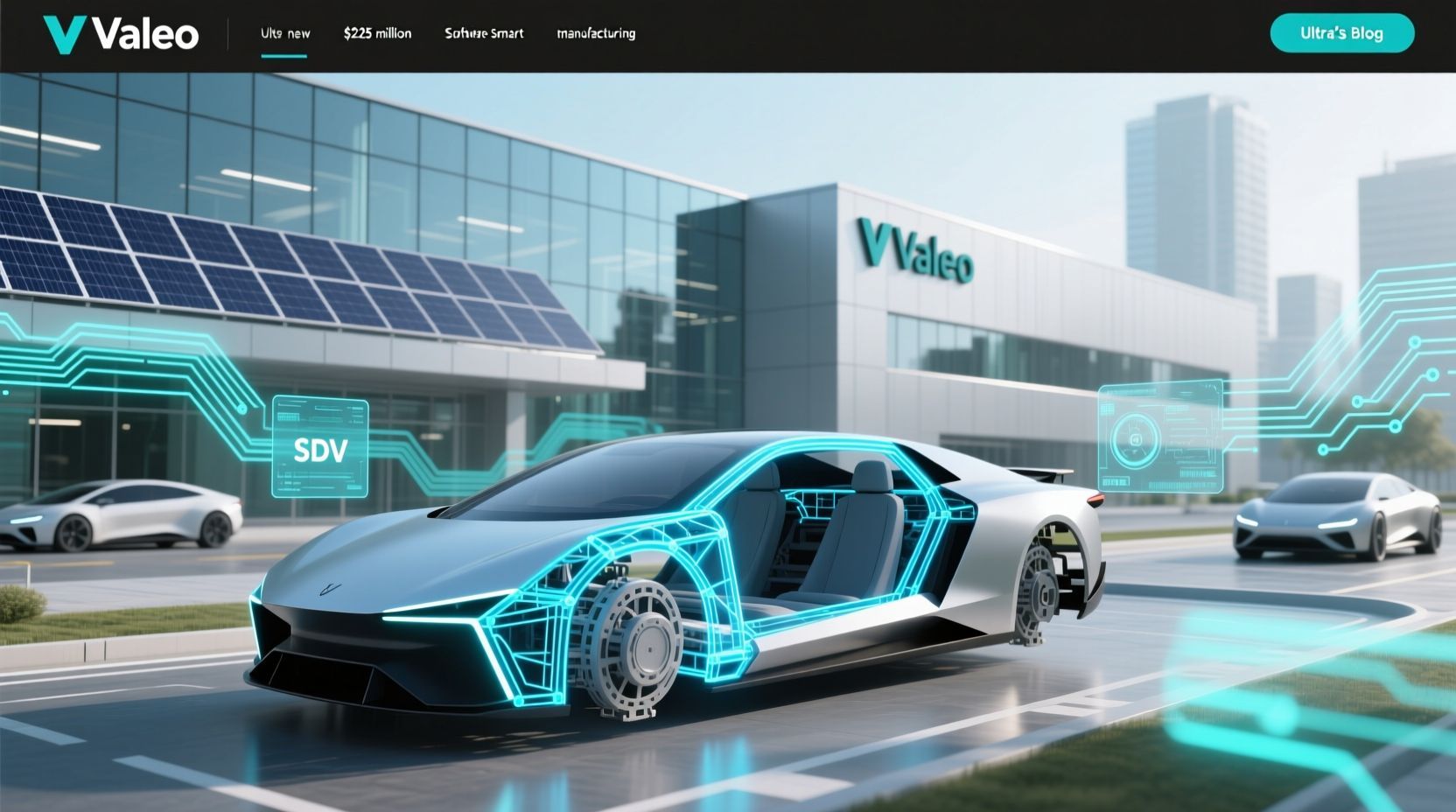
The ground has broken, and with it, a new era for automotive engineering accelerates. Valeo, a global leader in automotive technology, recently announced the groundbreaking of a state-of-the-art $225 million high-tech manufacturing facility in McAllen, Texas. This isn’t just another factory; it’s a foundational pillar for the next generation of mobility: the software-defined vehicle (SDV).
For R&D engineers, this development isn’t merely news; it’s a clarion call. The rapid shift from distributed electronic control units (ECUs) to centralized, high-performance compute platforms fundamentally alters every aspect of vehicle design, development, and deployment. The urgency to understand, adapt, and innovate within this paradigm is paramount. Falling behind means risking irrelevance in an industry undergoing its most profound transformation in decades.
Background Context: A Strategic Pivot to Software-Defined Mobility
On March 24, 2026, Valeo officially broke ground on its new 337,000 square-foot facility in McAllen, Texas. This substantial $225 million investment, spread over the next five years, is earmarked for the production of sophisticated central compute units. These units are specifically designed to power General Motors’ next-generation software-defined vehicles, with production slated to commence in late 2027.
This initiative is a direct manifestation of Valeo’s “Elevate 2028” strategic plan, which places electrification, advanced driver assistance systems (ADAS), and crucially, software-defined vehicle architecture at its core. The company’s commitment to this future is evident, with projections indicating that over 30% of its revenue will stem from software and electronics by 2026. This move signifies a broader industry trend where traditional automotive suppliers are evolving into integrated technology providers, focusing on high-margin, software-centric components.
The McAllen plant is strategically located to enhance supply chain resilience and proximity to key customers, addressing the increasing demand for advanced automotive electronics within North America. This regional investment is expected to create up to 500 new jobs, fostering a skilled workforce in advanced manufacturing and automotive technology.
Deep Technical Analysis: Architecting the Vehicle’s Central Brain
The central compute units to be manufactured at the Valeo McAllen plant represent a significant leap in automotive electrical/electronic (E/E) architecture. Unlike traditional vehicles, which rely on dozens, if not hundreds, of discrete ECUs, SDVs consolidate critical functions into a few high-performance central compute units. These “brains of the vehicle” integrate multiple electronic functions into a unified architecture, managing essential vehicle operations.
Central Compute Unit Architecture and Processing Power
The core of this innovation lies in the “liquid-cooled system powered by next-generation processors.” This specification immediately highlights several technical considerations:
- High-Performance Computing (HPC): “Next-generation processors” imply advanced System-on-Chips (SoCs) likely incorporating multi-core CPUs, powerful GPUs, and potentially dedicated AI accelerators (e.g., NPUs, TPUs). These processors must handle complex parallel computations for ADAS, infotainment, and vehicle control in real-time.
- Thermal Management: The “liquid-cooled” aspect is critical. Consolidating such immense processing power into a single unit generates significant heat, necessitating sophisticated thermal dissipation strategies to maintain optimal operating temperatures and ensure long-term reliability. This is a departure from air-cooled or passively cooled ECUs.
- Data Ingestion and Fusion: These units are designed to process “vast amounts of data from multiple sensors and systems.” This includes high-bandwidth data streams from LiDAR, radar, cameras, ultrasonic sensors, and internal vehicle networks (CAN, LIN, FlexRay, Automotive Ethernet). Engineers face challenges in real-time data acquisition, synchronization, and sensor fusion algorithms to create a comprehensive environmental model.
- Memory and Storage: Such data processing and complex software stacks demand substantial high-speed memory (LPDDR5, HBM) and robust, high-endurance storage solutions (NVMe SSDs) capable of handling continuous read/write cycles and critical system data.
Software-Defined Vehicle (SDV) Enablement
The central compute unit is the hardware foundation for the SDV paradigm, enabling features previously impossible with distributed architectures:
- Over-the-Air (OTA) Updates: A unified software stack allows for seamless, secure OTA updates for new features, performance enhancements, and critical security patches across the entire vehicle lifecycle, dramatically improving the customer experience through “faster connectivity, richer entertainment options and more frequent updates.”
- Abstraction Layers: Effective SDV development relies on robust abstraction layers between hardware and software. This often involves hypervisors (e.g., QNX Hypervisor, Xen) to isolate critical safety-related functions from infotainment and other less critical domains, ensuring functional safety (ISO 26262 compliance).
- Middleware and Operating Systems: Expect a diverse software stack, likely including real-time operating systems (RTOS) for critical functions (e.g., AUTOSAR Adaptive, QNX), alongside general-purpose operating systems (GPOS) like Linux for infotainment and advanced applications. Sophisticated middleware will be essential for inter-process communication and service discovery across the heterogeneous environment.
- Cybersecurity Architecture: A centralized compute system presents a larger attack surface. This necessitates an integrated, multi-layered cybersecurity approach, including hardware root-of-trust, secure boot, secure communication protocols, intrusion detection/prevention systems (IDS/IPS), and robust cryptographic modules.
Practical Implications for Engineering Teams
The shift to central compute units and SDVs carries profound implications for development and infrastructure teams across the automotive ecosystem:
- Skillset Evolution: There will be an increased demand for software engineers proficient in embedded Linux, QNX, hypervisor management, AI/ML development, high-performance computing, functional safety engineering (ISO 26262), and automotive cybersecurity. Traditional embedded C/C++ skills must now be augmented with expertise in modern programming languages, cloud-native principles, and data engineering.
- Development Toolchains and Methodologies: Existing toolchains for distributed ECUs will be insufficient. Teams must adopt advanced simulation environments, digital twins, and hardware-in-the-loop (HIL) testing platforms that can accurately model the complexity of a centralized system. Continuous integration/continuous delivery (CI/CD) pipelines, akin to those in enterprise software, become indispensable for managing rapid software iterations and OTA deployments.
- Cross-Functional Collaboration: The tight coupling of hardware and software in central compute units demands unprecedented collaboration between hardware, software, and systems engineering teams. Siloed development practices will lead to integration nightmares and delays.
- Data Management at Scale: Managing, storing, and analyzing the massive volumes of sensor data generated by SDVs for development, testing, and AI model training will require robust data infrastructure, including cloud-based solutions and specialized data pipelines.
- Supply Chain and Integration Complexity: While manufacturing is localized, the components within these compute units are global. Integrating diverse hardware components from various suppliers into a cohesive, high-performance unit presents significant engineering challenges, including driver development, firmware integration, and validation.
Best Practices for SDV Development and Deployment
To navigate this evolving landscape successfully, R&D and engineering teams should adopt the following best practices:
- Embrace a Software-First Mindset: Design hardware with software flexibility in mind. Prioritize modular software architectures (e.g., microservices, containerization where appropriate for resource-constrained environments) and API-driven development to enable rapid iteration and feature deployment.
- Integrate Cybersecurity from Inception: Implement a security-by-design approach. Conduct thorough threat modeling early in the development cycle, integrate secure boot, secure firmware updates, and robust access controls. Regular penetration testing and vulnerability assessments are non-negotiable.
- Prioritize Functional Safety and Reliability: Adhere rigorously to automotive safety standards like ISO 26262 and SOTIF (Safety Of The Intended Functionality). Utilize formal verification methods and extensive validation to ensure the central compute unit and its software perform reliably under all conditions.
- Invest in Advanced Simulation and Testing: Leverage digital twins, virtual ECUs, and sophisticated HIL test benches to validate complex interactions before physical prototypes are available. This reduces development costs and accelerates time to market.
- Foster an Open Standards and Interoperability Culture: Where possible, utilize open standards for communication protocols, data formats, and software interfaces to reduce vendor lock-in and promote a more interoperable ecosystem.
- Develop a Robust Data Strategy: Implement a scalable data collection, storage, and processing infrastructure. This is crucial for training AI models for ADAS and autonomous driving, as well as for vehicle diagnostics and predictive maintenance.
Actionable Takeaways for Development and Infrastructure Teams
The implications of Valeo’s investment and the broader SDV trend demand immediate strategic action:
- Upskill Your Workforce: Prioritize training programs for engineers in areas like embedded Linux, hypervisor management, AI/ML frameworks (e.g., TensorFlow Lite, ONNX Runtime for edge), cybersecurity, and functional safety standards.
- Modernize Your Toolchain: Evaluate and invest in advanced development tools, simulation platforms, and CI/CD pipelines tailored for complex, centralized automotive software.
- Redefine Your Architecture: Begin assessing current and future vehicle architectures for modularity, scalability, and software updateability. Plan for the eventual consolidation of functions onto central compute units.
- Strengthen Security Posture: Implement a comprehensive cybersecurity roadmap, focusing on secure design principles, continuous monitoring, and rapid patch deployment mechanisms for connected vehicles.
- Enhance Collaboration: Break down organizational silos between hardware, software, and test teams to ensure seamless integration and faster problem resolution.
Related Internal Topic Links
- Automotive Cybersecurity Best Practices for SDVs
- Achieving ISO 26262 Compliance in Software-Defined Architectures
- AI/ML at the Edge: Optimizing Models for Automotive Compute Units
Conclusion: The Road Ahead is Software-Defined
Valeo’s $225 million investment in McAllen is more than just a new manufacturing plant; it’s a tangible commitment to the software-defined future of the automotive industry. The central compute units produced here will serve as the nervous system for next-generation vehicles, enabling unprecedented levels of intelligence, connectivity, and adaptability. For R&D engineers, this signifies a fundamental shift away from isolated component development towards holistic system integration, where software defines the very essence of the driving experience.
The challenges are significant, encompassing complex hardware-software co-design, stringent safety and security requirements, and the need for agile, continuous development methodologies. However, the opportunities for innovation are equally vast. By embracing these changes, upskilling teams, and adopting forward-thinking engineering practices, development and infrastructure teams can not only navigate this revolution but actively shape the future of mobility, making vehicles safer, smarter, and more sustainable for all. The race to define the future of automotive software is on, and the stakes for engineers have never been higher.