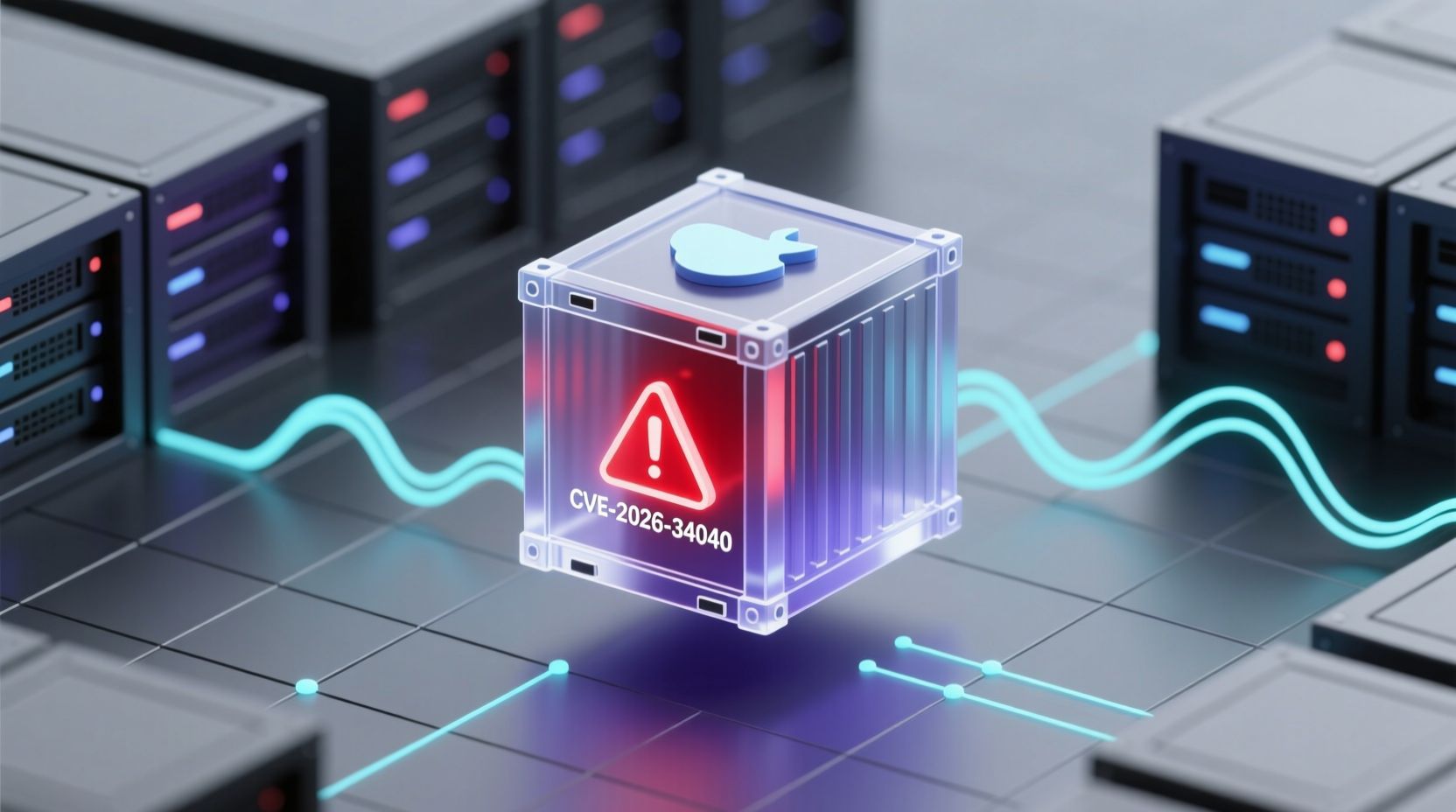
The clock is ticking for every engineering team leveraging Docker. A high-severity security vulnerability, tracked as CVE-2026-34040 (CVSS score: 8.8), has been publicly disclosed in Docker Engine. This flaw permits attackers to bypass authorization plugins (AuthZ) under specific circumstances, potentially granting them unauthorized access to your host systems and sensitive data. This isn’t just another patch; it’s a critical security mandate that requires immediate attention and remediation across your containerized environments.
Discovered by security researchers and disclosed on April 7-8, 2026, this vulnerability is particularly insidious because it undermines a fundamental security control that many organizations rely upon to enforce container policies. Its exploitation can lead to privileged container creation and direct access to the host filesystem, exposing credentials, SSH keys, Kubernetes configurations, and more. Engineers must act now to understand the mechanics of this vulnerability and implement the necessary fixes to safeguard their infrastructure.
Background Context: A Lingering Threat in Docker Engine
The newly identified CVE-2026-34040 is not an entirely novel class of vulnerability but rather an “incomplete fix” of a previously critical bug, CVE-2024-41110. The original flaw, which came to light in July 2024, addressed an AuthZ bypass involving zero-length request bodies. While that fix resolved one specific edge case, it failed to account for oversized HTTP request payloads, leaving an upper-bound condition exploitable.
Docker Engine, as the core runtime for building and running containers, often operates in environments where authorization plugins are crucial for enforcing security policies. Tools like Open Policy Agent (OPA), Prisma Cloud, or custom-built policies are frequently deployed to act as gatekeepers, evaluating and either approving or denying requests based on predefined security rules. These controls are designed to prevent high-risk actions such as launching privileged containers, mounting sensitive host filesystems, or granting access to critical system resources, thereby reducing the attack surface.
The fact that this vulnerability stems from a decade-old bug class, impacting Docker Engine versions as far back as 1.10, underscores a broader challenge in maintaining foundational infrastructure security. The widespread adoption of Docker across cloud infrastructure, CI/CD pipelines, and development environments means the potential exposure to this type of AuthZ bypass is significant.
Deep Technical Analysis: How CVE-2026-34040 Bypasses AuthZ
The mechanism behind CVE-2026-34040 is both simple and profoundly dangerous. It exploits a weakness in the middleware component of Docker Engine that sits between the Docker API and any authorization plugin.
Here’s a step-by-step breakdown of the attack vector:
- Crafted Malicious Request: An attacker with sufficient access to the Docker API sends a specially crafted HTTP request. This request could, for instance, be for creating a container with elevated privileges (e.g.,
"Privileged": true) or mounting the host’s filesystem. - Oversized Payload: The critical element of the exploit is that the request body is intentionally padded to exceed approximately 1 megabyte (MB) in size.
- Middleware Failure: When the Docker daemon receives this oversized request, its middleware component (responsible for forwarding requests to AuthZ plugins) silently drops the request body before sending it to the authorization plugin.
- Authorization Bypass: The AuthZ plugin, upon receiving a request with an empty body, perceives nothing to block and consequently allows the request to proceed. It effectively “sees nothing to block,” granting approval based on incomplete information.
- Daemon Execution: Critically, despite the AuthZ plugin only seeing an empty body, the Docker daemon proceeds to process the *full*, original (and malicious) request body. This leads to the execution of the attacker’s intended action, such as creating a privileged container or mounting the host filesystem with root access.
Security researchers at Cyera demonstrated that this flaw allows a single padded HTTP request to create a privileged container with host filesystem access. This means an attacker could gain access to sensitive host files like AWS credentials, SSH keys, and Kubernetes configurations.
The issue has been patched in Docker Engine version 29.3.1. Previous versions of Docker Engine are vulnerable if they utilize authorization plugins that introspect the request body to make access control decisions. This includes widely used enterprise security tools that rely on the integrity of the request body for policy enforcement.
Practical Implications for Development and Infrastructure Teams
The implications of CVE-2026-34040 are severe and far-reaching:
- Privilege Escalation and Host Compromise: An attacker with Docker API access (even if restricted by an AuthZ plugin) can bypass these controls to create containers with root-level privileges on the host. This effectively grants them full control over the underlying machine.
- Data Exfiltration: With host filesystem access, attackers can exfiltrate sensitive data, including cloud credentials, API keys, and other proprietary information.
- Stealthy Attacks: One of the most dangerous aspects is the stealth of the attack. Logs may appear normal, and the AuthZ plugin will report the request as “allowed,” leaving little to no immediate indication of compromise.
- Impact on AI Agents: Researchers highlighted a concerning scenario where AI coding agents running in Docker-based sandboxes could be tricked into exploiting this flaw. A prompt injection or supply chain attack could influence an AI agent to construct a padded HTTP request, bypass authorization, and create a privileged container, leading to data exfiltration. This expands the attack surface to include AI-driven development workflows.
- Wide Applicability: The vulnerability affects any organization running Docker with AuthZ plugins enabled, regardless of the specific plugin used, as the flaw lies in the Docker middleware itself.
Best Practices and Actionable Takeaways
Addressing CVE-2026-34040 requires immediate and decisive action. Here are the critical steps development and infrastructure teams must take:
1. Immediate Patching to Docker Engine 29.3.1
The most crucial step is to upgrade your Docker Engine installations to version 29.3.1 or later. This version contains the fix for CVE-2026-34040. Prioritize this update across all environments where Docker Engine is deployed, especially production and critical development systems.
# Example: Check your current Docker Engine version
docker version --format '{{.Server.Version}}'

# Example: Consult Docker documentation for upgrade path to 29.3.1
# (Specific commands will vary based on OS and installation method)
# For Debian/Ubuntu:
# sudo apt update
# sudo apt-get install docker-ce docker-ce-cli containerd.io docker-buildx-plugin docker-compose-plugin
2. Review and Harden Docker API Access
This vulnerability underscores the critical importance of restricting access to the Docker API. Follow the principle of least privilege rigorously:
- Limit Network Exposure: Ensure that the Docker API is not exposed to untrusted networks. Access should be restricted to trusted hosts and services only.
- TLS Encryption: Always secure Docker daemon communication with TLS.
- Authentication: Implement robust authentication mechanisms for Docker API access.
3. Consider Rootless Mode (Where Applicable)
Running Docker in rootless mode can provide an additional layer of security by running the Docker daemon and containers as a non-root user. While not a direct fix for this specific AuthZ bypass, it limits the impact of a container escape or privilege escalation by reducing the attacker’s privileges on the host.
4. Re-evaluate Authorization Plugin Reliance
While AuthZ plugins are essential, this incident highlights their potential failure points. Teams should:
- Avoid Body-Dependent Decisions (Temporarily): If possible, temporarily avoid using AuthZ plugins that solely rely on request body inspection for security decisions, until you are certain your Docker Engine is patched.
- Layered Security: Implement a layered security approach. Authorization plugins should be one of many controls, not the sole defense mechanism. Combine them with network segmentation, host-level security, and robust image scanning.
- Audit Logs: Enhance logging and monitoring for Docker API interactions and AuthZ plugin decisions. Look for unusual activity, especially large or malformed requests, even if they appear “allowed” by the plugin.
5. Implement Robust Container Image Scanning and Supply Chain Security
As AI agents become more prevalent in development, the risk of prompt injection or supply chain attacks exploiting vulnerabilities like CVE-2026-34040 increases. Ensure your CI/CD pipelines include comprehensive container image scanning for known vulnerabilities and actively monitor for suspicious activity in your software supply chain. Use tools like Docker Scout for continuous visibility into image vulnerabilities and policy compliance.
Related Internal Topic Links
- Container Security Best Practices: A Comprehensive Guide
- Automating Docker Patch Management in CI/CD Pipelines
- Understanding Docker Authorization Plugins and Policy Enforcement
Forward-Looking Conclusion
The discovery of CVE-2026-34040 serves as a stark reminder that even mature and widely adopted technologies like Docker are not immune to critical vulnerabilities. The fact that this particular flaw originated from an incomplete fix of an older bug emphasizes the continuous need for vigilance, thorough security auditing, and rapid response to disclosed issues. For R&D engineering teams, this incident is a call to action to prioritize security patching and to adopt a defense-in-depth strategy for their containerized workloads.
As the landscape of containerization evolves, with increased integration of AI and complex orchestration, the attack surface will only expand. Proactive patch management, stringent access controls, and continuous security monitoring are no longer optional but essential pillars of modern DevSecOps. By promptly addressing CVE-2026-34040 and integrating these best practices, engineering teams can significantly reduce their risk exposure and maintain the integrity of their Docker environments against current and future threats.