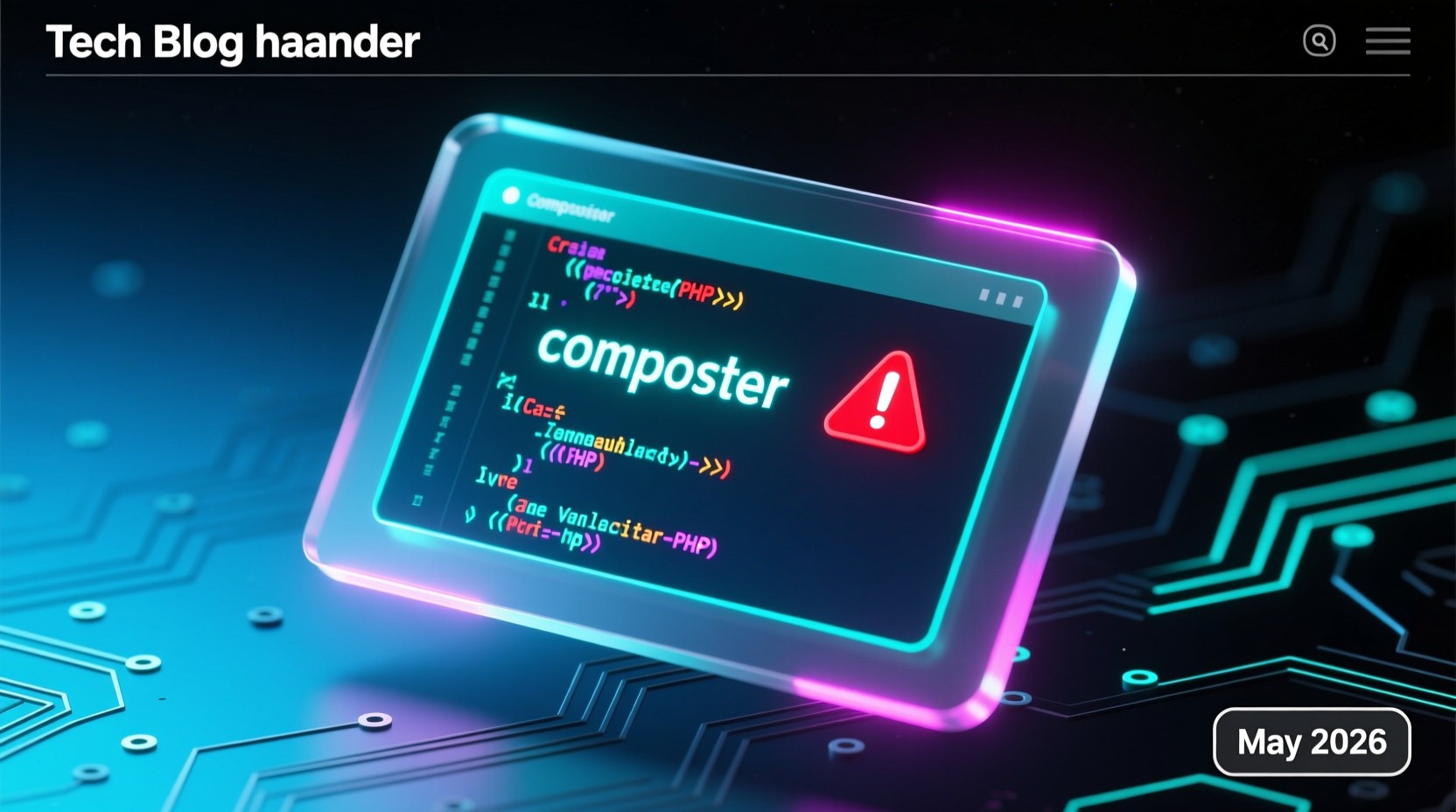
In the rapidly evolving landscape of software development, the integrity of our toolchain is paramount. Today, the PHP community faces a critical cybersecurity alert concerning its most fundamental dependency management tool: Composer. Two high-severity command injection vulnerabilities, identified as CVE-2026-40176 and CVE-2026-40261, have been disclosed, posing a significant risk of arbitrary command execution across potentially millions of PHP projects worldwide. For R&D engineering teams, this is not merely a bug fix; it’s a call to immediate action to prevent devastating supply chain attacks.
Background Context: Composer’s Pivotal Role and Supply Chain Risks
Composer stands as the cornerstone of modern PHP development, facilitating dependency management for virtually every contemporary PHP application, from enterprise-grade platforms to popular CMS like WordPress and Drupal. Its ubiquity makes any vulnerability within Composer itself a high-impact event, capable of rippling through the entire PHP ecosystem.
The concept of a “supply chain attack” has gained prominence in recent years, highlighting how adversaries can compromise software by targeting its dependencies. When a tool as central as Composer is vulnerable, it transforms into a potent vector for such attacks. Malicious actors could leverage these flaws to inject and execute arbitrary code during the dependency installation process, compromising development environments, CI/CD pipelines, and ultimately, production systems.
This situation underscores the continuous need for vigilance, not just in application code, but in the underlying tools and libraries that form our development infrastructure. The PHP development team, alongside the broader community, consistently releases updates for the core language, such as the recent PHP 8.5.1 security release, to address vulnerabilities and improve stability. However, external tools like Composer also require diligent monitoring and timely patching.
Deep Technical Analysis: CVE-2026-40176 and CVE-2026-40261
The recently disclosed vulnerabilities stem from improper input validation within Composer’s Perforce VCS (version control software) driver. These are not theoretical weaknesses but exploitable command injection flaws that allow an attacker to execute arbitrary commands on the system running Composer.
CVE-2026-40176: Improper Input Validation in Repository Configuration
This vulnerability carries a CVSS score of 7.8 (High severity). It arises when an attacker controls a repository configuration within a malicious composer.json file. By crafting a specific configuration for a Perforce VCS repository, an attacker can inject arbitrary commands. Composer, in turn, would execute these commands in the context of the user running Composer.
The core issue is Composer’s trust in the input provided in the composer.json when configuring Perforce repositories. Without sufficient sanitization or validation, specially crafted strings are interpreted as executable commands rather than benign configuration parameters. This means that if a developer unknowingly checks out a project with a compromised composer.json or installs a package from an untrusted source, their system could be immediately compromised upon running composer install or composer update.
CVE-2026-40261: Inadequate Escaping in Source References
With an even higher CVSS score of 8.8 (High severity), CVE-2026-40261 represents a critical command injection flaw due to inadequate escaping. This vulnerability allows an attacker to inject arbitrary commands through a crafted source reference that contains shell metacharacters.
This scenario is particularly dangerous because it doesn’t necessarily require direct manipulation of the composer.json‘s repository configuration. Instead, it targets how Composer handles source references – for instance, when resolving package versions or specific branches. By inserting shell metacharacters into these references, an attacker can break out of the intended command string and execute arbitrary shell commands. Crucially, the maintainers noted that Composer would execute these injected commands even if Perforce VCS is not installed on the system, broadening the attack surface significantly.
Affected Versions and Patches
These vulnerabilities affect a broad range of Composer versions:
- Versions
>= 2.3and< 2.9.6(Fixed in version2.9.6) - Versions
>= 2.0and< 2.2.27(Fixed in version2.2.27)
Composer has released patches to address these issues. The immediate recommendation is to upgrade Composer to the fixed versions.
Practical Implications for Engineering Teams
The impact of these Composer vulnerabilities cannot be overstated. Arbitrary command execution means an attacker could:
- Exfiltrate Sensitive Data: Access environment variables, configuration files (e.g.,
.env,wp-config.php), SSH keys, or other credentials stored on the build server or developer workstation. - Inject Backdoors: Modify source code, inject malicious libraries, or alter build artifacts, leading to persistent compromise of applications.
- Establish Footholds: Download and execute additional malware, establishing a persistent presence within the compromised environment.
- Disrupt Operations: Delete files, corrupt databases, or trigger denial-of-service conditions.
These risks extend across the entire software development lifecycle:
- Development Environments: Developers are particularly susceptible, as they frequently run
composer installorcomposer update. A compromised package orcomposer.jsoncould turn a developer’s machine into an attack launchpad. - CI/CD Pipelines: Automated build and deployment systems often execute Composer commands. A successful exploit here could compromise the entire pipeline, injecting malicious code into production builds without human intervention.
- Production Deployments: While Composer is typically run during development or CI/CD, some deployment strategies might involve running Composer on production servers, directly exposing them to risk.
Best Practices for Adoption and Mitigation
Mitigating these vulnerabilities requires immediate action and a reinforcement of existing security practices:
- Immediate Composer Upgrade: The most critical step is to upgrade your Composer installations to the patched versions:
2.9.6or higher for the 2.9.x series, and2.2.27or higher for the 2.2.x series. Ensure all development machines, CI/CD runners, and deployment environments are updated. - Source Code Review for
composer.json: Before running Composer commands, especially on new or untrusted projects, meticulously inspect thecomposer.jsonfile. Pay close attention to repository configurations and any unusual entries that might facilitate command injection. - Only Use Trusted Repositories: Restrict Composer to fetch packages only from trusted repositories. For private packages, use Private Packagist or a similar solution, and ensure its security is maintained. Composer has already disabled publication of Perforce source metadata on Packagist.org as a precaution.
- Avoid
--prefer-distfor Untrusted Sources: The advisory recommends avoiding the use of--prefer-distor the"preferred-install: dist"configuration setting when installing dependencies from untrusted sources, as this might bypass some security checks related to source code integrity. - Implement Strong CI/CD Security:
- Isolate CI/CD environments: Run Composer commands in ephemeral, containerized environments that are destroyed after each build.
- Least Privilege: Ensure the user running Composer in CI/CD has only the minimum necessary permissions.
- Static Analysis: Incorporate tools like PHPStan with security extensions to detect unsafe input handling, injection risks, and misuse of sensitive APIs in your PHP code.
- Dependency Auditing: Regularly audit your project’s dependencies for known vulnerabilities. Tools like "Security Advisories" in Composer help with this, but manual vigilance is also necessary.
- Stay Updated with PHP Core: While this specific issue is with Composer, remember that the PHP language itself receives regular security updates. For instance, PHP 8.5.1 was a recent security release, and staying on supported, patched versions (like PHP 8.5.x, 8.4.x, or 8.3.x for security fixes) is crucial. Older versions like PHP 8.1 have reached End-of-Life and no longer receive security patches.
Actionable Takeaways for Development and Infrastructure Teams
For Development Teams:
- Immediate Composer Update: Upgrade your local Composer installations to
2.9.6(or higher) or2.2.27(or higher) immediately. - Code Review Emphasis: Prioritize reviewing
composer.jsonfiles, especially in new projects or when adding new dependencies, for suspicious repository definitions. - Security-First Mindset: Integrate security considerations into daily development workflows, treating dependency integrity as a first-class concern.
For Infrastructure Teams:
- CI/CD Pipeline Audits: Verify that all CI/CD pipelines are running the latest patched Composer versions. Automate Composer updates within these pipelines where feasible.
- Environment Hardening: Ensure build agents and deployment servers have robust security configurations, including network segmentation and strict access controls.
- Monitoring and Logging: Enhance logging for Composer execution within automated environments to detect unusual command invocations or unauthorized network activity.
- Patch Management Strategy: Formalize a process for regularly updating Composer and other critical development tools across all environments.
Related Internal Topics
- Secure PHP Coding Practices: A Comprehensive Guide
- Advanced Dependency Management in PHP: Beyond the Basics
- Hardening Your CI/CD Pipelines Against Supply Chain Attacks
Conclusion
The disclosure of CVE-2026-40176 and CVE-2026-40261 in PHP Composer serves as a stark reminder of the continuous and evolving threat landscape facing software development. These command injection vulnerabilities are not theoretical; they represent a direct and immediate pathway for attackers to compromise systems across the PHP ecosystem. Proactive and swift action is not optional but essential.
By immediately patching Composer, rigorously inspecting composer.json files, adhering to trusted sources, and strengthening CI/CD security, engineering teams can significantly reduce their exposure. Moving forward, a culture of continuous security vigilance, encompassing both application code and its underlying dependencies, will be the most effective defense against the sophisticated supply chain attacks of tomorrow. The security of our digital infrastructure depends on our collective commitment to these principles.