The digital perimeter of modern enterprises is constantly under siege, with new vulnerabilities emerging at an alarming rate. For R&D engineers, this means a perpetual state of vigilance, where the integrity of our web applications hinges on our ability to react swiftly and decisively to breaking threats. Today, we delve into a critical Remote Code Execution (RCE) vulnerability, CVE-2026-33032, recently discovered and actively exploited in the Nginx UI management tool. This flaw presents a severe risk to web application security, demanding immediate attention from development and infrastructure teams globally.
Background Context: The Criticality of Management Interfaces and Nginx’s Ubiquity
Nginx stands as a cornerstone of modern web infrastructure, serving as a high-performance web server, reverse proxy, load balancer, and HTTP cache for countless applications worldwide. Its efficiency and flexibility have made it an indispensable component in architectures ranging from microservices to monolithic deployments. Given its widespread adoption, any vulnerability affecting Nginx or its associated management tools carries significant implications for global web application security.
Nginx UI (nginx-ui) is a popular web-based management interface designed to simplify the configuration and monitoring of Nginx servers. With thousands of GitHub stars, it’s deployed to manage potentially hundreds of thousands of Nginx instances, making it a critical, albeit often overlooked, component in the software supply chain. The convenience offered by such management interfaces inherently introduces a new attack surface. When these tools are exposed, even internally, they become prime targets for adversaries seeking to gain a foothold into an organization’s infrastructure.
The landscape of web application security is further complicated by the rapid integration of emerging technologies, particularly Artificial Intelligence (AI) and Machine Learning (ML) components. While these integrations promise enhanced functionality and automation, they also introduce novel attack vectors and often bypass the mature security controls established for traditional application components. This incident with Nginx UI serves as a stark reminder of these evolving risks.
Deep Technical Analysis: Unpacking CVE-2026-33032 in Nginx UI
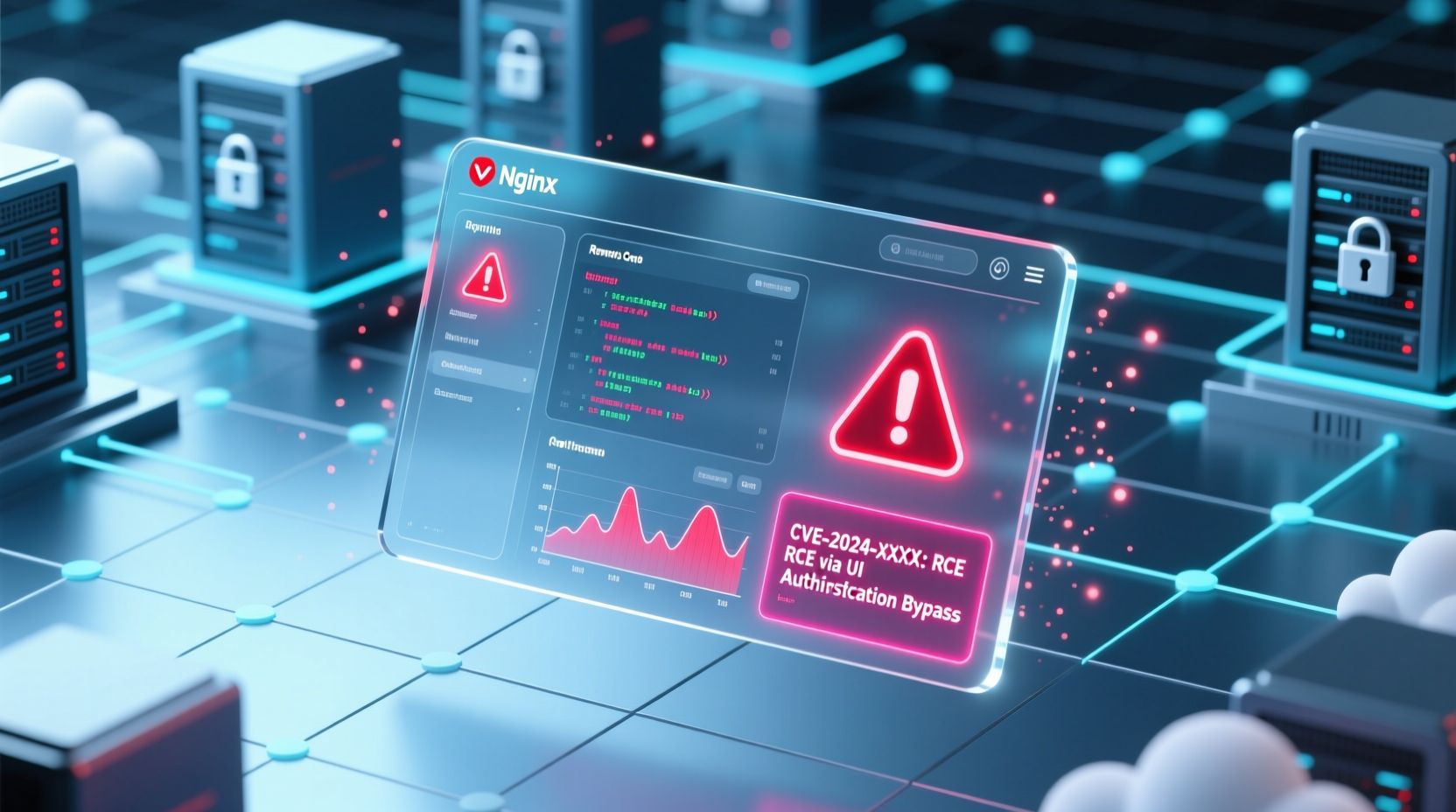
The recently disclosed CVE-2026-33032 is a critical Remote Code Execution vulnerability affecting the Nginx UI management tool. This flaw allows unauthenticated attackers to gain full control over vulnerable Nginx servers, representing a catastrophic compromise potential.
- CVE-ID: CVE-2026-33032
- Affected Versions: Nginx UI versions prior to 2.3.4.
- Patched Version: Nginx UI 2.3.4.
- Root Cause: The vulnerability stems from insufficient input validation and sanitization within Nginx UI’s recently introduced AI (MCP) integration. This new component, while designed to enhance management capabilities, appears to have been developed without the rigorous security scrutiny applied to core Nginx UI functionalities. Attackers can exploit this by sending specially crafted HTTP requests to the AI (MCP) integration endpoint. These requests, due to the inadequate validation, bypass existing security controls, allowing for the injection and execution of arbitrary code on the underlying server.
- Exploitation Vector: The vulnerability is remotely exploitable and does not require authentication. Attackers can leverage malformed or unexpected input directed at the AI (MCP) integration interface. Public Proof-of-Concept (PoC) exploit code has already become available, and threat intelligence firms have reported active exploitation in the wild since March 2026.
- Impact: The successful exploitation of CVE-2026-33032 grants unauthenticated attackers full system compromise, enabling arbitrary command execution, data exfiltration, service disruption, and potential lateral movement within the compromised network. For organizations relying on Nginx UI to manage their web infrastructure, this translates to an immediate and severe risk of complete server takeover and operational paralysis.
Architecture Decisions & Attack Surface Expansion
The critical nature of CVE-2026-33032 highlights a growing concern in modern application development: the expansion of the attack surface through new feature integrations, particularly those involving complex, rapidly evolving domains like AI/ML. As Pluto Security researchers noted, “AI integration endpoints expose the same capabilities as the core application but often skip its security controls”. This observation is profoundly insightful. New features, especially those developed rapidly to meet market demands, may not undergo the same stringent security review processes as established codebases. This can lead to a situation where a new, less mature component inherits the privileges and access of the main application, effectively becoming a weak link in the security chain.
Furthermore, the Nginx UI project has faced other security challenges recently, including CVE-2026-27944 (allowing unauthenticated backup data downloads) and CVE-2026-33030 (enabling authenticated attackers to access, modify, and delete other users’ resources). This pattern underscores the inherent risks associated with exposing powerful management interfaces and the necessity for continuous security hardening across all components.
Changelog Analysis and Security Patch
The release of Nginx UI version 2.3.4 specifically addresses CVE-2026-33032 by implementing strengthened input validation and more robust security controls around the AI (MCP) integration. While specific details of the code changes are not fully public, the patch likely focuses on:
- Strict Input Sanitization: Implementing comprehensive sanitization for all inputs processed by the AI (MCP) component, rejecting malformed or suspicious data.
- Parameter Whitelisting: Moving from a blacklist to a whitelist approach for acceptable input parameters and values, severely limiting the attack surface.
- Authentication Enforcement: Ensuring that critical operations within the AI (MCP) integration are properly gated behind authentication mechanisms, even if the primary vulnerability was unauthenticated.
- Privilege Segregation: Potentially isolating the AI (MCP) component with reduced privileges, limiting the impact even if a bypass were to occur.
Practical Implications & Actionable Takeaways for Development and Infrastructure Teams
The discovery and active exploitation of CVE-2026-33032 demand immediate and coordinated action from all teams responsible for web application security and infrastructure management:
- Immediate Upgrade: Prioritize upgrading all Nginx UI installations to version 2.3.4 without delay. This is the single most critical step to mitigate the RCE vulnerability.
- Review Network Exposure: Assess the network accessibility of your Nginx UI instances. Ideally, management interfaces should never be exposed directly to the public internet. Restrict access to internal networks, dedicated VPNs, or jump boxes. Implement strict firewall rules to limit inbound connections to only trusted sources.
- Enhance Input Validation: While the patch addresses the immediate vulnerability, adopt a defense-in-depth strategy. Reinforce input validation at multiple layers within your web applications — at the API gateway, application firewall, and within the application logic itself. Never trust user-supplied input.
- AI/ML Integration Security Audits: Any current or planned integrations involving AI/ML components must undergo rigorous security audits and threat modeling. These new attack surfaces are proving to be fertile ground for novel exploits. Treat AI integrations as high-risk components requiring specialized security expertise.
- Deploy WAF & RASP: Implement a Web Application Firewall (WAF) to detect and block malicious HTTP requests at the perimeter. For deeper protection, consider Runtime Application Self-Protection (RASP) solutions that can monitor application execution and prevent exploitation attempts in real-time.
- Strengthen Supply Chain Security: This incident underscores that the software supply chain extends beyond direct application dependencies to include management tools and third-party integrations. Regularly audit all components, including administrative panels, for vulnerabilities. Utilize software composition analysis (SCA) tools to identify and track known vulnerabilities in all dependencies.
- Proactive Patch Management: Establish a robust and automated patch management pipeline for all infrastructure components, not just core applications. Regular monitoring of security advisories for all software in your stack is paramount.
Best Practices for a Resilient Web Application Security Posture
Beyond immediate remediation, a comprehensive approach to web application security is essential for long-term resilience:
- Secure Development Lifecycle (SDL): Integrate security into every phase of the development lifecycle, from design and architecture to deployment and maintenance. This includes threat modeling, security-focused code reviews, and security testing.
- Automated Security Testing: Implement Static Application Security Testing (SAST), Dynamic Application Security Testing (DAST), and Interactive Application Security Testing (IAST) within your CI/CD pipelines to catch vulnerabilities early and consistently.
- Continuous Monitoring and Alerting: Establish robust logging and monitoring for all web applications and infrastructure components. Configure alerts for unusual activity, failed login attempts, or suspicious network traffic, especially on administrative interfaces.
- Principle of Least Privilege: Apply the principle of least privilege to all users, services, and network configurations. Grant only the minimum necessary permissions to perform required tasks.
- Threat Intelligence Integration: Stay informed about the latest threats and attack techniques. Subscribe to security advisories, industry reports, and participate in security communities to proactively anticipate and defend against emerging risks.
- Developer Security Training: Invest in continuous security training for your development and operations teams. Educate them on common vulnerabilities, secure coding practices, and the importance of a security-first mindset.
Related Resources to Fortify Your Defenses
- API Security Best Practices for Microservices: Explore strategies for securing the critical interfaces that power modern applications.
- Securing AI/ML Pipelines: New Attack Surfaces: Dive deeper into the unique security challenges and best practices for AI/ML integrations.
- Implementing a DevSecOps Pipeline: A Comprehensive Guide: Learn how to embed security seamlessly into your development and operations workflows.
Conclusion: Navigating the Evolving Web Security Landscape
The discovery of CVE-2026-33032 in Nginx UI serves as a potent reminder that web application security is not a static state but a continuous, dynamic process. As our architectures grow more complex and integrate new technologies like AI, the attack surface expands, demanding heightened vigilance and adaptive security strategies. For R&D engineers, the mandate is clear: prioritize proactive security measures, embrace a defense-in-depth philosophy, and foster a culture of continuous learning and adaptation. Only by staying ahead of the curve, meticulously patching vulnerabilities, and rigorously securing every layer of our applications can we effectively safeguard our digital assets against the ever-evolving threat landscape. The time to act is now; the integrity of your web applications depends on it.