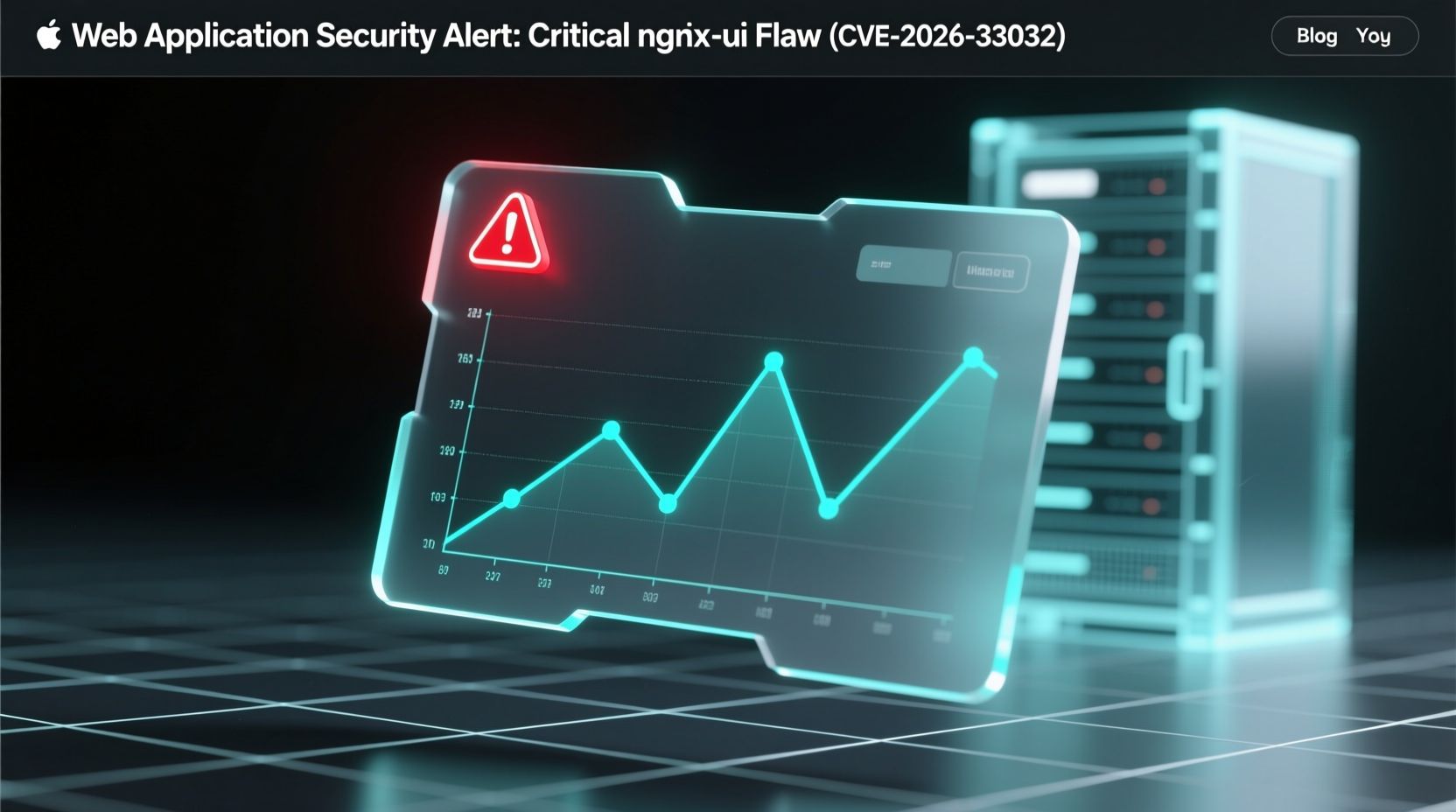
In the rapidly evolving landscape of cyber threats, the integrity of our web application infrastructure hinges on our ability to respond decisively to critical vulnerabilities, especially those under active exploitation. Today, the spotlight falls on a severe authentication bypass vulnerability, CVE-2026-33032, impacting nginx-ui, an open-source web-based management tool for Nginx. This flaw, dubbed “MCPwn” by Pluto Security, carries a CVSS score of 9.8 and is currently being actively exploited in the wild, posing an immediate and severe risk to an estimated 2,600 publicly reachable instances.
For R&D engineering teams and infrastructure architects, this is not a theoretical exercise but an urgent call to action. The compromise of a management interface like nginx-ui can grant unauthenticated attackers full control over your Nginx services, leading to arbitrary code execution, configuration manipulation, data exfiltration, and complete service disruption. Procrastination is not an option when adversaries are already leveraging these weaknesses.
Background Context: The Rise of Control-Plane Vulnerabilities
The April 2026 Patch Tuesday has highlighted a broad spectrum of vulnerabilities across various critical software and platforms, from Adobe and SAP to Microsoft and Fortinet, underscoring the relentless pace of threat discovery. While many of these demand attention, the nginx-ui vulnerability stands out due to its active exploitation and its target: a control-plane component.
nginx-ui serves as a convenient, web-based interface for managing Nginx web servers, simplifying tasks such as configuration changes, virtual host management, and service monitoring. Tools like these, designed to enhance operational efficiency, often become high-value targets for attackers. The underlying principle is simple: compromise the control layer, and you control everything beneath it. This shift in attack focus from application logic to the foundational management infrastructure represents a growing trend in the threat landscape, where attackers leverage trusted automation and management platforms as direct pathways to critical systems.
CVE-2026-33032 specifically targets this control plane, granting an unauthenticated attacker the ability to seize control of the Nginx service itself.
Deep Technical Analysis: Unpacking CVE-2026-33032 (MCPwn)
The vulnerability, tracked as CVE-2026-33032, is an authentication bypass flaw within the nginx-ui‘s implementation of its Model Context Protocol (MCP) integration.
nginx-ui exposes two primary HTTP endpoints for its MCP integration: /mcp and /mcp_message. The critical architectural oversight lies in the disparate security controls applied to these endpoints. While the /mcp endpoint correctly enforces both IP whitelisting and authentication via its AuthRequired() middleware, the /mcp_message endpoint bypasses this crucial authentication step. It only applies IP whitelisting, and critically, the default IP whitelist is often empty, which the middleware interprets as “allow all.”
This misconfiguration creates a gaping security hole: any network attacker can directly invoke all exposed MCP tools and functionalities by sending specially crafted HTTP requests to the /mcp_message endpoint, entirely circumventing any authentication requirements.
Successful exploitation of CVE-2026-33032 enables a range of devastating consequences:
- Arbitrary Nginx Configuration Modification: Attackers can rewrite Nginx configuration files, redirecting traffic, injecting malicious scripts, or serving arbitrary content.
- Nginx Service Reload/Restart: The ability to reload or restart the Nginx service can be used for denial-of-service attacks or to activate newly injected malicious configurations.
- Traffic Interception and Credential Harvesting: By manipulating Nginx configurations, attackers can set up proxies or redirects to intercept sensitive traffic, including administrator credentials.
- Remote Code Execution (RCE): While not a direct RCE in
nginx-uiitself, the ability to modify Nginx configurations can easily lead to RCE on the underlying server, for instance, by configuring Nginx to execute scripts or forward requests to a malicious backend.
The vulnerability affects nginx-ui versions prior to 2.3.4. The fix was released on March 15, 2026, in version 2.3.4, which addresses the improper handling of authentication for the /mcp_message endpoint.
It’s worth noting that the “MCPwn” moniker also extends to related vulnerabilities, such as those found in the Atlassian MCP server (CVE-2026-27825 and CVE-2026-27826), which could be chained for remote code execution. This highlights a broader pattern of security weaknesses in Model Context Protocol integrations where security controls may not be uniformly applied across all exposed functionalities.
Practical Implications for Development and Infrastructure Teams
The active exploitation of CVE-2026-33032 means that organizations running vulnerable nginx-ui instances are under immediate threat. Pluto Security’s identification of 2,600 publicly reachable instances underscores the widespread exposure. The implications are profound:
- Critical Infrastructure Compromise: Nginx often serves as a critical component in web application delivery, acting as a reverse proxy, load balancer, or web server. Its compromise can lead to widespread outages or malicious redirection.
- Data Breach Risk: Attackers gaining control over Nginx can reroute traffic to phishing sites, inject malicious content (e.g., Magecart-style attacks), or facilitate data exfiltration from backend services.
- Reputational Damage: Service disruptions, data breaches, and website defacement directly impact an organization’s reputation and customer trust.
- Compliance Violations: Failure to patch known, actively exploited vulnerabilities can lead to severe regulatory penalties and legal repercussions.
Development teams must understand that even if their application code is secure, the underlying infrastructure management tools present a significant attack surface. Infrastructure teams, conversely, must prioritize patching and configuration hardening for these critical components.
Best Practices and Actionable Takeaways
Given the urgency of CVE-2026-33032, immediate action is paramount. Here are the actionable steps and best practices for development and infrastructure teams:
- Patch Immediately: The most critical step is to upgrade your
nginx-uiinstallation to version 2.3.4 or later without delay. This version contains the necessary security fixes for CVE-2026-33032. - Emergency Mitigation (If Patching is Delayed): If immediate patching is not feasible, implement interim measures:
- Disable MCP Functionality: As advised by
nginx-uimaintainers, disable the MCP functionality if it’s not strictly required. - Restrict Network Access: Implement strict firewall rules to limit access to the
nginx-uimanagement interface (typically on port 80/443, but check your configuration) to only trusted IP addresses or internal networks (e.g., VPN-only access). Ensure that the IP whitelist for the/mcp_messageendpoint is explicitly configured.
- Disable MCP Functionality: As advised by
- Audit Nginx Configurations: Post-patching, conduct a thorough audit of all Nginx configuration files managed by
nginx-ui. Look for any unauthorized modifications, suspicious directives, or unexpected changes that might have occurred during potential exploitation. - Network Segmentation: Isolate management interfaces and tools like
nginx-uiinto separate, highly restricted network segments. This minimizes the lateral movement capabilities of an attacker even if initial compromise occurs. - Strong Authentication and Access Control: Ensure all management interfaces, including
nginx-ui, enforce strong, multi-factor authentication (MFA). Implement the principle of least privilege, granting only necessary permissions to users and service accounts. - Logging and Monitoring: Enhance logging for
nginx-uiand Nginx itself. Monitor access logs for unusual requests to the/mcp_messageendpoint, unexpected configuration changes, or suspicious Nginx reloads. Integrate these logs with your SIEM for real-time alerting. - Regular Vulnerability Scanning: Continuously scan your external and internal assets for known vulnerabilities. Automated tools can help identify exposed
nginx-uiinstances and other critical weaknesses. - Incident Response Plan Review: Ensure your incident response plan is up-to-date and includes procedures for responding to actively exploited zero-day vulnerabilities affecting critical infrastructure components.
Related Internal Topics
- Advanced Nginx Hardening Strategies: Beyond the Basics
- Securing CI/CD Pipelines Against Supply Chain Attacks
- Implementing Zero Trust Architecture for Web Applications
Conclusion
The active exploitation of CVE-2026-33032 in nginx-ui serves as a stark reminder of the persistent and evolving threats in the web application security domain. As our reliance on automated management tools grows, so does the importance of securing these control planes. The “MCPwn” vulnerability underscores that even seemingly innocuous components can become critical vectors for compromise when fundamental security controls are overlooked.
For engineering teams, this incident reinforces the imperative for a proactive, defense-in-depth approach. This includes not only diligent patching and adherence to security best practices but also a deep understanding of the architecture and security posture of every tool in your stack. Staying informed, acting swiftly, and continuously adapting your security posture are no longer optional but fundamental requirements for safeguarding critical web services in an increasingly hostile digital environment.