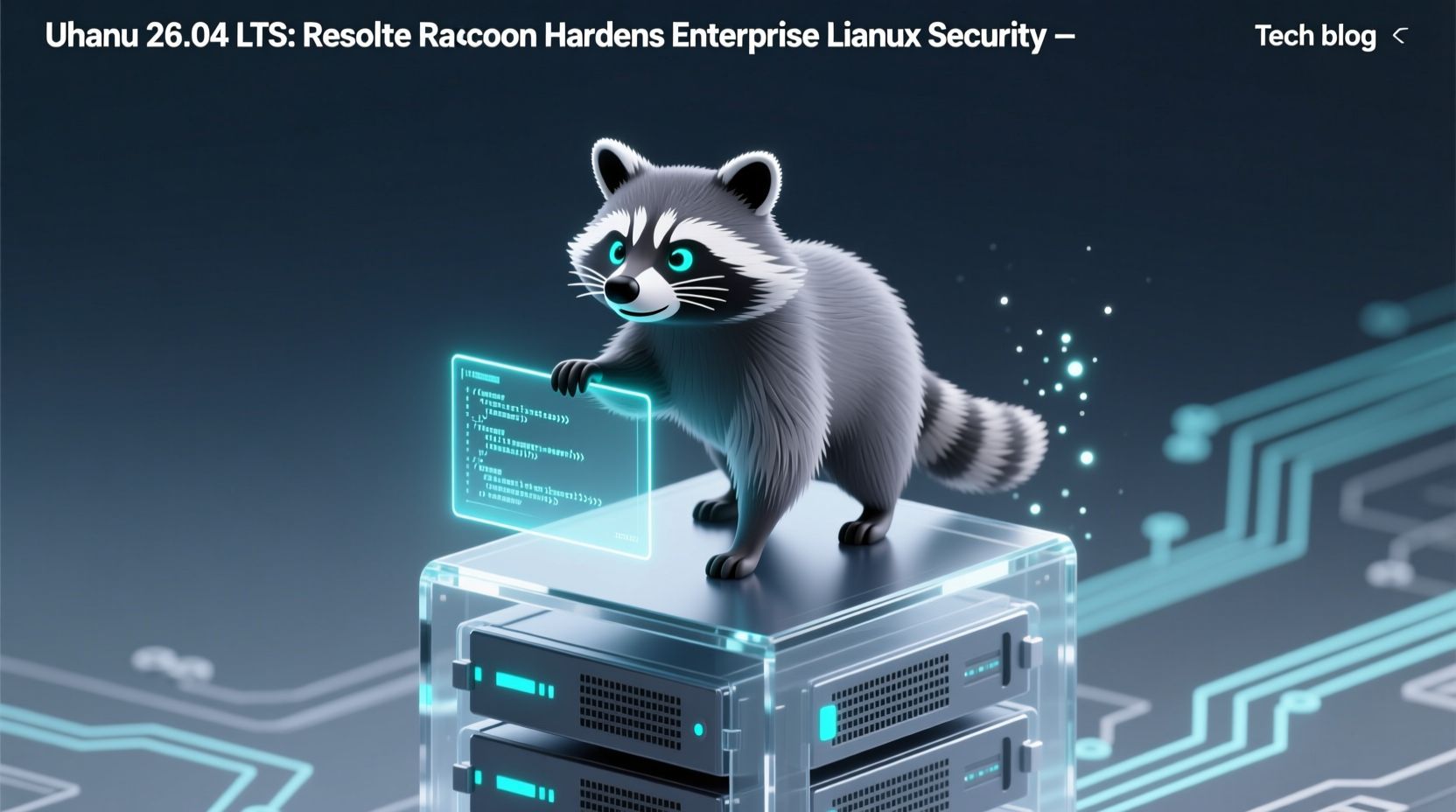
The landscape of enterprise IT is in constant flux, driven by an insatiable demand for performance, reliability, and, critically, impenetrable security. Today, April 11, 2026, marks a significant milestone in this evolution with the imminent final release of Ubuntu 26.04 LTS “Resolute Raccoon”, scheduled for April 23, 2026. For R&D engineers and infrastructure architects, this Long Term Support (LTS) release is not merely an incremental update; it represents a fundamental recalibration of the operating system’s core tenets, demanding immediate attention and strategic planning. The urgency stems from sweeping changes in security posture, a definitive shift in desktop graphics, and a renewed commitment to modern hardware architectures that will profoundly impact development pipelines and deployment strategies for years to come.
Background Context: The Evolution of Enterprise Linux
Ubuntu has long been a cornerstone of enterprise infrastructure, from cloud deployments to developer workstations, owing to its predictable release cycle and extensive support. LTS releases, occurring every two years, are particularly crucial as they offer five years of standard security maintenance, extendable to a decade with an Ubuntu Pro subscription. This extended support makes them the preferred choice for production environments where stability and longevity are paramount. The journey to 26.04 LTS has been characterized by an industry-wide push towards memory-safe languages, enhanced hardware integration, and a more secure graphical stack. Recent months have underscored the imperative for robust security, with multiple kernel vulnerabilities affecting various Ubuntu versions, including 24.04 LTS and 25.10, highlighted by advisories from CERT-FR in early April 2026. These vulnerabilities, ranging from arbitrary code execution to privilege escalation (e.g., CVE-2021-47142, CVE-2024-36903), emphasize the continuous battle against sophisticated threats and the critical role of timely updates and architectural hardening.
Deep Technical Analysis: Resolute Raccoon’s Core Innovations
Ubuntu 26.04 LTS “Resolute Raccoon” delivers a formidable array of technical advancements, touching every layer of the operating system.
Kernel 7.0: Performance and Security at the Core
At its heart, Ubuntu 26.04 LTS is powered by the freshly minted Linux kernel 7.0, a significant leap forward from previous iterations. This kernel brings day-one support for cutting-edge hardware, including Intel’s Nova Lake, AMD Zen 6, and Snapdragon X2 platforms, ensuring optimal performance and compatibility for next-generation systems. Beyond raw hardware enablement, kernel 7.0 integrates crucial features like Apple Silicon USB3 support, enhanced AMD and Intel graphics capabilities, and dedicated acceleration for AI/ML workloads. Performance optimizations are evident in areas such as faster DM-VERITY and improved AES-GCM cryptography. Furthermore, the kernel 6.19, a direct precursor to 7.0, introduced significant ZRAM efficiency improvements and strengthened namespace isolation, directly benefiting containerized environments and multi-tenant cloud deployments. The kernel also undergoes substantial “spring cleaning” to remove deprecated code remnants, some dating back to Linux v0.1, enhancing maintainability and reducing potential attack surfaces.
GNOME 50 and the Wayland-Native Desktop
For desktop users and developers, Ubuntu 26.04 LTS embraces GNOME 50, a monumental release that solidifies the transition to a Wayland-native desktop experience. This marks the official deprecation or removal of X11 sessions, unifying rendering paths and addressing long-standing issues like flickering and jagged edges. GNOME 50 introduces variable refresh rate (VRR) support and flawless fractional scaling, providing a smoother and more visually consistent user experience. Critically, Wayland performance on NVIDIA hardware has seen major improvements, with reports indicating up to 12% higher framerates on high-end GPUs like the RTX 5090. This resolves a historical pain point for NVIDIA users on Wayland. New default applications like Showtime (video player), Resources (system monitor), Loupe (image viewer), Papers (document viewer), and Ptyxis (container-aware terminal) are all built on the modern libadwaita design language, ensuring a cohesive and contemporary aesthetic.
Unprecedented Security Hardening
Security is a paramount theme in Ubuntu 26.04 LTS. Canonical has made significant strides in hardening the operating system at multiple layers:
- TPM-backed Full Disk Encryption (FDE): Building upon previous releases, 26.04 LTS brings TPM-backed FDE to general availability with enhanced user control. Engineers can now add or remove a PIN or passphrase post-installation and re-encrypt disks directly from the Security Center, providing robust data protection.
- Rust-Powered Core Utilities: In a move towards memory safety, Canonical is transitioning critical system components like
sudoand core utilities to Rust. The inclusion ofsudo-rsandrust-coreutilsby default significantly reduces the attack surface for common vulnerabilities associated with C-based memory management. - OpenSSH 10.2p1 with Post-Quantum Cryptography: The updated OpenSSH to version 10.2p1 (from 9.6p1 in 24.04 LTS) introduces post-quantum cryptography features, preparing systems for future cryptographic challenges. This is crucial for protecting long-term data against the theoretical capabilities of quantum computers.
- Enhanced Container Security: Canonical’s partnership with Snyk now offers native support for scanning chiseled Ubuntu containers, bolstering supply chain security for containerized applications. Snap packages also benefit from improved permission prompting, giving users more granular control over application access.
- Centralized Software Management: The App Center is evolving into a single, unified interface for managing all software, including traditional
.debpackages, beginning the deprecation of older tools likesoftware-properties. This streamlines updates and reduces potential vectors for misconfiguration.
Recent security advisories, such as CVE-2026-31410 in the Linux kernel’s ksmbd, and CVE-2026-23450 affecting the TCP/SMC stack, underscore the continuous need for vigilance. While these specific CVEs were identified in the preceding weeks, Ubuntu 26.04 LTS incorporates the latest kernel and package versions designed to address such vulnerabilities and prevent similar exploits through architectural improvements.
Architectural Decisions and Deprecations
Ubuntu 26.04 LTS embraces modern hardware with the availability of amd64v3/x86-64-v3 optimized packages across the entire archive, offering free performance gains for modern CPUs. Server-side, IBM Z requirements have been raised to z15, and RISC-V support is maturing, particularly with QEMU virtualization. In terms of system services, Chrony now replaces systemd-timesyncd as the default time daemon for new installations, improving time synchronization accuracy. Notably, some official Ubuntu flavors, such as Ubuntu MATE and Ubuntu Unity, have opted to skip the LTS status for this release due to contributor constraints, which may impact users relying on these specific desktop environments for long-term deployments.
Practical Implications for Development and Infrastructure Teams
The release of Ubuntu 26.04 LTS carries significant implications for engineering teams:
- Hardware Refresh Cycles: The increased minimum RAM requirement for Ubuntu Desktop (6GB, up from 4GB) necessitates a review of workstation hardware, particularly for development teams. While server requirements remain flexible, optimizing for
amd64v3will be key for performance-sensitive applications. - Wayland Migration Strategy: The definitive shift to Wayland means development teams must ensure their applications are fully compatible. While XWayland provides backward compatibility, native Wayland support will offer superior performance and security. Comprehensive testing of graphical applications is essential.
- Security Baseline Elevation: The built-in security features, from TPM-backed FDE to Rust-powered utilities, provide a higher baseline for system security. Infrastructure teams should integrate these into their hardening guides, potentially simplifying compliance efforts.
- Containerization and Cloud Native: Enhanced kernel isolation and improved tooling for chiseled containers, coupled with better Ubuntu Pro integration for WSL, reinforce Ubuntu’s position as a robust platform for cloud-native development and deployment. Teams leveraging Docker, Kubernetes, or other container orchestration platforms will benefit from these advancements.
- Upgrade Planning: Direct upgrades to 26.04 LTS are supported from 24.04 LTS (Noble Numbat) and 25.10 (Questing Quokka). Users on older LTS releases (e.g., 22.04 LTS) must first upgrade to 24.04 LTS. Careful planning and testing of upgrade paths are critical to avoid downtime and compatibility issues.
Best Practices for Adoption
To successfully integrate Ubuntu 26.04 LTS, consider these best practices:
- Phased Rollout: Implement a phased rollout for upgrades, starting with non-production environments and pilot teams to identify and resolve potential issues before broad deployment.
- Comprehensive Compatibility Testing: Rigorously test all mission-critical applications, custom scripts, and third-party tools on a 26.04 LTS staging environment, paying close attention to Wayland compatibility for desktop applications and kernel interaction for server workloads.
- Leverage New Security Features: Actively enable and configure TPM-backed FDE for sensitive systems. Integrate the Rust-powered utilities into your security auditing and development practices, recognizing the inherent memory safety benefits.
- Automated Patching and Monitoring: Ensure automated security updates are enabled and robust monitoring is in place to track system health and security events. Ubuntu Pro can extend security maintenance, a key consideration for long-term deployments.
- Review and Update Documentation: Update internal documentation to reflect new system requirements, configuration changes (e.g., Chrony as default time daemon), and best practices for the 26.04 LTS environment.
Actionable Takeaways for Teams
- Development Teams: Begin testing applications against Wayland and GNOME 50. Explore leveraging Rust for new system-level components. Familiarize yourselves with the new App Center for package management.
- Infrastructure Teams: Audit current hardware for 6GB RAM compliance for desktop deployments. Plan upgrade paths from 24.04 LTS or 25.10. Implement TPM-backed FDE policies. Harden OpenSSH configurations with post-quantum cryptography and transition to key-based authentication.
- Security Teams: Integrate Snyk scanning for chiseled containers. Review and update incident response playbooks to account for new security features like Snap permission prompting and the Security Center. Prioritize patching based on recent kernel vulnerabilities (e.g., CVE-2026-31410, CVE-2026-23450) that might inform future threats.
Related Internal Topic Links
- Linux Kernel Security Hardening: Advanced Techniques
- Migrating to Wayland: A Developer’s Guide
- Ubuntu Pro: Unlocking Enterprise-Grade Security and Support
Conclusion: A Resolute Step Forward
Ubuntu 26.04 LTS “Resolute Raccoon” represents a definitive stride forward for the enterprise Linux ecosystem. Its comprehensive enhancements in security, the robust Wayland-native desktop, and profound architectural optimizations position it as a foundational release for the next half-decade. While the increased system requirements and the paradigm shift to Wayland demand proactive planning and meticulous execution, the benefits—including a significantly hardened attack surface, superior graphical performance, and enhanced hardware compatibility—far outweigh the challenges. Engineers and architects who embrace this release strategically will empower their organizations with a stable, secure, and performant platform ready to tackle the complexities of modern R&D and production environments. The future of enterprise Linux is here, and it is resolute.
Sources
- ubuntu.com
- itsfoss.com
- hackster.io
- ubuntu.com
- ubuntu-mate.community
- xda-developers.com
- ubunlog.com
- slicker.me
- youtube.com
- tuxmachines.org
- ubuntu.com
- changeflow.com
- cirt.gy
- zdnet.com
- mpiricsoftware.com
- phoronix.com
- ubuntu.com
- zdnet.com
- reddit.com
- canonical.com
- ubuntu.com
- ubuntu.com
- andreszenteno.com
- cybercrimeswatch.com
- sarvhost.net