A seismic shift is underway in AI infrastructure, demanding immediate attention from R&D engineers. NVIDIA’s recent announcements, particularly the unveiling of the DGX GH200 supercomputer and the continued evolution of its CUDA platform, signal a new era of accelerated computing and colossal AI models. Ignoring these developments is no longer an option for those aiming to stay at the forefront of innovation. This article delves into the technical intricacies of these advancements, providing critical insights and actionable strategies for engineering teams navigating this rapidly evolving landscape.
The Dawn of Terabyte-Scale AI: NVIDIA DGX GH200 Architecture
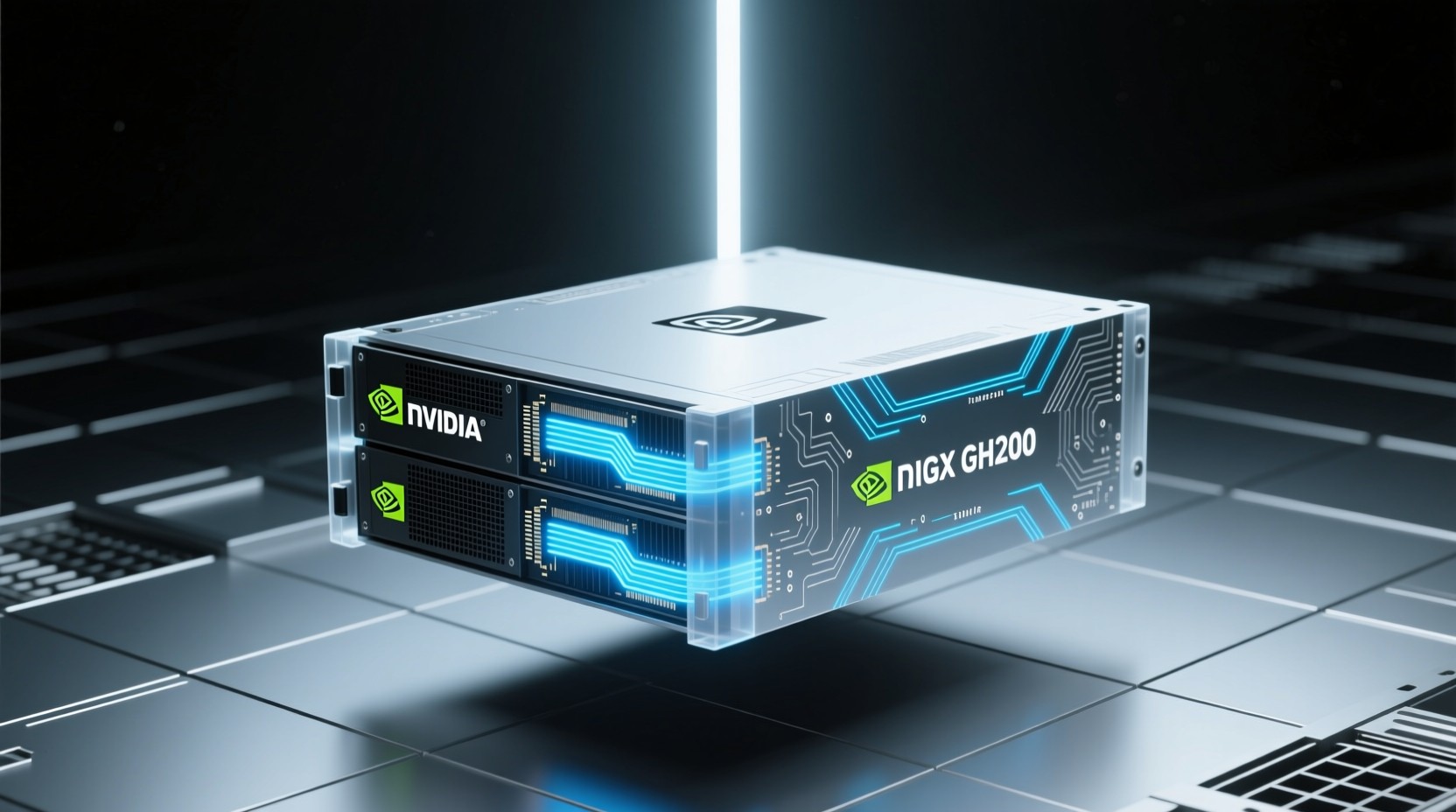
The introduction of the NVIDIA DGX GH200 represents a monumental leap in computational power and memory capacity, specifically engineered to tackle the burgeoning demands of “giant” AI models. At its core, the DGX GH200 is not merely an iteration but a paradigm shift, unifying up to 256 NVIDIA GH200 Grace Hopper Superchips into a single, colossal GPU. This architectural marvel is designed to provide a staggering 144 terabytes (TB) of shared memory accessible to the GPU’s unified memory programming model. This represents an almost 500-fold increase in accessible GPU memory compared to the previous generation NVIDIA DGX A100.
The technical backbone of the DGX GH200 is the NVIDIA NVLink Switch System, which orchestrates the interconnection of these numerous Grace Hopper Superchips. This advanced interconnect fabric allows all 256 GPUs to function cohesively as a single, massive GPU. Each Grace Hopper Superchip itself is a marvel of integration, combining an Arm-based NVIDIA Grace CPU with an NVIDIA Hopper Tensor Core GPU within the same package. This co-packaging is facilitated by NVIDIA’s NVLink-C2C (chip-to-chip) interconnect, offering seven times the bandwidth of PCIe Gen5 while consuming significantly less power. The resulting system delivers an aggregate performance of 1 exaflop.
For engineers, this means the ability to train and deploy AI models that were previously computationally infeasible due to memory constraints. This is particularly crucial for generative AI language models, large recommender systems, and complex graph analytics workloads that thrive on vast datasets and parameter counts. The DGX GH200 is not just a hardware upgrade; it’s an enabler of entirely new AI capabilities.
CUDA’s Continuous Evolution: Version 13.2 and Beyond
While the DGX GH200 garners significant attention, the underlying software ecosystem, particularly NVIDIA’s CUDA platform, is also undergoing rapid evolution, crucial for harnessing the power of such advanced hardware. The recent release of CUDA 13.2 and its accompanying updates, such as CUDA 13.2 Update 1, brings critical improvements and new features.
A significant development highlighted in CUDA 13.2 is the expanded support for NVIDIA CUDA Tile. This tile-based programming model represents a higher level of abstraction over the traditional Single Instruction, Multiple Thread (SIMT) model. CUDA Tile allows developers to define operations on “tiles” of data, abstracting away the complexities of underlying specialized hardware like tensor cores. This move towards hardware abstraction is designed to enhance code portability and future-proofing across NVIDIA’s evolving GPU architectures, including Ampere, Ada, and the upcoming Blackwell. CUDA 13.2 introduces CUDA Tile IR (Instruction Set Architecture) and cuTile Python, a domain-specific language for authoring tile-based kernels in Python.
Furthermore, CUDA 13.2 enhances developer productivity with features like runtime API exposure for green contexts, enabling finer-grained GPU resource partitioning and deterministic resource allocation. This is particularly beneficial for latency-sensitive workloads. The release also includes updates to core libraries and tools, such as cuBLAS and cuDNN, which are fundamental for deep learning and high-performance computing tasks. CUDA 13.2.1, for instance, includes cuBLAS 13.4.0.1 and cuDNN 9.21.0.82.
The implications for R&D engineers are profound. Adopting CUDA Tile can simplify the development of highly optimized kernels, especially for AI algorithms, and ensure that code remains relevant as new GPU architectures are released. The focus on developer productivity and hardware abstraction in recent CUDA releases is a clear signal from NVIDIA to accelerate AI development at scale.
Practical Implications and Migration Strategies
For Infrastructure and Operations Teams:
- Scalability and Deployment: The DGX GH200 is a data-center-scale GPU. Deploying and managing such systems requires robust infrastructure planning, high-bandwidth networking (like NVLink and InfiniBand), and advanced power and cooling solutions. Cloud providers like Google Cloud, Meta, and Microsoft are expected to be early adopters, suggesting that cloud-based access might be the most immediate way for many organizations to leverage this technology.
- Resource Management: With 144 TB of shared memory, efficient resource allocation and scheduling become paramount. NVIDIA Base Command is designed to aid in rapid deployment, user onboarding, and system management for these large-scale systems. Understanding and integrating with these management platforms will be key.
- Cost-Benefit Analysis: The sheer scale and power of the DGX GH200 come with significant costs. Teams must conduct thorough cost-benefit analyses to justify investment, focusing on the specific AI workloads that can uniquely benefit from this level of memory and compute.
For Development Teams:
- Unified Memory Programming: The DGX GH200’s emphasis on a unified memory programming model necessitates a deep understanding of this paradigm. Developers will need to adapt existing codebases or develop new strategies to efficiently utilize this massive shared memory space, minimizing data movement bottlenecks.
- Leveraging CUDA Tile: For new projects or refactoring efforts, exploring NVIDIA CUDA Tile with cuTile Python or future C++ support is highly recommended. This can abstract away hardware intricacies and potentially lead to more performant and future-proof code. Developers should consult the CUDA Tile IR and cuTile Python documentation for integration.
- Performance Benchmarking: With the advent of new architectures and programming models, rigorous benchmarking will be essential. Teams should establish baseline performance metrics for their critical AI workloads on existing hardware and then re-evaluate them on the DGX GH200 or equivalent systems to quantify the gains and identify areas for optimization. Benchmark numbers from NVIDIA’s own technical blogs and research papers will be invaluable for setting expectations.
- Migration Considerations: For existing CUDA applications, the transition to newer CUDA versions like 13.2 should be a priority. While backward compatibility is generally strong, specific features or optimizations might require code adjustments. For applications heavily reliant on low-level CUDA programming, understanding the shift towards higher-level abstractions like CUDA Tile will be important for long-term maintainability.
Best Practices for AI Infrastructure Development
- Embrace a Full-Stack Approach: NVIDIA is increasingly positioning itself as a full-stack AI provider, from hardware to software and cloud services. For optimal results, organizations should consider adopting NVIDIA’s integrated solutions, such as the DGX platform, which incorporates software, infrastructure, and expertise.
- Prioritize Interconnect Performance: The NVLink Switch System is a critical component of the DGX GH200. Ensuring high-performance interconnectivity, whether through NVLink or other high-speed networking solutions, is paramount for distributed training and inference.
- Stay Abreast of Software Updates: The rapid pace of development in CUDA and related libraries means that continuous learning and adoption of the latest stable versions are crucial. Regularly reviewing release notes for performance improvements, new features, and deprecations is a best practice.
- Invest in Talent: The complexity and scale of these new AI systems demand highly skilled engineers. Investing in training and development for teams on accelerated computing, distributed systems, and advanced AI frameworks will be essential for success.
Related Internal Topics
The NVIDIA DGX GH200 and the continuous advancements in the CUDA ecosystem are not incremental updates; they are harbingers of a new era in artificial intelligence. The sheer scale of memory and compute power now available unlocks possibilities for AI development previously confined to theoretical discussions. For R&D engineers, the imperative is clear: understand these technologies, adapt development strategies, and integrate them into infrastructure plans. Failure to do so risks falling behind in a field that is rapidly transforming every industry. The future of AI is being built on terabytes of memory and exaflops of compute, and NVIDIA is laying down the foundational blueprints.