The Imperative of Adaptability: Navigating WordPress 7.0’s Delay and Escalating Security Threats
For R&D engineers operating within the WordPress ecosystem, the landscape is in constant flux. Today, two critical narratives demand immediate attention: the strategic delay of WordPress 7.0 and a concurrent escalation in critical security vulnerabilities across the platform. While the postponement of a major release might initially seem to defer immediate action, it, in fact, amplifies the urgency for proactive architectural review and a hardened security posture. This period offers a vital window to prepare for significant technological shifts and to address burgeoning threats that could compromise operational integrity.
Background: WordPress 7.0’s Vision and Unexpected Pause
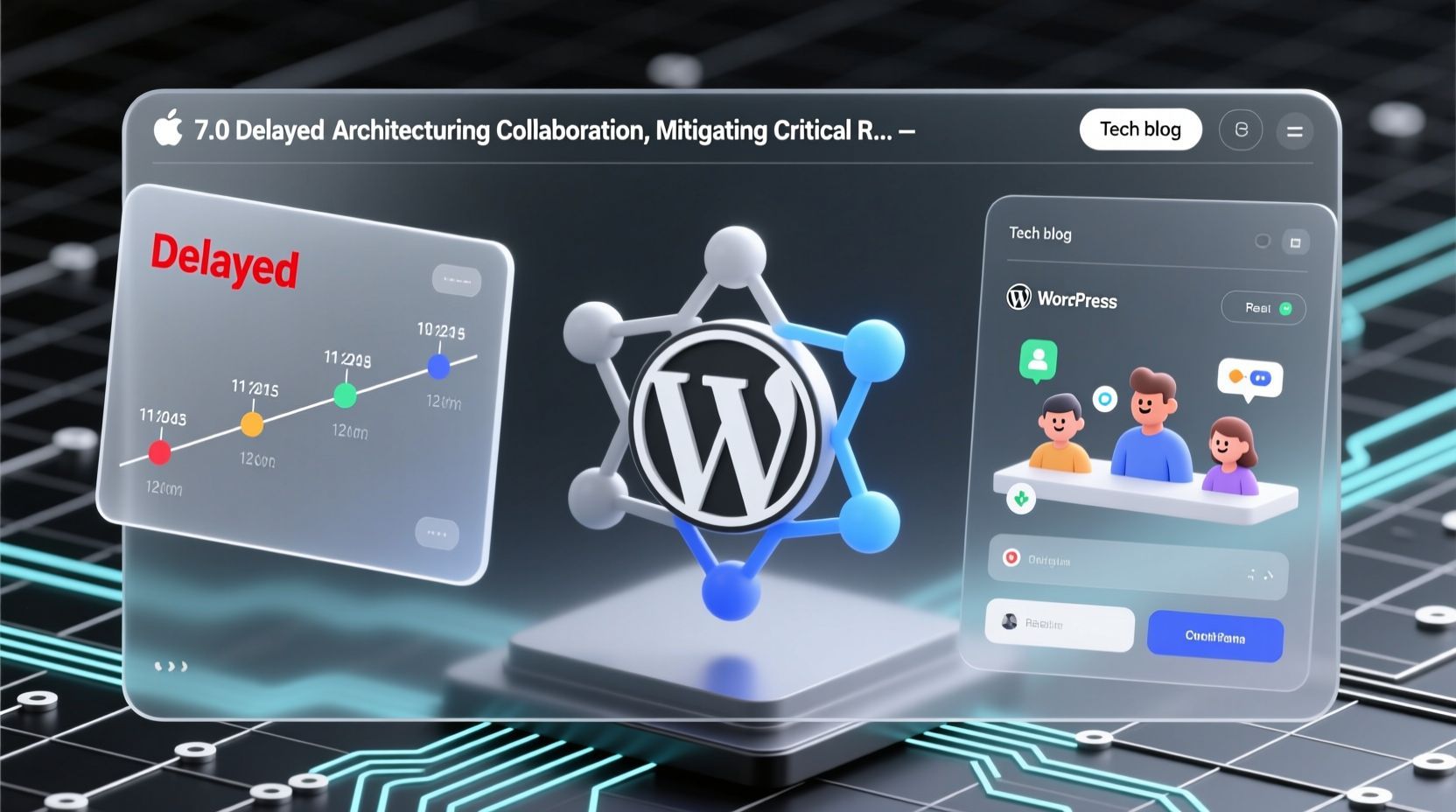
WordPress 7.0, initially slated for release on April 9, 2026, was poised to mark a monumental leap forward as the flagship release for Gutenberg Phase 3: Collaboration. This ambitious update promised to fundamentally transform how teams interact with content, introducing Google Docs-style real-time multi-user editing directly within the WordPress editor. Other transformative features included a native AI client, a comprehensive admin redesign dubbed DataViews, and advancements in responsive editing.
However, the core team announced on March 31, 2026, and further detailed on April 2, 2026, that the release cycle needed to be extended. The primary reason for this unprecedented return to a beta-like testing phase after entering the Release Candidate stage was to address performance and stability issues within the real-time collaboration’s database architecture. Matias Ventura, Lead Architect of Gutenberg, confirmed the delay, with a revised timeline expected by April 22, 2026, and the final release now anticipated in mid-to-late May 2026. This decision, prioritizing quality and long-term stability over speed, has been widely praised by the community.
This delay underscores the complexity inherent in introducing such foundational architectural changes and highlights the WordPress project’s commitment to robust, performant solutions, especially for features relying on technologies like WebSockets for instantaneous data synchronization.
Deep Technical Analysis: Architectural Shifts and Critical Vulnerabilities
WordPress 7.0: A Glimpse into the Future Architecture
The delayed WordPress 7.0 is not merely an incremental update; it represents a significant architectural evolution. Key technical highlights include:
- Real-Time Collaboration: This marquee feature relies on sophisticated data synchronization mechanisms, likely employing WebSocket technology to ensure live cursors and instant content updates across multiple users. The challenges in stabilizing this “experimental” feature’s database architecture were the direct cause of the delay, indicating deep-seated engineering considerations for scalability and consistency.
- Native AI Client (Abilities API + AI Connectors): WordPress 7.0 introduces a standardized API for integrating various AI services (e.g., OpenAI, Anthropic, Google) directly into the core. This
WP AI ClientPHP library provides a uniform interface, abstracting away provider-specific complexities and allowing plugins to register “Abilities” for safe AI interaction. TheConnectors APIfurther establishes platform-level infrastructure for credential storage and provider selection. - DataViews Admin Redesign: This re-architected administrative interface replaces legacy admin list tables with a modern, app-like experience. It features rebuilt Posts, Pages, and Media screens with inline filtering, sorting, grouping, and multiple view options, eliminating page reloads for a more fluid user experience. DataViews is designed to be extensible, laying groundwork for future admin redesign efforts.
- PHP-only Block Registration: A significant win for developers, this feature allows the registration and rendering of simple, server-side blocks entirely via PHP, eliminating the need for JavaScript, React overhead, or complex build pipelines for certain block types. This simplifies development and potentially improves performance.
- PHP Version Requirements: With WordPress 7.0, the minimum required PHP version is raised to 7.4, dropping support for PHP 7.2 and 7.3. PHP 8.2 or PHP 8.3 are strongly recommended for optimal performance and security. This aligns WordPress with modern PHP standards, leveraging performance improvements and security enhancements inherent in newer PHP versions.
- Interactivity API Changes: Developers leveraging the Interactivity API should note the deprecation of
state.navigation. A newwatch()function and server-sidestate.urlpopulation enable cleaner patterns for side effects and navigation tracking, requiring migration for existing implementations. - Block Visibility: Expanding on previous versions, 7.0 introduces viewport-based controls, allowing users to show or hide blocks per device (mobile, tablet, desktop) via CSS, not DOM removal.
Escalating Security Threats: Urgent Remediation
While WordPress 7.0 promises innovation, the current security landscape demands immediate attention:
- Supply Chain Attack on Essential Plugin Portfolio: As of April 16, 2026, news broke regarding a sophisticated supply-chain attack. Over 30 plugins from the “Essential Plugin” portfolio, collectively boasting over 400,000 installs, were compromised. After a change of ownership, a dormant backdoor was inserted into their source code. This backdoor activated earlier this month, pushing malicious code to thousands of active WordPress sites. WordPress has taken decisive action by permanently closing the affected plugins from its directory. This incident highlights the critical risk associated with third-party dependencies and the importance of vetting plugin provenance.
- SeedProd SSRF Vulnerability (CVE-2026-39464): Published April 10, 2026, a Server-Side Request Forgery (SSRF) vulnerability (CWE-918) was identified in the SeedProd Coming Soon Page, Under Construction & Maintenance Mode plugin. This flaw allows attackers to force the WordPress server to make unauthorized requests to arbitrary internal or external destinations, potentially exposing internal services, cloud metadata endpoints (e.g., AWS EC2 metadata at 169.254.169.254), or bypassing firewalls.
- User Registration & Membership Authentication Bypass (CVE-2026-1492): Disclosed on April 13, 2026, this critical vulnerability (CWE-269) affects the User Registration & Membership plugin (versions up to 5.1.2). It allows remote attackers to achieve full administrative access without valid credentials due to improper validation of user-controlled input and weak authorization checks in AJAX-based membership workflows. The CVSS v4.0 score for this is a critical 9.8.
Practical Implications for Development and Infrastructure Teams
The convergence of upcoming architectural changes and active security threats necessitates a multi-faceted approach:
For WordPress 7.0 Readiness:
- PHP Version Upgrade: Infrastructure teams must prioritize upgrading PHP environments to at least 7.4, with a strong recommendation for PHP 8.3. This isn’t just about compatibility; it’s a critical performance and security enhancement.
- Staging Environment Testing: Begin testing current sites on WordPress 7.0 nightly builds (available via the WordPress Beta Tester plugin) within isolated staging environments. Focus on theme and plugin compatibility, especially with the new DataViews and the sandboxed editor iframe.
- Plugin and Theme Audit: Review all custom and third-party plugins/themes for compatibility with PHP 7.4+ and potential conflicts with new 7.0 APIs, particularly the Interactivity API and new block registration methods.
- Hosting Compatibility: Verify that your hosting provider supports WebSocket technology for Real-Time Collaboration, as this will be a foundational requirement for the feature.
For Immediate Security Posture:
- Urgent Plugin Deactivation/Update: Immediately audit your plugin list. If any plugins from the “Essential Plugin” portfolio are installed, deactivate and remove them. For SeedProd and User Registration & Membership plugins, ensure you are running patched versions; if not, update immediately or consider temporary deactivation and alternative solutions until a secure update can be applied.
- Implement Egress Filtering: For the SeedProd SSRF vulnerability, infrastructure teams should implement egress filtering on web servers to prevent outbound requests to internal network resources, cloud metadata endpoints (e.g.,
169.254.169.254), and localhost services. - Web Application Firewall (WAF) Rules: Configure WAFs to block requests containing private IP addresses or suspicious URL schemes in parameters, mitigating SSRF risks.
- Regular Security Scans & Audits: Increase the frequency of security scans and manual code audits, especially for recently updated or newly installed plugins.
- Principle of Least Privilege: Ensure all WordPress users, particularly those with administrative capabilities, operate under the principle of least privilege. Audit user roles and permissions regularly.
Best Practices for a Resilient WordPress Ecosystem
To navigate this evolving technical landscape, adopt the following best practices:
- Proactive Update Strategy: Implement a disciplined approach to WordPress core, plugin, and theme updates. Leverage automated updates where feasible, but always with a robust backup and staging environment strategy.
- Secure Development Lifecycle (SDL): Integrate security considerations throughout the entire development process for custom solutions. This includes input validation, secure API usage, and dependency scanning.
- Dependency Management: Maintain an up-to-date inventory of all third-party plugins and themes. Monitor their security advisories closely and prioritize updates or replacements for vulnerable components.
- Layered Security: Beyond WAFs and egress filtering, consider endpoint protection, intrusion detection systems (IDS), and robust access controls.
- Comprehensive Backup Strategy: Regular, tested backups (both files and database) are non-negotiable for rapid recovery from any incident, be it a failed update or a security breach.
Actionable Takeaways for Development and Infrastructure Teams
Engineers must act decisively:
- Prioritize PHP 8.3 Migration: Begin planning and executing the upgrade of your WordPress hosting environments to PHP 8.3 to align with future performance and security recommendations.
- Immediate Security Patching: Audit and update or deactivate any vulnerable plugins identified (e.g., SeedProd, User Registration & Membership) and remove any from the compromised Essential Plugin portfolio.
- Establish a 7.0 Testing Protocol: Set up dedicated staging environments to rigorously test your sites against WordPress 7.0 beta/RC releases, focusing on custom code, theme, and plugin compatibility.
- Review Hosting Capabilities: Confirm your hosting environment supports WebSockets and can handle the architectural demands of Real-Time Collaboration.
- Enhance Monitoring: Implement enhanced monitoring for suspicious activity, especially concerning outbound network connections and unauthorized administrative actions.
Related Internal Topic Links
- PHP 8.x Migration: Performance Gains and Compatibility Challenges
- Securing Your APIs: Best Practices for WordPress Integrations
- Exploring Headless WordPress: A Modern Approach to Content Delivery
Conclusion
The delay of WordPress 7.0, while a temporary pause, serves as a powerful reminder of the platform’s ongoing evolution and the deep engineering challenges involved in pushing the boundaries of web content management. Simultaneously, the recent spate of critical vulnerabilities, particularly the supply chain attack, underscores the ever-present need for vigilance and proactive security measures. For R&D engineers, this period is not one for complacency but for strategic preparation. By embracing the architectural shifts, upgrading foundational technologies like PHP 8.3, and rigorously hardening security defenses against current and emerging threats, engineering teams can ensure their WordPress implementations remain robust, performant, and secure in a rapidly changing digital world.