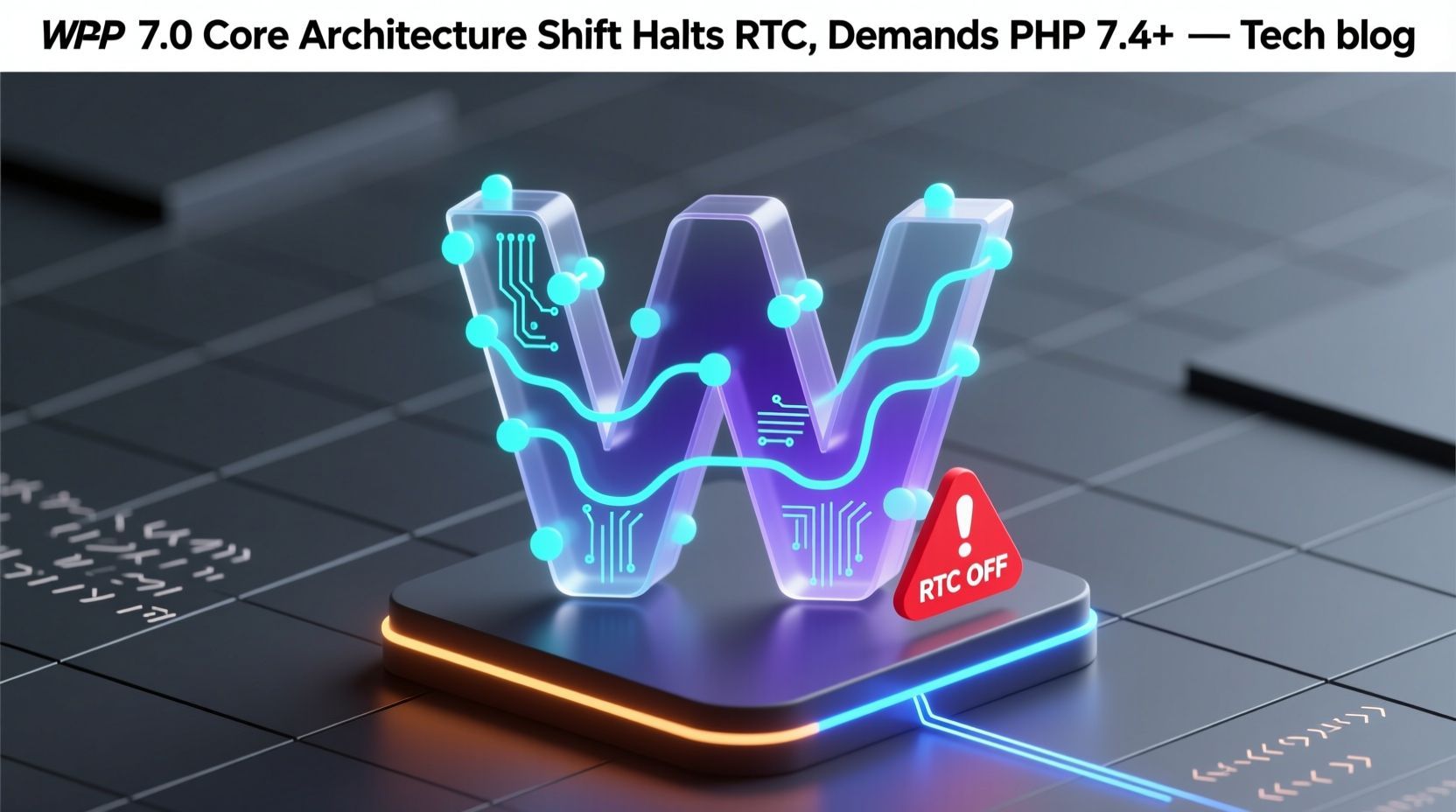
The digital landscape is in perpetual motion, and for engineers deeply invested in the WordPress ecosystem, staying ahead of pivotal platform shifts isn’t merely beneficial—it’s mission-critical. A significant announcement from the WordPress project leadership has sent ripples through the developer community: the ambitious WordPress 7.0 release, initially poised to redefine content creation with its Real-Time Collaboration (RTC) features, has encountered an architectural roadblock, necessitating an unprecedented return to beta status. This delay, coupled with crucial PHP version deprecations, signals a mandatory technical re-evaluation for every development and infrastructure team.
The urgency cannot be overstated. While the core team works diligently to recalibrate the release schedule for WordPress 7.0, the underlying architectural decisions and impending infrastructure requirements demand immediate attention. Ignoring these signals could lead to significant technical debt, security vulnerabilities, or costly migration headaches down the line. As senior technology analysts, our role is to dissect these developments and provide actionable intelligence to safeguard and optimize your WordPress deployments.
Background Context: The Vision for WordPress 7.0
WordPress 7.0 was heralded as a transformative release, with Real-Time Collaboration (RTC) standing out as its marquee feature. The aim was to bring a Google Docs-like co-editing experience directly into the block editor, fundamentally changing how teams interact with content within WordPress. This feature, alongside an overhauled admin experience, native AI infrastructure, and an expanded suite of block capabilities, promised a leap forward in the platform’s evolution.
The initial excitement was palpable, but the complexity of integrating real-time data synchronization into WordPress’s established architecture presented formidable challenges. The core team’s commitment to stability and performance, particularly for a feature that would fundamentally alter the database interaction model, led to the current pause. This proactive decision, though delaying the release, underscores a dedication to robust engineering over rushed deployment.
Deep Technical Analysis: RTC’s Architectural Bottleneck and PHP Requirements
The heart of the WordPress 7.0 delay lies in a critical performance issue identified within the Real-Time Collaboration (RTC) database architecture. The initial implementation strategy for RTC involved persistently storing synchronization data via post_meta on a specialized internal post type, wp_sync_storage. While seemingly a logical extension of WordPress’s existing data model, this approach introduced an unforeseen and severe performance bottleneck.
Specifically, the continuous updates to post_meta for real-time sync data had the unintended side effect of disabling WordPress’s persistent post query caches whenever a user had the editor open. For a platform that relies heavily on efficient caching to deliver performant experiences, this architectural decision was a non-starter for a core feature. The impact would be widespread performance degradation, particularly on sites with multiple concurrent editors or high traffic.
The revised architectural direction, as announced by the project leadership, involves moving towards a dedicated database table for collaboration data. This shift is a significant undertaking, requiring a redesign of how RTC data is structured, stored, and retrieved to ensure it does not interfere with core WordPress caching mechanisms. This move suggests a more isolated and optimized data persistence layer for real-time interactions, minimizing its footprint on the broader WordPress database operations. While specific schema details are pending, engineers should anticipate potential changes in how collaboration data can be accessed or extended programmatically in future versions.
Beyond the RTC architecture, WordPress 7.0 introduces a critical infrastructure requirement: the deprecation of support for PHP 7.2 and 7.3. The new minimum PHP version for WordPress 7.0 will be PHP 7.4, with PHP 8.2+ being strongly recommended for optimal performance and security. This aligns with the broader industry trend towards modern PHP versions, which offer significant performance enhancements (e.g., JIT compilation in PHP 8.x) and improved security features. Running on outdated PHP versions not only exposes sites to known vulnerabilities but also prevents them from leveraging the latest language features and optimizations that WordPress core and plugin developers are increasingly adopting.
For instance, the performance gains from upgrading from PHP 7.3 to PHP 7.4, and especially to PHP 8.2+, can be substantial, often yielding a 20-30% reduction in execution time for typical WordPress workloads. This directly translates to faster page load times and a more responsive administrative interface. Benchmarking your current PHP environment against PHP 7.4 and PHP 8.2+ is a recommended proactive measure.
Practical Implications for Engineering Teams
The delay and architectural re-evaluation of WordPress 7.0, coupled with PHP deprecations, have several immediate and long-term implications for engineering and infrastructure teams:
- PHP Version Upgrade Mandate: This is no longer a suggestion but a hard requirement. Teams must initiate audits of their entire WordPress portfolio to identify sites still running PHP 7.2 or 7.3. Upgrade paths to PHP 7.4 as a minimum, and ideally to PHP 8.2 or 8.3, should be prioritized. This involves testing themes, plugins, and custom code for compatibility. Tools like the WordPress Site Health tool can assist in identifying deprecated functions or compatibility issues.
- RTC Feature Adoption Strategy: With the architectural shift, engineers should re-evaluate their adoption strategy for Real-Time Collaboration. While the feature is highly anticipated, understanding its new underlying data model will be crucial for any custom integrations or extensions. Monitor official WordPress developer blogs closely for updates on the new RTC database schema.
- Performance Baseline Re-evaluation: The original RTC implementation’s impact on caching highlights the importance of rigorous performance testing. As new details emerge, development teams should be prepared to benchmark their applications against the new WordPress 7.0 architecture, especially if custom caching layers or complex queries are in use.
- Security Posture Review: The ongoing threat landscape, exemplified by recent incidents like the backdoored Smart Slider 3 Pro plugin (version 3.5.1.35), which was exploited via compromised update infrastructure to allow remote code execution and rogue admin accounts, underscores the critical need for vigilance. Even core WordPress has seen vulnerabilities, such as CVE-2026-3906 in versions 6.9 through 6.9.1, allowing authenticated subscriber-level users to create notes on any post due to a missing authorization check in the REST API. This highlights that even minor releases and third-party components can introduce significant risk.
Best Practices and Actionable Takeaways
To navigate these changes effectively, development and infrastructure teams should implement the following best practices:
- Prioritize PHP Upgrades:
- Audit: Use WordPress’s Site Health tool and tools like PHP Compatibility Checker plugins to identify compatibility issues.
- Test: Thoroughly test all themes, plugins, and custom code on a staging environment running PHP 7.4+ (preferably 8.2+) before deploying to production.
- Update Dependencies: Ensure all third-party libraries and dependencies are compatible with the target PHP version.
- Enhance Security Protocols:
- Regular Updates: Implement a rigorous schedule for applying WordPress core, plugin, and theme updates. Remember, exploitation timelines for critical vulnerabilities can be as short as five hours from disclosure.
- Principle of Least Privilege: Regularly review user roles and capabilities, especially for REST API interactions. The CVE-2026-3906 vulnerability serves as a stark reminder of the risks associated with inadequate authorization checks.
- Web Application Firewall (WAF): Deploy a robust WAF (e.g., Cloudflare, Wordfence, Sucuri) to provide an additional layer of defense against known and zero-day exploits.
- Supply Chain Security: Exercise extreme caution when integrating third-party plugins or themes, verifying their source and integrity. The Smart Slider 3 incident is a critical reminder of supply chain attacks.
- Stay Informed on WordPress 7.0 Development:
- Subscribe to the official Make WordPress Core blog and developer announcements.
- Actively participate in or monitor relevant Slack channels and forums for real-time updates on the RTC architectural changes and new release schedule (expected by April 22nd, 2026).
- Implement Robust CI/CD and Testing:
- Automate testing against different PHP versions and WordPress core updates.
- Maintain comprehensive regression tests for critical functionalities to catch issues introduced by core or dependency updates.
Related Internal Resources
- PHP 8 Migration Guide for Enterprise WordPress
- Securing the WordPress REST API: Advanced Strategies
- Optimizing Performance for Headless WordPress Deployments
The Road Ahead
The delay of WordPress 7.0, while initially disappointing for those eager to leverage its new features, is ultimately a testament to the project’s commitment to delivering a stable and performant platform. The architectural pivot for Real-Time Collaboration signifies a deeper, more robust foundation for future interactive features, ensuring that the innovation doesn’t come at the cost of core performance. The mandatory shift to PHP 7.4+ also pushes the entire ecosystem towards a more modern and secure footing.
For R&D engineering teams, this period represents a crucial opportunity. Rather than merely awaiting the new release, proactive preparation—especially around PHP compatibility and enhanced security—will ensure a smoother transition and position your WordPress applications for optimal performance and resilience in the evolving digital landscape. The future of WordPress is collaborative and performant, but only for those who are prepared to build upon its evolving core.