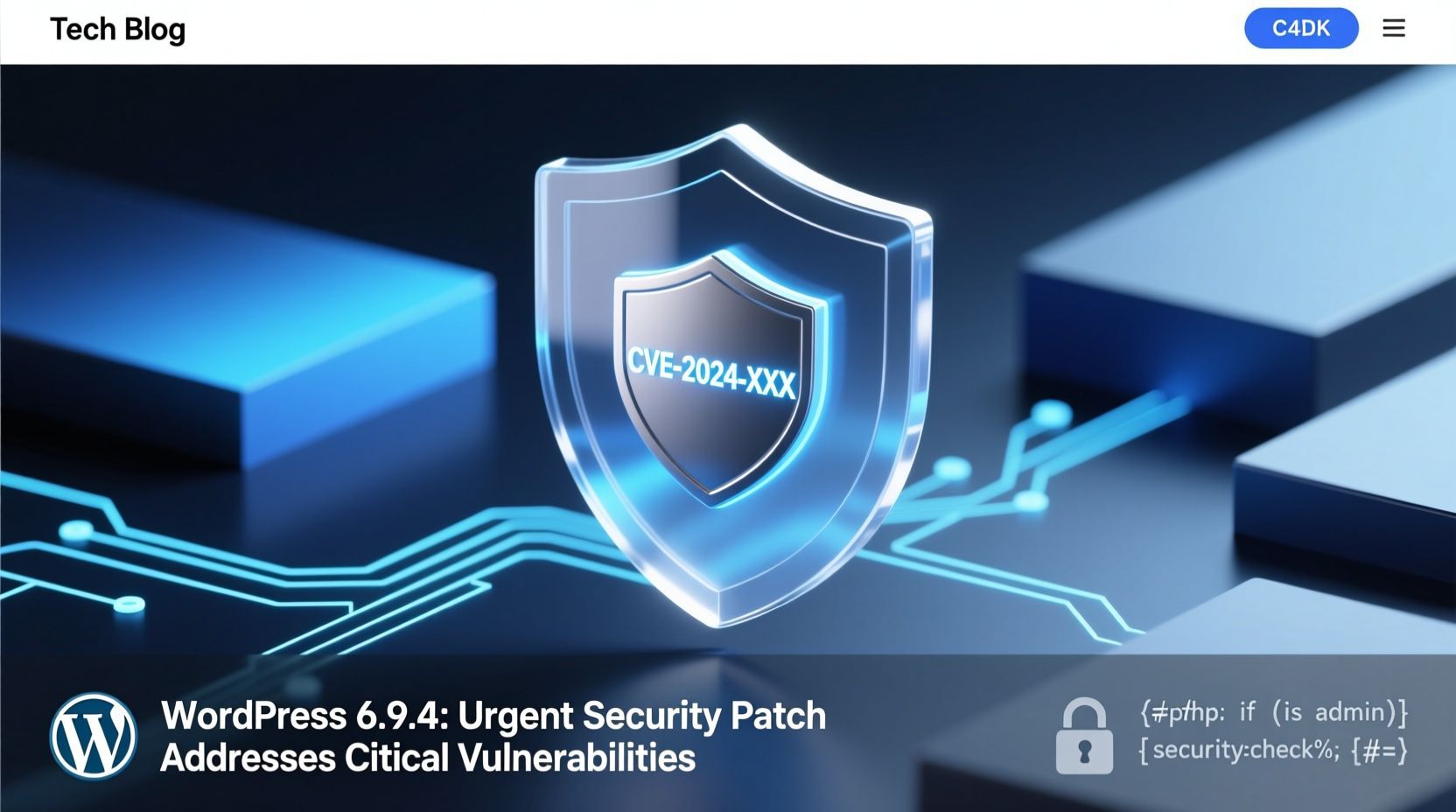
In the dynamic landscape of web development, maintaining robust security posture is not merely a best practice—it’s an imperative. For engineering teams managing WordPress deployments, the recent, rapid succession of core updates culminating in WordPress 6.9.4 represents a critical juncture. This release, pushed out swiftly on March 11, 2026, directly addresses a spate of severe vulnerabilities, some of which were actively exploited in the wild, including sophisticated “ClickFix” malware campaigns. Ignoring this update is not an option; it’s a direct invitation to compromise.
As senior technology analysts, our focus is on dissecting the technical underpinnings of these updates, understanding their implications, and providing actionable strategies for development and infrastructure teams. The urgency is paramount, as exploitation timelines for high-impact vulnerabilities have compressed to mere hours, leaving little room for delayed response.
Background: The Evolving Threat Landscape for WordPress
WordPress, powering over 43% of all websites, remains an attractive target for malicious actors due to its ubiquity and the vast ecosystem of plugins and themes. The year 2025 alone saw security researchers identify a staggering 11,334 new vulnerabilities across the WordPress ecosystem, a 42% increase over the previous year. Of these, 1,966 carried a high-severity rating, indicating a strong likelihood of mass-scale automated exploitation. This trend underscores a meaningful acceleration in attacker attention.
The immediate catalyst for the 6.9.4 release was a security incident involving malicious campaigns targeting WordPress sites. Attackers were found compromising installations and injecting scripts that displayed fake CAPTCHA prompts. These prompts then tricked visitors into pasting commands into their system terminals or PowerShell, leading to the download of infostealer malware. This “ClickFix” technique bypasses traditional drive-by exploits, relying instead on user social engineering to execute commands. The WordPress Security Team responded with WordPress 6.9.2, followed almost immediately by 6.9.3 and then 6.9.4 to address subsequent issues introduced by the initial fixes, highlighting the complexity of securing a platform at this scale.
Deep Dive: Analyzing WordPress 6.9.4’s Critical Patches
WordPress 6.9.2, the precursor to 6.9.4, addressed a total of ten security issues. The rapid follow-up releases (6.9.3 and 6.9.4) were primarily to stabilize the ecosystem and resolve regressions, particularly a template loading bug affecting themes using non-standard file path approaches.
The vulnerabilities patched in this series of updates are diverse and impactful:
- Blind Server-Side Request Forgery (SSRF): This vulnerability could allow an attacker to make a server-side request to an arbitrary domain, potentially revealing sensitive internal network information or interacting with internal services.
- Property-Oriented Programming (PoP) Chain Weakness: Identified in the HTML API and Block Registry, this weakness could be leveraged to achieve arbitrary code execution or object injection by chaining deserialization gadgets.
- Regex Denial of Service (DoS): A regex DoS vulnerability in numeric character references could allow an attacker to craft a malicious input that consumes excessive server resources, leading to service disruption.
- Stored Cross-Site Scripting (XSS): Several instances of stored XSS were addressed, including those in navigation menus and via the
data-wp-binddirective. These allow attackers to inject malicious scripts into web pages, which are then executed in the browsers of other users. - AJAX Authorization Bypass: This flaw could permit unauthorized actions via AJAX endpoints, potentially granting an attacker elevated privileges or access to restricted functionalities.
- PclZip Path Traversal: A path traversal vulnerability within the bundled PclZip library could allow an attacker to write files to arbitrary locations on the server, a common precursor to remote code execution.
- XML External Entity (XXE) in getID3 library: The bundled getID3 library was vulnerable to XXE, which could expose sensitive data, allow SSRF, or enable DoS attacks by processing maliciously crafted XML input. Notably, this vulnerability was also patched upstream, indicating its broader impact.
The architectural implications of these fixes often involve hardening input validation, sanitization routines, and access control mechanisms across various WordPress components, including the REST API and the Block Editor. While specific CVE IDs were not universally disclosed for all issues in the public announcements, the nature of these vulnerabilities underscores critical attack vectors that could lead to full site compromise, data exfiltration, or defacement.
Practical Implications for Development and Infrastructure Teams
The rapid release of WordPress 6.9.4 highlights several key considerations for engineering teams:
- Immediate Patching Mandate: Given the active exploitation scenarios, immediate application of the 6.9.4 update is non-negotiable for all production WordPress sites.
- Impact on Custom Development and Themes: The fix for the template loading bug in 6.9.3/6.9.4 specifically addressed “themes using an unusual approach to loading template files via ‘stringable objects’ instead of primitive strings for file paths.” While WordPress officially only supports string paths for the
template_includefilter, teams with highly customized themes or legacy codebases must thoroughly test their sites in a staging environment before deploying the update to production. This is crucial to prevent unexpected blank frontends or functional regressions. - PHP Version Compatibility: While not a direct change in 6.9.4, modern WordPress versions, including 6.7 and beyond, recommend PHP 8.2 or 8.3 and have a minimum requirement of PHP 7.4. Ensuring your server environment meets these recommendations is vital for both performance and security, as older PHP versions may have unpatched vulnerabilities.
- CI/CD Pipeline Adjustments: Engineering teams utilizing CI/CD pipelines for WordPress deployments must integrate these rapid security updates into their automated testing and deployment workflows. This means having mechanisms to quickly pull, test, and deploy new minor versions.
- Backup and Rollback Strategies: The potential for regressions, even in security-focused minor releases, necessitates robust backup and rollback strategies. Prior to any update, a full backup of the database and file system is essential.
Best Practices for a Secure WordPress Deployment
Beyond immediate patching, engineers must adopt a proactive, defense-in-depth approach to WordPress security:
- Automated Updates with Staging: Configure automatic minor updates where feasible, but always route them through a staging environment for automated and manual testing. For major releases, a dedicated update window and thorough testing are paramount.
- Web Application Firewall (WAF): Implement a WAF (e.g., ModSecurity rules, cloud-based WAFs like Cloudflare, Sucuri) to provide an additional layer of protection, especially against zero-day exploits and common attack vectors like XSS and SQL injection. Many WAFs can virtually patch known vulnerabilities before official patches are released.
- Principle of Least Privilege: Ensure all WordPress users, including administrators, editors, and custom roles, operate with the minimum necessary permissions. Similarly, server-level user accounts should have restricted access.
- Regular Security Audits and Code Reviews: Periodically audit your WordPress installation, including plugins and themes, for vulnerabilities. For custom code, integrate security-focused code reviews into your development lifecycle.
- Plugin and Theme Management: Minimize the number of installed plugins and themes. Regularly review and remove inactive or unmaintained components. Prioritize plugins from reputable developers with strong security track records. Remember, plugins account for 91% of all newly reported vulnerabilities.
- Strong Authentication: Enforce strong, unique passwords, and enable two-factor authentication (2FA) for all administrative users.
- Database Security: Secure your database by using strong credentials, limiting database user privileges, and regularly backing up your database.
- Server Hardening: Implement server-level security measures, including file permissions, disabling directory browsing, and securing SSH access.
Actionable Takeaways for Your Engineering Workflow
- Establish a Rapid Patching Protocol: Define clear procedures for emergency WordPress core updates, including communication channels and rollback plans.
- Automate Compatibility Testing: Leverage tools like WP-CLI and automated testing frameworks to quickly assess the impact of updates on your custom code and critical plugins in staging environments.
- Monitor Security Feeds: Subscribe to official WordPress security announcements, reputable security blogs (e.g., Wordfence, SolidWP), and vulnerability databases to stay informed about emerging threats. The WordPress Vulnerability Report from April 1, 2026, indicated 225 new vulnerabilities in the ecosystem, with 91 unpatched.
- Educate Stakeholders: Ensure that non-technical stakeholders understand the importance of rapid patching and the potential risks associated with delaying updates.
Related Internal Topics
- Optimizing WordPress Performance for High-Traffic Applications
- Advanced Security Strategies for PHP-based Applications
- Implementing Robust CI/CD Pipelines for CMS Deployments
Conclusion: Proactive Security in a Dynamic Web Ecosystem
The release of WordPress 6.9.4 serves as a potent reminder that in the realm of web development, security is a continuous, evolving challenge. For R&D engineering teams, a proactive stance is no longer a luxury but a necessity. The threat landscape is increasingly sophisticated, with exploitation windows shrinking and attack methods evolving, as demonstrated by the “ClickFix” campaigns.
Looking ahead, the imminent release of WordPress 7.0 on April 9, 2026, promises significant advancements, including real-time collaboration, a rebuilt admin experience, and native AI infrastructure. While these features will undoubtedly enhance functionality and user experience, they also introduce new architectural complexities and potentially expand the attack surface. Engineering teams must remain vigilant, integrating security by design into every stage of their development and deployment workflows. Staying current with core updates, rigorously testing third-party components, and adopting comprehensive security practices will be paramount to safeguarding WordPress installations in the face of an ever-changing digital threat landscape.