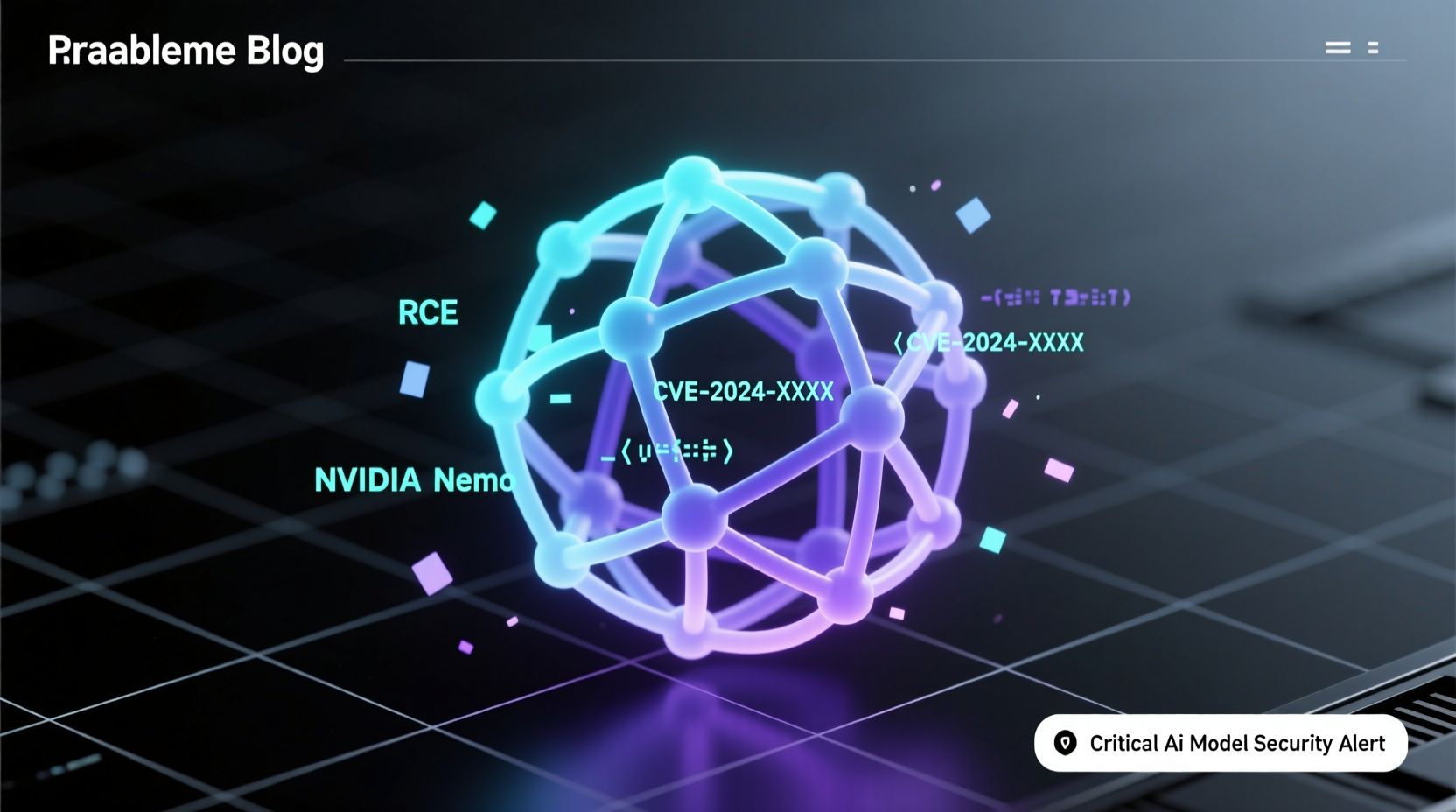
The rapid proliferation of AI models across enterprise infrastructure has introduced a new frontier of cybersecurity challenges. Today, an urgent advisory demands the immediate attention of every R&D engineering team leveraging the NVIDIA NeMo Framework: critical remote code execution (RCE) vulnerabilities, identified as CVE-2026-24157 and CVE-2026-24159, have been disclosed. Failure to patch these flaws in NeMo Framework versions prior to 2.6.2 could expose your generative AI models and conversational AI agents to severe compromise, leading to unauthorized code execution, privilege escalation, information disclosure, and data tampering. The clock is ticking for engineers to act decisively and fortify their AI deployments.
Background Context: The NVIDIA NeMo Framework
The NVIDIA NeMo Framework stands as a cornerstone in the generative AI landscape, providing an end-to-end platform for building, customizing, and deploying large language models (LLMs) and conversational AI agents. Its robust toolkit enables developers to fine-tune and adapt prominent open-source models, such as Llama, Mistral, and Google Gemma, with proprietary enterprise data, accelerating the development of specialized AI applications.
NeMo’s widespread adoption underscores its importance, yet this ubiquity also broadens its attack surface. As AI models transition from research curiosities to mission-critical components, the security posture of the underlying frameworks becomes paramount. The integrity of models, the confidentiality of training data, and the reliability of inference pipelines all hinge on the foundational security of platforms like NeMo. The newly discovered vulnerabilities highlight a critical vector that adversaries can exploit within the AI model supply chain, specifically during the loading and deserialization of model checkpoints.
Deep Technical Analysis: CVE-2026-24157 and CVE-2026-24159
The recently identified vulnerabilities in NVIDIA NeMo Framework pose a significant threat to the integrity and security of AI systems. Understanding the technical specifics of these CVEs is crucial for effective mitigation.
CVE-2026-24157: Vulnerability in Checkpoint Loading
This CVE specifically targets the restore_from() method within the NeMo Framework, a core functionality designed to load model instances, including weights and configuration, from local .nemo files. A .nemo file is essentially a compressed archive (tar.gz) that encapsulates the model’s weights alongside a model_config.yaml file, which defines the model’s architecture and operational parameters.
The vulnerability arises from insecure deserialization during the checkpoint loading process. When an attacker crafts a malicious .nemo file, they can embed arbitrary code within the archive, particularly within the configuration or weight files. When the restore_from() method attempts to deserialize and load this untrusted data, the embedded malicious code can be executed within the context of the application running the NeMo Framework. This could occur during routine operations such as model evaluation, inference setup, or fine-tuning, making it a highly insidious attack vector.
The potential consequences are severe: remote code execution (RCE) allows an attacker to run arbitrary commands on the host system, potentially leading to a full system compromise. This could facilitate the escalation of privileges, enabling the attacker to gain higher-level access than initially intended. Furthermore, sensitive information, such as proprietary model architectures, training data, or API keys, could be disclosed, and data tampering could corrupt models or inference results.
CVE-2026-24159: General Remote Code Execution
While CVE-2026-24157 focuses on checkpoint loading, CVE-2026-24159 broadly indicates another remote code execution vulnerability within the NVIDIA NeMo Framework. This suggests a more generalized flaw, potentially residing in other input processing mechanisms, insecure function calls, or unhandled exceptions within the framework’s broader codebase. Without specific details on the exact attack vector, common scenarios for such vulnerabilities include:
- Insecure Input Handling: Malicious inputs beyond model checkpoints, such as improperly sanitized prompts, configuration parameters, or API requests, could trigger code execution.
- Dependency Vulnerabilities: The NeMo Framework, like any complex software, relies on numerous third-party libraries. A vulnerability in one of these dependencies, if not properly isolated or patched, could be inherited and exposed through NeMo.
- Insecure API Endpoints: If NeMo is deployed with exposed APIs, certain endpoints might have insufficient authentication or authorization, allowing unauthorized users to trigger malicious operations.
The impact of CVE-2026-24159 mirrors that of its counterpart, threatening code execution, privilege escalation, information disclosure, and data tampering. The presence of two distinct RCE vulnerabilities underscores the critical need for immediate patching and a thorough review of AI model security practices.
Architectural Implications of Insecure Deserialization
Insecure deserialization remains a persistent and high-impact vulnerability across various software domains, now extending its reach into AI frameworks. The core architectural problem lies in the implicit trust placed on serialized data. When an application deserializes an object, it reconstructs the object’s state and often executes code within the object’s methods. If this serialized data originates from an untrusted source, an attacker can craft payloads that execute arbitrary code during the deserialization process. For AI frameworks, where complex model architectures and configurations are routinely serialized and deserialized, this creates a fertile ground for exploitation.
The recommended mitigation for both vulnerabilities is to update to NVIDIA NeMo Framework version 2.6.2 or later. This patch presumably addresses the underlying insecure deserialization logic and other potential RCE vectors, hardening the framework against these specific attacks.
Practical Implications for Development and Infrastructure Teams
The discovery of CVE-2026-24157 and CVE-2026-24159 necessitates immediate and coordinated action from both development and infrastructure teams.
Urgent Patching and Deployment
The foremost priority is to upgrade all instances of the NVIDIA NeMo Framework to version 2.6.2 or later. This is not an optional maintenance task; it’s a critical security imperative. Infrastructure teams should:
- Identify all environments (development, staging, production, CI/CD runners) where NeMo Framework is installed or utilized.
- Prioritize patching production systems and any publicly exposed services immediately.
- Roll out updates across all other environments following a standard patch management process.
- Verify the successful upgrade and functionality of all AI models and pipelines post-patch.
CI/CD Pipeline Security
CI/CD pipelines are prime targets for supply chain attacks. These vulnerabilities highlight the need for:
- Automated Scanning: Integrate vulnerability scanners into CI/CD pipelines to detect outdated or vulnerable versions of NeMo Framework and its dependencies.
- Artifact Management: Ensure that all
.nemofiles and other model artifacts are stored in secure, access-controlled repositories. Implement integrity checks (e.g., cryptographic signatures) to verify the provenance of models before they are loaded. - Build Environment Isolation: Run build and training jobs in isolated, ephemeral environments to minimize the blast radius of any potential compromise.
Model Supply Chain Risk Management
The ease with which malicious code can be embedded in model checkpoints underscores the broader challenge of AI model supply chain security. Development teams must:
- Validate Provenance: Always verify the source and integrity of any third-party or externally sourced
.nemofiles or other model assets. Treat all external model assets as untrusted until validated. - Internal Model Governance: Establish clear policies for creating, storing, and sharing model checkpoints internally. Ensure that only authorized and scanned models are used in downstream applications.
- Runtime Verification: Consider implementing runtime integrity checks for models loaded into production, especially in high-assurance environments.
Runtime Protection and Developer Workflow Changes
Even with patches, a defense-in-depth strategy is crucial:
- Execution Environment Hardening: Apply the principle of least privilege to the environments where AI models run. Limit network access, file system permissions, and available system calls.
- Monitoring and Alerting: Implement robust monitoring for unusual activity in AI model inference or training environments, such as unexpected process spawning or outbound network connections.
- Developer Education: Educate development teams on the risks of using untrusted model assets and the importance of secure coding practices when interacting with serialization/deserialization functions.
Best Practices for AI Model Security
Beyond immediate patching, a holistic approach to AI model security is essential for long-term resilience.
- Integrate AI Security into SDL: Embed security considerations throughout the entire AI/ML development lifecycle, from design and data collection to deployment and monitoring. This includes threat modeling specific to AI systems.
- Robust Input Validation and Sanitization: While these CVEs relate to deserialization, rigorous input validation for all model inputs (text, images, audio, etc.) and configuration parameters is a fundamental defense against various attack types, including prompt injection.
- Comprehensive Supply Chain Security: Implement strict controls over the entire AI supply chain, including data sources, training environments, model registries, and deployment artifacts. Utilize tools for software composition analysis (SCA) and container scanning.
- Principle of Least Privilege: Ensure that AI models and their host environments operate with the minimum necessary permissions. This limits the damage an attacker can inflict if a vulnerability is exploited.
- Regular Security Audits and Penetration Testing: Conduct specialized security assessments focused on AI-specific attack vectors, such as model inversion, data poisoning, and adversarial attacks, in addition to traditional application security testing.
- Proactive Dependency Management: Maintain an up-to-date inventory of all software dependencies, regularly scan for known vulnerabilities, and promptly apply patches.
- Runtime Security Monitoring: Deploy AI-aware security platforms that can monitor model behavior in real-time, detect anomalies, and enforce policy-based controls to prevent exploitation of zero-day vulnerabilities or sophisticated attacks.
Actionable Takeaways
For development and infrastructure teams working with NVIDIA NeMo Framework, the following actions are paramount:
- Immediate Upgrade: Prioritize upgrading all NeMo Framework installations to version 2.6.2 or later to mitigate CVE-2026-24157 and CVE-2026-24159.
- Source Verification: Implement rigorous checks for the provenance and integrity of all
.nemomodel files and other serialized assets, especially those from external sources. - Pipeline Hardening: Enhance CI/CD pipelines with automated vulnerability scanning for AI frameworks and secure artifact management practices.
- Environment Isolation: Ensure that AI model training and inference environments are strictly isolated and adhere to least privilege principles.
- Developer Awareness: Conduct training to raise awareness among developers about the risks associated with insecure deserialization and the importance of secure handling of AI model assets.
Related Internal Topic Links
- LLM Supply Chain Security: Mitigating Risks in AI Development
- Securing Agentic AI: Best Practices for Autonomous Systems
- Building Secure MLOps Pipelines: A Comprehensive Guide
The cybersecurity landscape for AI models is evolving at an unprecedented pace. The NVIDIA NeMo Framework vulnerabilities serve as a stark reminder that even foundational tools require constant vigilance. By embracing a proactive and comprehensive approach to AI model security, R&D engineering teams can not only mitigate immediate threats but also build resilient, trustworthy AI systems capable of weathering future challenges. The era of “AI-first” development must also be an era of “security-first” AI engineering, where robust defenses are as integral to innovation as the models themselves.