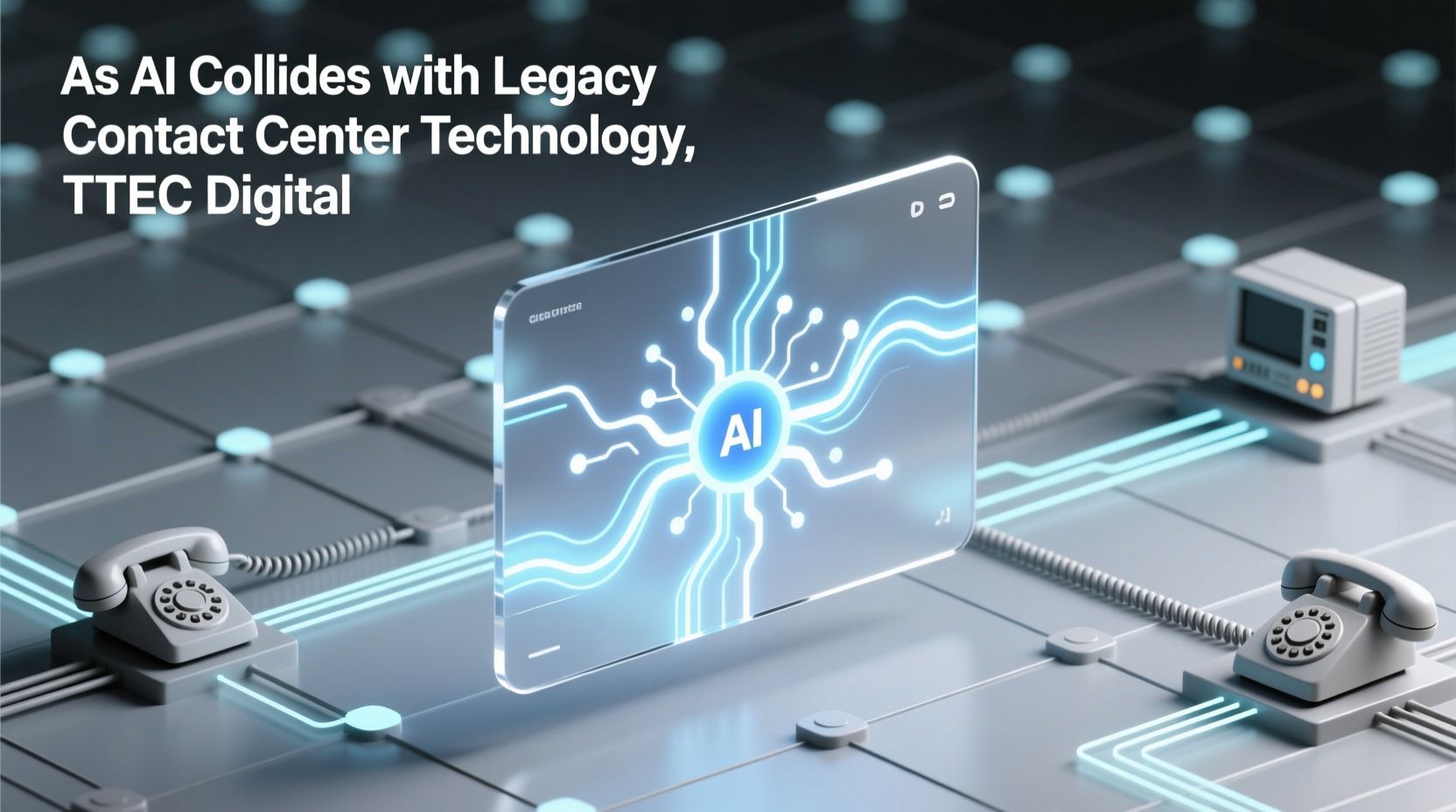
The relentless pace of AI innovation presents both unprecedented opportunities and significant challenges for enterprises, particularly within the customer experience (CX) domain. For engineering and infrastructure teams managing complex contact center environments, the collision of advanced AI capabilities with decades of investment in legacy technology creates a critical juncture. The demand for intelligent automation, personalized interactions, and real-time insights is undeniable, yet the prospect of a costly, high-risk rip-and-replace migration often stalls progress. This is the urgent problem TTEC Digital aims to solve with its latest software release, the AI Gateway.
Background: The AI-Legacy Chasm in Contact Centers
For years, contact centers have been the operational heart of customer interaction, built upon robust, albeit often monolithic, platforms from vendors like Avaya, Cisco, Genesys, and Five9. These systems, while highly customized and deeply integrated into enterprise workflows, were not architected for the fluid, API-driven, and computationally intensive demands of modern artificial intelligence. The challenge lies in integrating cutting-edge AI models—from generative AI for content creation to advanced natural language processing (NLP) for sentiment analysis and virtual agents—into these existing ecosystems without destabilizing mission-critical operations or incurring exorbitant technical debt.
Many organizations find themselves in a strategic bind: embrace AI to remain competitive and enhance customer satisfaction, or defer adoption due to the perceived complexity and cost of integrating with their legacy infrastructure. This dilemma has fueled a market need for agile, non-disruptive integration solutions that empower a phased, strategic approach to AI adoption.
Deep Technical Analysis: TTEC Digital AI Gateway as the Universal Connector
TTEC Digital’s AI Gateway is positioned as a pivotal middleware solution, designed specifically to act as a “universal connector” between diverse legacy contact center platforms and a rapidly evolving landscape of AI services. Announced in early April 2026, this new software release offers a single integration point, significantly reducing the complexity and development overhead typically associated with multi-vendor AI deployments.
Architectural Design and Integration Points
At its core, the AI Gateway operates by ingesting media streams and metadata from existing contact center systems, routing them through real-time APIs to various AI providers, and then returning enriched data or actionable intelligence back to the legacy environment. This architectural decision enables rapid AI adoption without demanding a full platform migration.
- AI Provider Agnosticism: The Gateway currently supports integration with leading AI platforms such as Amazon, Google Cloud AI (including Vertex AI and generative AI capabilities), and Microsoft. Furthermore, TTEC Digital has built the architecture with planned integrations for emerging frontier AI developers like Anthropic, OpenAI, and Nvidia, ensuring future-proofing against vendor lock-in.
- Broad Contact Center Platform Compatibility: On the contact center side, the AI Gateway connects with a comprehensive range of platforms, including Avaya, Cisco, Five9, Genesys, NiCE, Twilio, and Zoom. This broad compatibility is crucial for enterprises with heterogeneous environments.
- CRM and Enterprise System Integration: Beyond the contact center, the solution also integrates with major CRM systems like Salesforce, Microsoft Dynamics 365, ServiceNow, and Zendesk. This capability is vital for providing a unified agent desktop and a 360-degree customer view, enriching AI applications with critical customer context.
- Real-time API-Driven Exchange: The emphasis on real-time APIs facilitates advanced features such as bidirectional virtual agents, live agent assistance with real-time transcription and sentiment analysis, and dynamic routing based on AI-derived insights.
Performance and Scalability Considerations
While specific benchmark numbers (e.g., latency, throughput) for the AI Gateway were not detailed in the initial announcements, the emphasis on “real-time APIs” and the reported “material increases in ROI, cost savings, and customer satisfaction” by early adopters suggest a focus on performance optimization. From an engineering perspective, the Gateway’s design as a universal connector implies a stateless or near-stateless architecture for the core routing logic, minimizing overhead and maximizing scalability across distributed environments. The ability to “mix and switch models at any time” further highlights a flexible, containerized approach to AI model deployment and management, likely leveraging cloud-native principles for elasticity.
Practical Implications for Development and Infrastructure Teams
The introduction of the TTEC Digital AI Gateway has several profound implications for engineering and infrastructure teams:
- Reduced Migration Risk: The primary benefit is the ability to leverage modern AI without the prohibitive cost and risk of a full-scale contact center platform migration. This allows teams to iterate on AI use cases in a controlled manner.
- Accelerated Time-to-Value: By providing pre-built connectors and a standardized integration layer, the AI Gateway significantly reduces the development effort required to bring AI capabilities online. This translates to faster deployment of virtual agents, agent assist tools, and sentiment analysis.
- Enhanced Operational Efficiency: AI-powered automation can offload routine inquiries, improve routing accuracy, and provide agents with real-time contextual guidance, leading to reduced average handle times (AHT) and improved first call resolution (FCR).
- Improved Customer Experience (CX): With AI-driven self-service and personalized interactions, organizations can deliver more consistent, efficient, and satisfying customer journeys.
- Data Silo Bridging: The Gateway’s ability to ingest data from various contact center and CRM sources helps break down data silos, providing a more holistic view for AI model training and operational analytics.
Best Practices for AI-Legacy Integration
For development and infrastructure teams embarking on AI integration with legacy contact center technology, several best practices are paramount:
- Strategic Phased Rollout: Instead of a big-bang approach, identify specific, high-impact AI use cases (e.g., FAQ automation, sentiment detection for call routing) and implement them in phases. This allows for controlled testing, iteration, and demonstrable ROI.
- Robust Data Governance: Establish clear policies for data ingestion, anonymization, security, and retention, especially when dealing with sensitive customer data flowing through the AI Gateway to external AI providers. While no specific CVEs were mentioned, ensuring secure API endpoints and data encryption in transit and at rest is critical.
- Performance Monitoring and Optimization: Implement comprehensive monitoring of the AI Gateway’s performance, latency, and resource utilization. Continuously optimize data pipelines and AI model inference to ensure seamless real-time interactions.
- Scalability Planning: Design the underlying infrastructure supporting the AI Gateway for horizontal scalability to accommodate fluctuating call volumes and increasing AI processing demands. Cloud-native deployment strategies are highly recommended.
- Agent Training and Change Management: Successful AI integration extends beyond technology. Provide thorough training for contact center agents on new AI-powered tools and workflows. Address potential anxieties about AI’s role and emphasize its function as an assist tool, not a replacement.
- Leverage Expertise Beyond Technology: As TTEC Digital CTO Alfredo Rizzo notes, “technology alone is not enough to drive long-term results. The real value lies in the expertise required to manage the surrounding CX systems and the AI as they evolve.” Partnering with CX and AI specialists is crucial for continuous optimization and strategic evolution.
Actionable Takeaways for Teams
Development and infrastructure teams should immediately consider the following:
- API-First Strategy: Prioritize an API-first approach for all new integrations and ensure existing systems can expose data and functionality via modern APIs to facilitate seamless connection with solutions like the AI Gateway.
- Data Pipeline Modernization: Invest in modern data ingestion and processing pipelines (e.g., Kafka, stream processing) to efficiently feed real-time interaction data to AI models and consume AI-generated insights.
- Multi-Cloud/Multi-AI Vendor Strategy: Embrace the flexibility offered by solutions like AI Gateway that support multiple AI providers. This mitigates vendor lock-in and allows for leveraging best-of-breed AI models for specific tasks.
- Security Architecture Review: Conduct a thorough security review of data flow between legacy systems, the AI Gateway, and external AI services. Implement OAuth, mTLS, and robust access controls.
- Proof-of-Concept (POC) for Key Use Cases: Identify 1-2 critical contact center pain points that AI can address (e.g., intelligent IVR, agent scripting, post-call summarization) and pilot the AI Gateway with these specific use cases to demonstrate tangible value.
Related Internal Topic Links
- Elevating Customer Experience with AI: A Strategic Blueprint
- Best Practices for Cloud Contact Center Migration: A Technical Deep Dive
- Unlocking Insights: Advanced Data Analytics in the Modern Contact Center
Conclusion
The collision of AI with legacy contact center technology no longer needs to be a destructive force. TTEC Digital’s AI Gateway represents a significant stride in bridging this divide, offering a pragmatic and powerful solution for enterprises to integrate advanced AI capabilities without the daunting task of a complete system overhaul. By acting as an intelligent middleware, it empowers development and infrastructure teams to unlock the transformative potential of AI for customer experience, driving measurable improvements in efficiency, cost savings, and customer satisfaction. As the AI landscape continues its rapid evolution, solutions that prioritize flexible, non-disruptive integration will be key to fostering a competitive and future-proof contact center ecosystem. The future of CX is intrinsically linked to intelligent automation, and the AI Gateway provides a clear, actionable path forward for organizations ready to embrace it.