The Imperative: Navigating the AI-Legacy Collision in Contact Centers
For R&D engineering teams tasked with modernizing customer experience (CX) platforms, the collision between rapidly evolving artificial intelligence (AI) capabilities and entrenched legacy contact center technology presents an urgent, multifaceted challenge. The promise of generative AI, advanced analytics, and intelligent automation is undeniable, yet its practical application often grinds to a halt against decades-old, highly customized infrastructure. The dilemma is stark: embark on a disruptive, multi-year “rip and replace” migration or risk falling behind competitors who successfully harness AI for superior customer interactions and operational efficiencies.
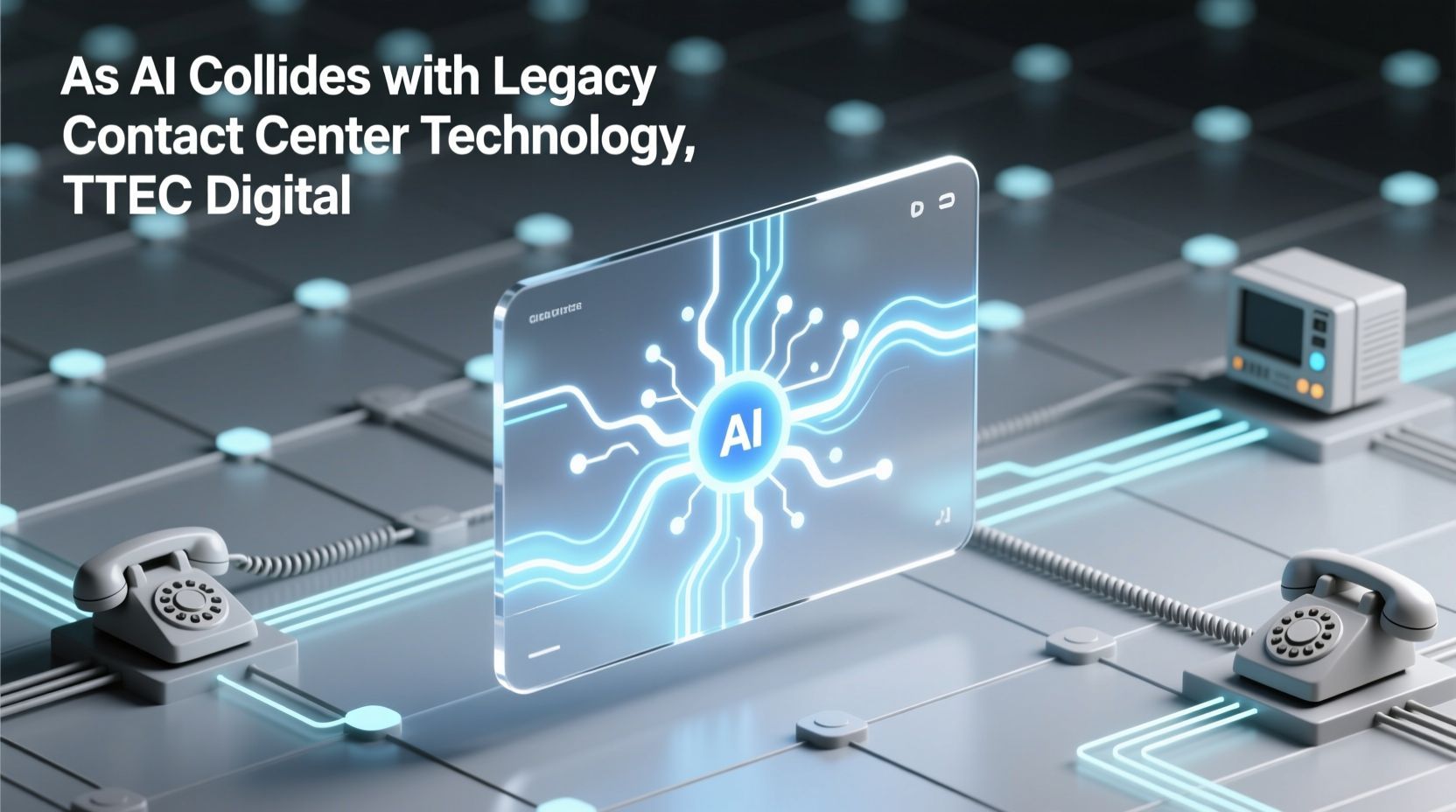
The urgency of this situation was underscored by TTEC Digital’s recent announcement on April 2, 2026, introducing its AI Gateway, a novel software solution engineered to directly address this critical integration gap. As AI Collides with Legacy Contact Center Technology, TTEC Digital is positioning the AI Gateway as a definitive entry point for enterprise-grade AI transformation, signaling a pivotal shift in how organizations can approach legacy system modernization.
Background Context: The Pervasive Legacy Challenge
The typical enterprise contact center is a complex tapestry of on-premises Private Branch Exchanges (PBXs), Automatic Call Distributors (ACDs), Interactive Voice Response (IVR) systems, workforce management (WFM) tools, and Customer Relationship Management (CRM) platforms. Many of these systems, while robust and reliable, predate the explosion of cloud-native AI services and often communicate via proprietary protocols or antiquated APIs. This architectural debt creates significant friction for AI adoption.
Integrating modern AI often demands real-time data streams, low-latency API calls, and flexible data ingestion mechanisms that legacy systems were simply not designed to provide. The result is a common scenario where organizations struggle with expensive custom integrations, data silos, and a fragmented CX ecosystem. A webinar hosted by TTEC Digital on April 27, 2026, highlighted this reality, noting that 54% of CX leaders identify integration complexity as their top AI barrier, attributing it to how most legacy platforms were originally built. This inability to seamlessly blend AI with existing operations not only slows innovation but also inflates costs and introduces significant operational risk.
Deep Technical Analysis: TTEC Digital’s AI Gateway
TTEC Digital’s AI Gateway emerges as a strategic architectural component specifically designed to mitigate the inherent friction when As AI Collides with Legacy Contact Center Technology, TTEC Digital. Described as a “universal connector” and an “intelligence layer,” this solution provides a standardized, API-driven bridge between disparate systems.
Architectural Overview and Core Functionality
At its core, the AI Gateway functions by intelligently ingesting media streams and associated metadata directly from existing contact center platforms. This ingestion layer is crucial, as it normalizes diverse data formats from various legacy sources into a consistent structure suitable for AI consumption. Once processed, this normalized data is routed through real-time APIs to the chosen AI provider. This real-time processing capability is paramount for use cases requiring immediate responses, such as live agent assistance, sentiment analysis during a call, or dynamic IVR routing.
The Gateway’s design philosophy centers on abstracting the underlying complexity of integrating with multiple AI models and legacy systems. By providing a single integration point, it significantly reduces the development effort and maintenance overhead typically associated with point-to-point integrations.
Supported Platforms and Ecosystem Flexibility
A key technical strength of the AI Gateway is its broad compatibility. On the AI provider side, it currently supports leading hyperscalers such as Amazon, Google, and Microsoft, with a forward-looking architecture ready for integration with emerging frontier AI platforms like Anthropic, OpenAI, and Nvidia. This vendor-neutral approach allows enterprises to leverage best-of-breed AI capabilities and, crucially, to “mix and switch models at any time,” fostering a competitive and future-proof AI ecosystem.
For legacy contact center infrastructure, the AI Gateway integrates with major platforms including Avaya, Cisco, Five9, Genesys, Twilio, and Zoom. It also extends its reach to critical CRM platforms like Salesforce and Dynamics 365. This extensive support ensures that the majority of enterprise contact centers can adopt AI without being forced into a complete platform migration, a concern explicitly addressed by Alfredo Rizzo, TTEC’s Chief Technology Officer.
Addressing Technical Debt and Integration Challenges
The AI Gateway tackles several pervasive technical challenges:
- API Impedance Mismatch: It provides a consistent API surface for AI consumption, abstracting the varied and often idiosyncratic APIs of legacy systems.
- Data Normalization: By ingesting raw media and metadata, it handles the complex task of transforming disparate data formats into a unified schema required by AI models.
- Real-time Processing and Latency: The focus on real-time APIs ensures that AI-driven insights and actions can be delivered with minimal latency, critical for live customer interactions.
- Security and Governance: While specific CVE IDs for the AI Gateway were not released, the presence of a dedicated integration layer implies a centralized point for applying security policies, access controls, and data governance rules for AI interactions, which is vital when handling sensitive customer data.
Practical Implications for Engineering Teams
For development and infrastructure teams, the AI Gateway’s launch has several profound implications:
- Reduced Migration Burden: The most significant benefit is the ability to infuse AI capabilities into existing ecosystems without the prohibitive cost and disruption of a full “rip and replace” migration. This allows engineering resources to focus on AI innovation rather than core infrastructure overhaul.
- Accelerated AI Adoption and Time-to-Value: By streamlining integration, the Gateway enables faster deployment of AI use cases, leading to quicker realization of ROI and business value. Early adopters across healthcare, BFSI, telecommunications, and public sectors have reported material increases in ROI, cost savings, and customer satisfaction.
- Enhanced CX Capabilities: Engineering teams can now more easily implement advanced AI use cases such as conversational agents, intelligent agent assistance, real-time transcription, automated summarization, and deeper customer insights. These capabilities directly translate into improved customer satisfaction and operational efficiency.
- Data-Driven Innovation: The ability to ingest and normalize data from diverse sources unlocks new possibilities for advanced analytics and machine learning, driving continuous improvement in CX strategies.
Best Practices for AI-Legacy Integration
Leveraging an AI Gateway effectively requires adherence to several best practices:
- Phased Rollouts and A/B Testing: Utilize the Gateway’s flexibility to deploy AI features incrementally. Start with low-risk, high-impact use cases and A/B test their performance against traditional methods before wider deployment. This minimizes disruption and allows for iterative optimization.
- Robust Data Governance and Security: Implement stringent data governance policies, especially concerning sensitive customer information transiting through the Gateway. Ensure encryption in transit and at rest, and adhere to compliance standards (e.g., GDPR, CCPA, HIPAA). The Gateway acts as a choke point for data, making its security paramount.
- Comprehensive Monitoring and Observability: Establish robust monitoring for both the AI services and the legacy systems connected via the Gateway. Track key performance indicators (KPIs) such as AI model latency, accuracy, integration errors, and their impact on overall contact center metrics.
- Develop Hybrid Skillsets: Foster collaboration between traditional contact center engineers and AI/ML specialists. Training programs should bridge the gap, enabling teams to understand both legacy system constraints and AI model requirements.
- Strategic Vendor Neutrality: Capitalize on the Gateway’s ability to integrate with multiple AI providers. Avoid vendor lock-in by designing AI solutions that can leverage different models or switch providers as the AI landscape evolves.
Actionable Takeaways for Development & Infrastructure Teams
To capitalize on solutions like TTEC Digital’s AI Gateway, development and infrastructure teams should:
- Conduct a Technical Readiness Assessment: Evaluate your current contact center and CRM infrastructure for compatibility with AI Gateway’s ingestion capabilities. Identify key data sources (voice, chat, CRM records) and their current accessibility via APIs or data streams.
- Prioritize High-Impact AI Use Cases: Begin by identifying specific pain points in your CX that AI can address effectively. Focus on use cases that offer clear, measurable ROI, such as intelligent routing, real-time agent assist, or automated post-call summarization.
- Plan for Data Normalization and API Standardization: Even with a Gateway, understanding your data landscape is crucial. Plan for how data will be extracted, transformed, and loaded (ETL) into the Gateway, and how API calls will be managed and orchestrated.
- Develop a Long-Term AI Strategy: View the AI Gateway not just as a quick fix, but as a foundational component of a scalable, future-proof AI strategy. Consider how it will enable the adoption of future AI innovations and potentially new contact center technologies.
- Embrace Continuous Optimization: As Chris Brown, President of TTEC Digital, noted, “technology alone is not enough… the real value lies in the expertise required to manage the surrounding CX systems and the AI as they evolve”. Establish processes for ongoing evaluation, tuning, and improvement of AI models and their integration.
Related Internal Topic Links
- Cloud Contact Center Migration Strategies: A Phased Approach
- Unlocking Value: Generative AI Use Cases in Customer Service
- Data Governance and AI Ethics: Building Trust in Intelligent Systems
Forward-Looking Conclusion
The introduction of TTEC Digital’s AI Gateway marks a significant milestone in the ongoing saga As AI Collides with Legacy Contact Center Technology, TTEC Digital. By offering a pragmatic, non-disruptive path to AI integration, it empowers enterprises to unlock the transformative potential of artificial intelligence without being held captive by their existing infrastructure. This architectural shift from monolithic overhauls to intelligent, API-driven integration layers represents the future of enterprise AI adoption. As AI continues its rapid evolution, solutions that prioritize agility, interoperability, and managed complexity will be indispensable for engineering teams striving to build truly intelligent and customer-centric contact centers.