The relentless pace of digital transformation demands that engineering teams deliver high-quality software with unprecedented speed and agility. Yet, the traditional software development lifecycle (SDLC) remains notoriously labor-intensive, often struggling under the weight of legacy systems, complex regulatory changes, and persistent technical debt. For R&D engineers, this translates to constant pressure, tight deadlines, and the looming threat of project delays. The urgency to innovate without compromising stability has never been higher.
Enter Fujitsu’s groundbreaking AI-Driven Software Development Platform, a recent global announcement poised to redefine how enterprises approach software creation and maintenance. This isn’t merely an incremental improvement; it’s a paradigm shift towards fully autonomous software development, promising a staggering 100-fold increase in productivity for specific tasks. For engineering leaders and individual contributors alike, understanding the technical underpinnings and strategic implications of this platform is no longer optional—it’s critical for staying competitive in an rapidly evolving landscape.
Background Context: The Imperative for AI in SDLC
For decades, software development methodologies have evolved, from Waterfall to Agile and DevOps, each aiming to streamline processes and improve outcomes. However, core challenges persist, particularly for large-scale, complex enterprise systems that are often burdened by intricate business logic, regulatory compliance, and a vast codebase accumulated over years. Manual processes in requirements gathering, design, coding, testing, and deployment introduce bottlenecks, human error, and significant costs.
Generative AI, especially Large Language Models (LLMs), has emerged as a disruptive force, demonstrating capabilities in code generation, documentation, and even basic test case creation. Fujitsu’s initiative builds upon this foundation, pushing beyond mere assistance to achieve true end-to-end automation. This move is particularly strategic given the global shortage of skilled IT professionals and the increasing demand for rapid system modifications driven by legal and business changes. The platform directly addresses these pain points by offloading repetitive, time-consuming tasks to intelligent AI agents, freeing human engineers to focus on higher-value innovation and architectural oversight.
Deep Technical Analysis: The AI-Driven Software Development Platform
At the heart of Fujitsu’s AI-Driven Software Development Platform lies a sophisticated interplay of cutting-edge AI technologies. The platform leverages the company’s proprietary Takane large language model (LLM), developed in collaboration with Cohere, alongside advanced agentic AI technology from Fujitsu Research. This combination is designed to enable AI agents to comprehend and interact with complex, evolving large-scale systems prevalent in enterprise and public sector organizations.
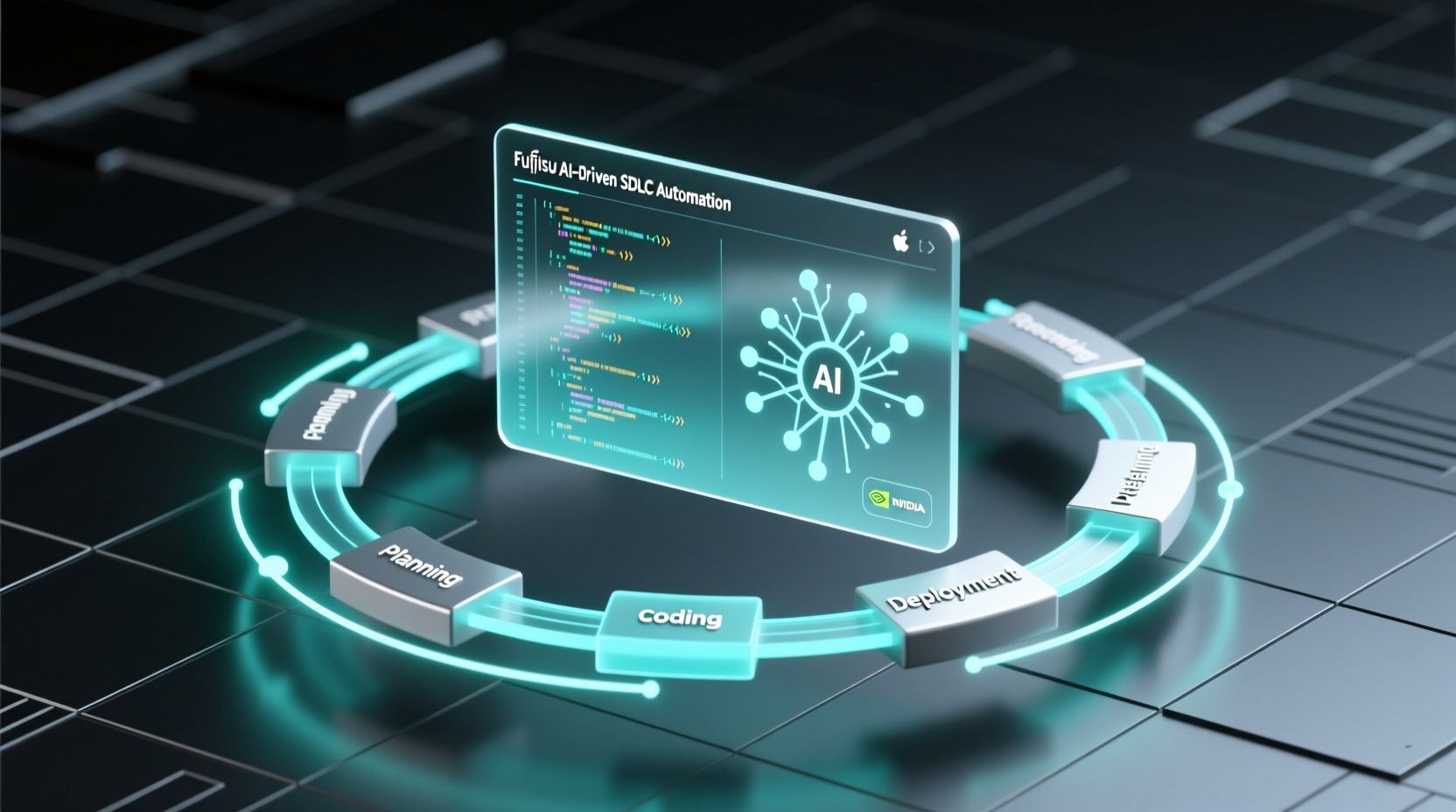
The architectural design is noteworthy for its multi-agent system approach. Instead of a monolithic AI, the platform deploys multiple specialized AI agents that collaboratively execute each stage of the software development process. This collaborative agentic architecture allows for:
- Requirements Definition and Design: AI agents interpret natural language requirements, identify dependencies, and even propose design patterns, translating high-level business needs into technical specifications.
- Implementation: Leveraging the Takane LLM, agents generate code snippets, functions, and even entire modules based on the design specifications. The LLM’s capabilities are enhanced by Fujitsu’s advancements in optimizing LLM performance, including a reported 94% memory reduction for the Takane LLM, which is crucial for efficient, large-scale code generation.
- Integration Testing: Agents automatically create test cases, execute them, and analyze results, identifying bugs and potential integration issues. This stage includes unit, integration, and potentially system-level testing, ensuring code quality and functional correctness.
- Refinement and Iteration: The platform is designed for autonomous iteration. If tests fail or new requirements emerge, the AI agents can re-evaluate, redesign, and regenerate code, effectively closing the feedback loop without human intervention.
The Role of AI-Ready Engineering
A critical component Fujitsu emphasizes is AI-Ready Engineering. This involves preparing existing system assets, documentation, and organizational knowledge in a structured format that AI systems can accurately interpret. For legacy systems, this preparatory phase is paramount, ensuring the AI agents can understand the nuances of existing codebases, architectural decisions, and tacit knowledge held by human experts. Without robust AI-Ready Engineering, even the most advanced AI platform would struggle to reliably automate modifications to complex, undocumented systems.
Performance Benchmarks and Initial Deployments
The platform’s efficacy has been demonstrated in a Proof of Concept (PoC) related to the 2024 medical fee revisions in Japan. In this PoC, the AI-Driven Software Development Platform completed a change request that would conventionally require three person-months of effort in just four hours, achieving an extraordinary 100-fold increase in productivity. This benchmark, while specific to a particular use case, highlights the transformative potential of the platform for routine, yet complex, software modifications.
Fujitsu is initially deploying this platform to carry out revisions for all 67 types of medical and government business software products provided by Fujitsu Japan Limited by the end of fiscal year 2026. These revisions are critical due to ongoing legal and regulatory changes, a perfect scenario for demonstrating the platform’s ability to handle high-volume, compliance-driven updates with speed and accuracy. The platform has been in active use for 2026 medical fee revisions since January 2026.
Practical Implications & Best Practices
For development and infrastructure teams, Fujitsu’s AI-Driven Software Development Platform signals a significant shift in operational paradigms. While full automation without human intervention is the ambitious goal, the immediate implications suggest a powerful augmentation of human capabilities.
Impact on Development Teams
- Shift in Skillset: Engineers will transition from purely coding to more strategic roles, focusing on AI model supervision, prompt engineering, validating AI-generated artifacts, and complex problem-solving that requires human intuition.
- Accelerated Delivery: Routine updates, bug fixes, and compliance-driven modifications can be executed at unprecedented speeds, freeing up cycles for new feature development and innovation.
- Reduced Technical Debt: The platform’s ability to understand and modify legacy systems, especially with robust AI-Ready Engineering, could significantly accelerate the modernization of existing applications.
Best Practices for Adoption
- Invest in AI-Ready Engineering: Prioritize documentation, code quality, and knowledge formalization to create a robust foundation for AI understanding. This includes clear architectural diagrams, API specifications, and comprehensive test suites.
- Phased Implementation: Start with well-defined, contained projects or specific SDLC stages (e.g., automated testing, minor code refactoring) to build confidence and refine AI interaction patterns.
- Establish Governance and Oversight: Implement strong human-in-the-loop processes for critical decisions, code reviews, and validation of AI-generated outputs. Define clear metrics for AI performance and reliability.
- Upskill Your Workforce: Provide training for engineers on AI principles, prompt engineering, and how to effectively collaborate with AI agents.
Actionable Takeaways for Development and Infrastructure Teams
The emergence of platforms like Fujitsu’s AI-Driven Software Development Platform necessitates a proactive strategy from engineering organizations.
- Evaluate Legacy System Readiness: Conduct an audit of your existing systems to assess their “AI-Readiness.” Identify areas where documentation is sparse, code is highly coupled, or implicit knowledge is prevalent. This is your starting point for preparing for AI-driven automation.
- Pilot AI-Assisted Workflows: Even before full automation, explore integrating generative AI tools into specific parts of your SDLC, such as intelligent code completion, automated documentation generation, or AI-powered test case suggestions. This builds familiarity and identifies potential integration challenges.
- Redefine Developer Roles: Begin planning for a future where developers spend less time on boilerplate code and more on architectural design, complex problem-solving, and ensuring the ethical and reliable operation of AI-driven systems. Foster a culture of continuous learning and adaptation.
- Security and Compliance in AI-Generated Code: Establish stringent security policies and automated scanning for AI-generated code. Ensure that AI outputs adhere to your organization’s coding standards, security best practices, and regulatory compliance requirements. Consider integrating static analysis and vulnerability scanning tools directly into the AI-driven pipeline.
Related Internal Topic Links
- Generative AI in DevOps: Transforming Continuous Delivery
- Strategies for Legacy System Modernization with AI
- Ethical AI in Software Development: Best Practices and Governance
Conclusion
Fujitsu’s AI-Driven Software Development Platform marks a pivotal moment in the evolution of software engineering. By automating the entire SDLC with the Takane LLM and advanced agentic AI, Fujitsu is not just offering a tool but proposing a fundamental shift in how software is conceived, built, and maintained. The reported 100-fold productivity increase is a testament to the transformative power of AI-Driven SDLC. While the initial focus is on specific enterprise applications, the vision for broader industry adoption by the end of fiscal year 2026 is clear. For R&D engineers, this future demands a strategic embrace of AI, a commitment to AI-Ready Engineering, and a readiness to redefine their roles. The era of the autonomous software factory is dawning, and those who adapt will lead the charge into the next generation of digital innovation.