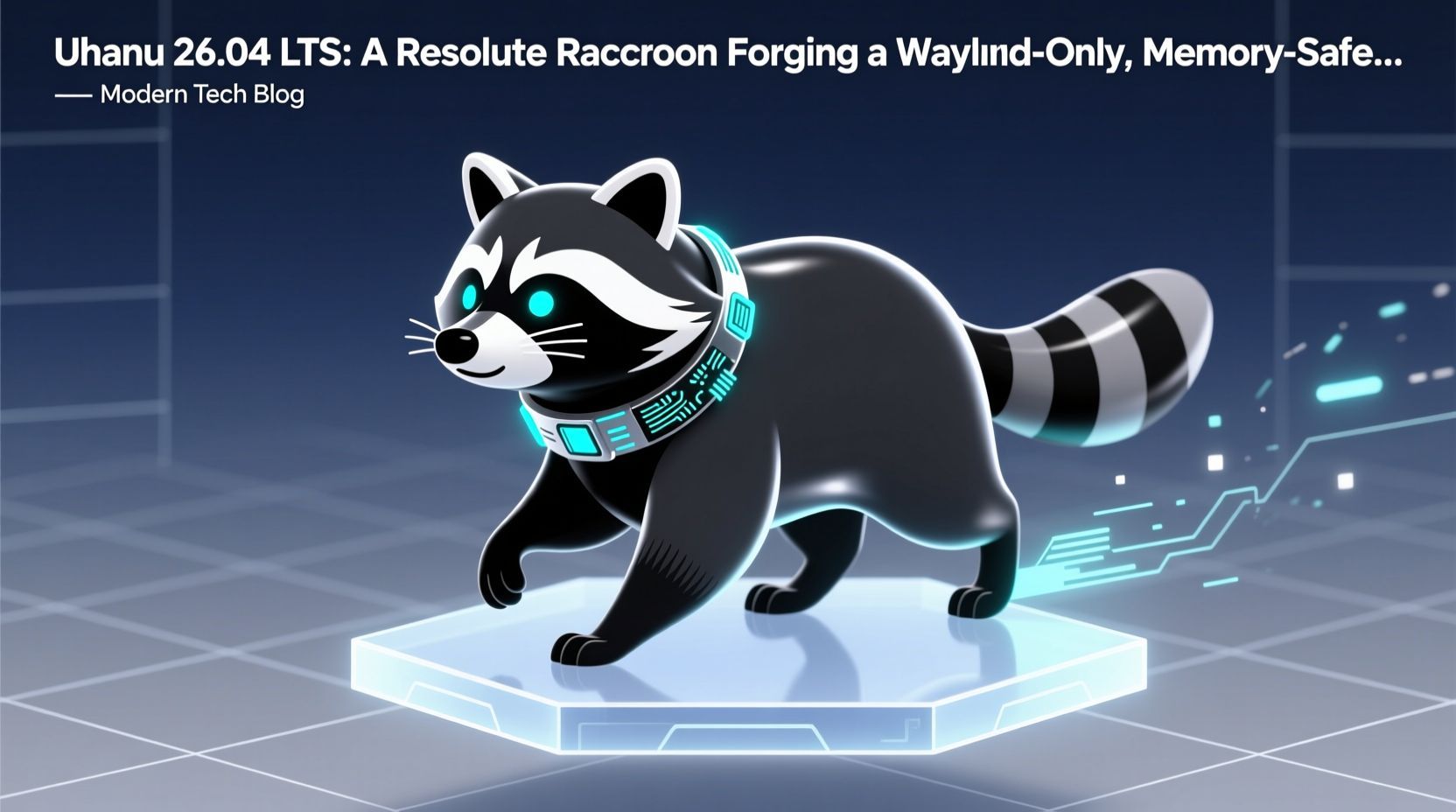
The long-awaited Ubuntu 26.04 LTS, codenamed “Resolute Raccoon,” has officially been released on April 23, 2026, and it’s not just another incremental update. This Long Term Support (LTS) release signals a profound architectural pivot, introducing breaking changes and foundational shifts that demand immediate attention from every R&D and infrastructure engineering team. Ignoring these changes is not an option; they will impact everything from container deployments to desktop workstations. Are your systems ready for a Wayland-only world and a Rust-fortified core? The time to assess and plan your migration strategy is now.
Background Context: A Decade of Commitment, a Future Reimagined
Ubuntu LTS releases, occurring every two years, are the bedrock for enterprises and developers seeking stability and long-term support. With a standard five-year support window, extendable to 10-15 years with Ubuntu Pro, Ubuntu 26.04 LTS “Resolute Raccoon” will define the operating environment for millions of systems well into the next decade. This release, however, breaks from previous LTS traditions by making bold, future-forward decisions that intentionally deprecate legacy components. Canonical’s vision for “Resolute Raccoon” is clear: a more secure, performant, and modern Linux ecosystem, even if it means a more demanding migration path for some.
Key among these shifts is the adoption of Linux kernel 7.0, GNOME 50 with a strict Wayland-only desktop, and a significant move towards memory-safe system utilities written in Rust. These aren’t minor version bumps; they represent a deliberate, strategic re-platforming designed to enhance security, improve performance, and align Ubuntu with emerging hardware and software paradigms.
Deep Technical Analysis: Under the Hood of Resolute Raccoon
Linux Kernel 7.0: Powering the Core
At its heart, Ubuntu 26.04 LTS ships with the Linux kernel 7.0. This latest kernel brings a host of improvements, particularly for modern hardware. Notable enhancements include:
- Intel Panther Lake Support: Optimized support for Intel Core Ultra Series 3 processors, including Intel Xe3 integrated graphics and the Neural Processing Unit (NPU). This is crucial for AI/ML workloads and next-generation computing.
- EtherCAT Industrial Networking: Integrated IgH EtherCAT module for real-time industrial Ethernet networks, broadening Ubuntu’s appeal in embedded and industrial control systems.
- Real-Time Kernel Availability: The
PREEMPT_RTreal-time kernel is now available in the main archive, moving beyond Ubuntu Pro exclusivity. - ARM64 Livepatch Support: Kernel Livepatch, critical for applying security patches without reboots, now supports ARM64 architecture, enhancing uptime for ARM-based server deployments.
- Sched_ext Support: A new eBPF-based scheduling system allows for user-space scheduler implementations, offering unprecedented flexibility and optimization opportunities for high-performance computing.
- Performance Gains: General performance optimizations are expected, particularly in container and network performance due to
io_uringand BPF improvements.
A significant architectural decision is the removal of the linux-lowlatency package, with tuning now handled by linux-generic combined with a user-space package for GRUB parameters.
GNOME 50: The Wayland-Only Desktop
The desktop experience in Ubuntu 26.04 LTS is fundamentally transformed by GNOME 50, marking a complete and irreversible transition to a Wayland-only display server. The X11 GNOME session has been entirely removed. While XWayland will provide compatibility for legacy X11 applications, engineers relying on specific Xorg features or desktop environments other than GNOME (which may still offer X11 sessions) must thoroughly test their setups. This move is a long-anticipated step towards a more secure and performant graphical stack, offering improved variable refresh rate (VRR) support and fractional scaling.
New default applications like “Showtime” (video player), “Resources” (system monitor), “Papers” (PDF viewer), and “Loupe” (image viewer) replace older counterparts, often with Rust-based rewrites for improved memory safety.
Memory-Safe Foundations: Rust at the Core
Perhaps the most profound architectural shift is the widespread adoption of Rust for critical system utilities, moving towards truly memory-safe systems. Ubuntu 26.04 LTS defaults to sudo-rs, a Rust-based implementation of the sudo command, and incorporates rust-coreutils for foundational utilities like ls, cp, and mv. This transition directly addresses decades of vulnerabilities stemming from memory management errors in C-based code, promising a significantly more secure base operating system. While functionally equivalent, teams with scripts parsing specific GNU coreutils output must validate compatibility.
Security Enhancements: A Proactive Stance
Security is a cornerstone of this release:
- TPM-backed Full Disk Encryption (FDE): Now a fully supported, production-ready feature, TPM-backed FDE binds encryption keys to specific hardware and Secure Boot states, making data inaccessible if the drive is moved or the system tampered with. The new Security Center app provides a control plane for managing FDE state and recovery mechanisms.
- Post-Quantum Cryptography (PQC): Enabled by default for OpenSSH and OpenSSL, using hybrid algorithms like
mlkem768x25519-sha256for OpenSSH andX25519+ML-KEMfor TLS connections. This proactive measure prepares infrastructure for the quantum computing era. - Confidential Computing: Support for Intel TDX confidential computing host further isolates virtual machines, enhancing data privacy in cloud environments.
Key Software Updates & Deprecations
Server-side, significant updates include PostgreSQL 18 (with up to 3x performance improvements for storage reads), MySQL 8.4 LTS (the first official LTS release for MySQL, dropping 32-bit server support), Valkey 9.0, and PHP 8.5. Chrony replaces systemd-timesyncd as the default time daemon for new installations. containerd has been updated to version 2.2.2, which includes breaking changes from 1.x deprecated features.
Critical deprecations and breaking changes include:
- cgroup v1 Removal:
systemd 259removes all support for cgroup v1. Upgrades from 24.04 LTS will be blocked if cgroup v1 is detected, impacting older Docker versions (pre-20.10) and Kubernetes clusters with hardcoded cgroup v1 configurations. apt-key addRemoval: The use ofapt-key addfor adding third-party repositories is no longer supported; users must transition tosigned-bydirectives insources.listfiles.- GNOME X11 Session Dropped: As noted, no X11 session option for GNOME users.
- PreLogin and PostSession scripts: Removed from GNOME as part of X11 cleanup.
Hardware Enablement and Cloud Native
Ubuntu 26.04 LTS introduces a new Hardware Enablement (HWE) virtualization stack (virt-hwe) that will receive continuous updates, mirroring the HWE kernel model. For cloud deployments, amd64v3 architecture variants are now supported, leveraging newer x86_64 ABI and instruction set extensions for improved performance. Ubuntu Server 26.04 LTS will now automatically install HWE/OEM kernel packages where available, streamlining deployments on modern hardware. Native NVIDIA CUDA and AMD ROCm packages are now directly available in the Ubuntu repositories, simplifying AI/ML and GPU-accelerated workload deployments.
Practical Implications for Engineering Teams
The changes in Ubuntu 26.04 LTS are significant and require a structured approach to adoption. For server and cloud environments, the removal of cgroup v1 and the shift to Rust-based core utilities are paramount. For desktop users, the Wayland-only GNOME 50 environment will be the most noticeable change.
Migration Considerations
Direct upgrades from Ubuntu 24.04 LTS to 26.04 LTS will only be officially enabled after the release of Ubuntu 26.04.1 LTS, expected around August 6, 2026. Users on 25.10 can upgrade immediately. Canonical explicitly blocks upgrades if certain conditions, like active cgroup v1 usage, are met.
Minimum system requirements have increased to 6 GB of RAM for an optimal desktop experience.
Best Practices and Actionable Takeaways
- Audit Existing Infrastructure: Immediately identify systems running cgroup v1 (
cat /proc/cgroupsormount | grep cgroup) and plan for migration to cgroup v2. Update Docker (to 20.10+) and Kubernetes configurations accordingly. - Review Third-Party Repositories: Transition all
apt-key addusages tosigned-bydirectives in/etc/apt/sources.list.d/files. - Test Wayland Compatibility: For desktop deployments, rigorously test all critical applications and workflows in a Wayland environment. Proprietary NVIDIA driver users should verify Wayland stability.
- Validate Scripting: Due to
rust-coreutils, verify that shell scripts relying on precise output parsing from commands likelsorgrepcontinue to function as expected. - Security Baseline: Leverage the new TPM-backed FDE and post-quantum cryptography defaults for enhanced security posture. Explore the new Security Center features.
- Phased Rollout: Canonical recommends waiting for the 26.04.1 point release for LTS-to-LTS upgrades. Implement a phased rollout, starting with non-production environments. Always perform full data backups or VM snapshots before any major upgrade.
- Cloud Image Strategy: For new cloud deployments, consider utilizing the
amd64v3architecture variants for improved performance. - Container Runtime Updates: Be aware of breaking changes in
containerd 2.2.2and update container images/configurations as necessary.
Related Internal Topic Links
- Container Orchestration: Navigating cgroup v2 Migration
- Securing Linux: The Rise of Rust in Memory-Safe Systems
- Wayland Adoption Strategies for the Enterprise Desktop
Conclusion
Ubuntu 26.04 LTS “Resolute Raccoon” is a landmark release that underscores Canonical’s commitment to a modern, secure, and performant Linux ecosystem. By embracing Linux kernel 7.0, a Wayland-only desktop with GNOME 50, and a core built on memory-safe systems like sudo-rs and rust-coreutils, Ubuntu is making a decisive leap forward. While these changes introduce a more demanding upgrade path than previous LTS versions, particularly with the removal of cgroup v1 and the X11 GNOME session, the long-term benefits in security, stability, and performance are undeniable. Engineering teams must proactively engage with these architectural shifts, conduct thorough audits, and strategically plan their migrations to harness the full potential of this groundbreaking LTS release. The future of Ubuntu is resolute, and it’s time for your infrastructure to adapt.
Sources
- servethehome.com
- serverspace.io
- ubuntu.com
- ubuntu.com
- medium.com
- pudn.club
- omgubuntu.co.uk
- linuxize.com
- phoronix.com
- ubuntu.com
- techpowerup.com
- omgubuntu.co.uk
- distrosea.com
- youtube.com
- ubuntu.com
- zdnet.com
- linuxteck.com
- itsfoss.com
- reddit.com
- ubuntu.com
- zdnet.com
- phoronix.com
- microsoft.com
- ubuntu.com
- alessioligabue.it