The Urgency: Seizing a NASA-Grade Competitive Edge
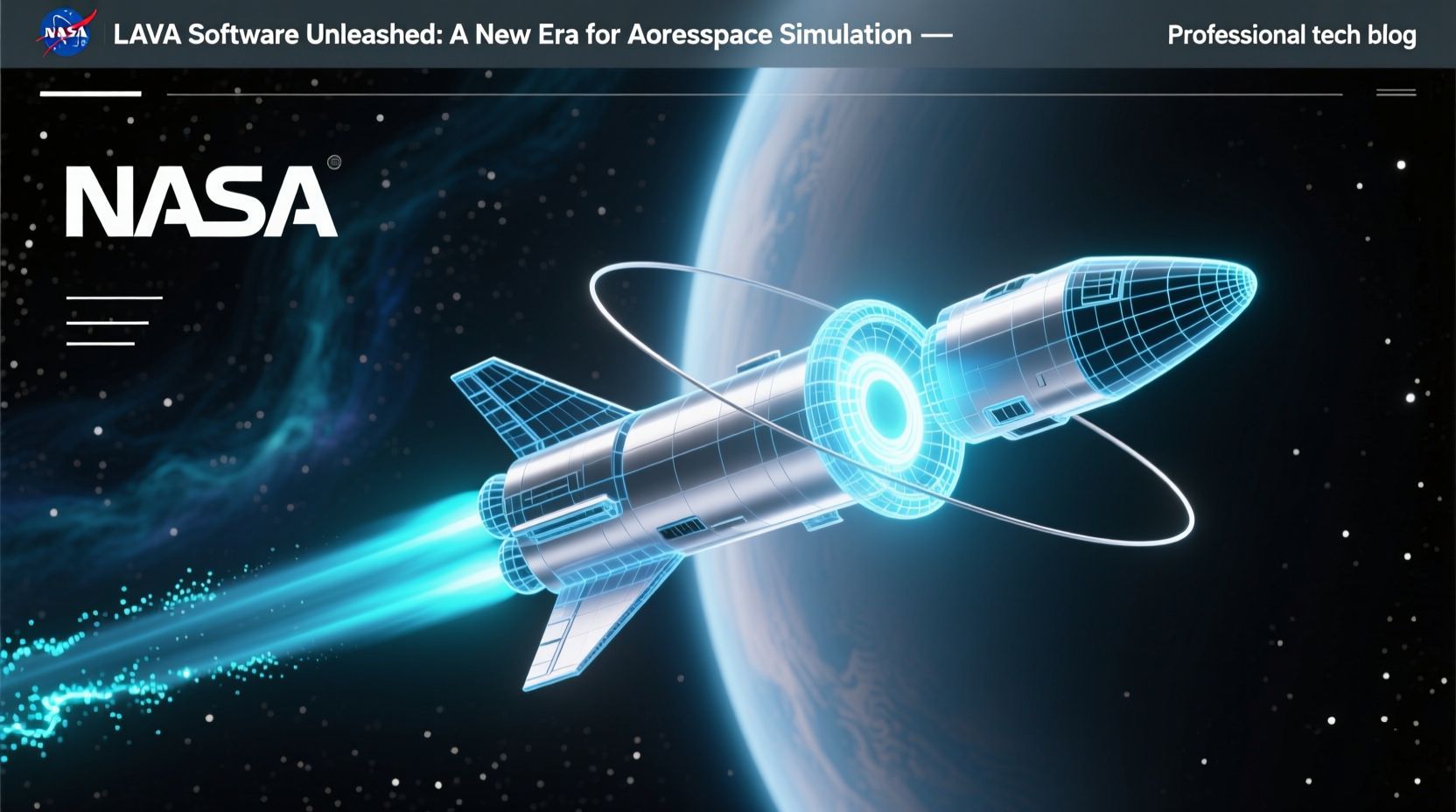
A paradigm shift has just occurred within the United States aerospace engineering landscape. Today, April 23, 2026, marks a pivotal moment as NASA officially releases its formidable Launch, Ascent, and Vehicle Aerodynamics (LAVA) framework to the broader US aerospace industry. For years, LAVA has been an indispensable, high-fidelity computational fluid dynamics (CFD) tool, exclusively wielded by NASA engineers to tackle the most complex airflow challenges inherent in critical space and aeronautical missions. From optimizing Artemis rocket launches to refining advanced aircraft designs, LAVA’s predictive power has been instrumental in ensuring mission success. The release of this powerful NASA LAVA Software is not merely a technical update; it’s a strategic imperative for any development or infrastructure team aiming to accelerate innovation, reduce physical prototyping costs, and achieve unparalleled simulation accuracy. The window of opportunity to integrate this capability and gain a significant competitive advantage is now open.
Background Context: Unveiling NASA’s LAVA Framework
Developed at NASA’s Ames Research Center, the LAVA framework is a sophisticated, multi-physics Computational Fluid Dynamics (CFD) software package engineered to predict with stunning accuracy how air interacts with rockets, aircraft, and spacecraft across various flight regimes. Its genesis lies in addressing critical challenges during the redesign of launch infrastructure at Kennedy Space Center, evolving into a comprehensive solver for a myriad of aerodynamic and aeroacoustic problems. Before this public release, LAVA was the gold standard for NASA’s internal R&D, simulating everything from Mars lander re-entry dynamics to optimizing aircraft for enhanced efficiency. The decision to make this powerful tool available to the US aerospace community, including researchers, companies, and innovators, underscores NASA’s commitment to fostering a collaborative ecosystem of accelerated innovation.
As Jared Duensing, LAVA team lead at NASA’s Ames Research Center, aptly states, “This isn’t only about releasing software; it’s about accelerating innovation. When university researchers can run more complex simulations and when small companies can optimize designs with NASA-grade precision, we’re not only sharing tools, we’re unleashing potential.”
Deep Technical Analysis: Under the Hood of LAVA’s Capabilities
At its core, LAVA is a highly advanced, modular framework that extends beyond traditional CFD. It seamlessly integrates auxiliary modules such as Conjugate Heat Transfer (CHT) and Computational Aero-Acoustics (CAA), providing a holistic approach to complex fluid-thermal-acoustic interactions. This multi-physics capability is crucial for accurately modeling real-world aerospace environments where these phenomena are intrinsically linked.
A key architectural decision in LAVA is its “grid-agnostic” design. This means it can accommodate a wide array of grid types, including block-structured Cartesian, generalized curvilinear overset, and unstructured polyhedral grids. This flexibility is paramount for handling the geometrically complex designs prevalent in the aerospace industry, from intricate launch vehicle configurations to detailed aircraft components. Furthermore, LAVA supports both explicit and implicit time-stepping schemes, allowing engineers to select the most appropriate method for their specific simulation requirements, balancing computational cost with temporal accuracy.
LAVA incorporates cutting-edge numerical methods to achieve its high fidelity. For instance, it supports hybrid Reynolds-averaged Navier-Stokes (RANS)/large-eddy simulation (LES) and wall-modeled large-eddy simulation (WMLES) approaches, which are critical for resolving turbulent flow phenomena with greater accuracy than traditional RANS models, especially in areas like boundary layer separation and flow buffet. For certain applications, LAVA also leverages the Lattice Boltzmann Method (LBM), which can offer significant performance advantages, with reported speed-ups of 10-50 times compared to Navier-Stokes solvers for specific problems. The implementation of both standard bounce back (SBB) and linear bounce back (LBB) rules for boundary conditions further enhances its ability to accurately capture flow physics near complex geometries.
While the breaking news today announces the release of the LAVA framework to the US aerospace industry, a specific version number for this public iteration has not been detailed in the initial announcements. Similarly, specific changelog analyses, deprecations, or CVE IDs related to security patches are not typically part of such a high-level public release. Early adopters will need to engage with NASA’s support channels and documentation to obtain these critical details as they become available. However, the existing body of work and validation within NASA for missions like Artemis I provides strong confidence in the framework’s stability and accuracy.
Practical Implications for the Aerospace Industry
The release of NASA LAVA Software opens up unprecedented opportunities across the US aerospace sector:
- Accelerated Design Cycles: Engineers can now perform higher-fidelity simulations earlier in the design process, rapidly iterating on concepts for new aircraft wings, rocket fairings, or re-entry vehicles without extensive physical prototyping.
- Enhanced Predictive Accuracy: LAVA’s proven ability to simulate complex phenomena like exhaust plume interactions, airflow-induced vibrations, and supersonic parachute inflation means more reliable predictions for mission-critical scenarios.
- Broad Application Spectrum: Its capabilities extend beyond traditional space launch, offering immense value for designing next-generation supersonic airliners, optimizing advanced drone aerodynamics, and developing efficient air taxis.
- Democratization of NASA-Grade Tools: Small and medium-sized enterprises (SMEs) and academic institutions can now access a tool previously reserved for the most advanced government projects, leveling the playing field for innovation.
However, adopting LAVA is not without its considerations. Its advanced nature implies a significant learning curve for new users and substantial computational resource requirements, particularly for large-scale, high-fidelity simulations. Integration with existing proprietary design and analysis workflows will also be a key challenge for many organizations.
Best Practices for Adoption and Integration
To maximize the benefits of LAVA and ensure a smooth integration, development and infrastructure teams should consider the following best practices:
- Start with Pilot Projects: Begin by applying LAVA to well-defined, smaller-scale problems where existing validation data is available. This allows teams to build familiarity and confidence without risking critical program timelines.
- Invest in Talent Development: The sophistication of LAVA necessitates a workforce skilled in advanced Computational Fluid Dynamics (CFD), numerical methods (e.g., RANS/LES, LBM), and multi-physics simulations (CHT, CAA). Training programs and workshops will be essential.
- Assess High-Performance Computing (HPC) Needs: High-fidelity simulations with LAVA will demand significant HPC resources. Evaluate current infrastructure, consider upgrades, or explore cloud-based HPC solutions for scalability and flexibility.
- Establish a Validation and Verification (V&V) Framework: Given the criticality of aerospace applications, a robust V&V strategy is paramount. Compare LAVA’s results against experimental data, flight test data, and other validated simulation tools.
- Engage with the NASA LAVA Community: Actively participate in forums, workshops, and user groups established by NASA. This will be invaluable for sharing knowledge, troubleshooting, and staying abreast of future developments.
- Security and Compliance Review: While specific CVEs are not publicly available at release, any new software integration requires a thorough security review to ensure compliance with industry standards and internal security protocols.
Actionable Takeaways for Development and Infrastructure Teams
For Development Teams:
- Strategic Upskilling: Prioritize training in advanced CFD methodologies, particularly hybrid RANS/LES and Lattice Boltzmann Methods, to fully leverage LAVA’s capabilities for complex turbulence and aeroacoustics.
- Target High-Impact Challenges: Identify current bottlenecks in your design process related to aerodynamic performance, thermal management, or aeroacoustic noise that LAVA’s high-fidelity simulations can address. Examples include buffet prediction, re-entry heating, and sonic boom mitigation.
- Integrate with Design Workflows: Plan for API integrations or data exchange protocols to seamlessly incorporate LAVA’s outputs into existing CAD/CAE environments, enabling a more holistic design and analysis pipeline.
For Infrastructure Teams:
- HPC Investment Roadmapping: Develop a multi-year plan for HPC infrastructure, considering both on-premises clusters and cloud compute resources. Focus on scalable architectures optimized for memory-intensive CFD workloads.
- Data Management Strategy: Prepare for the immense data volumes generated by LAVA simulations. Implement robust data storage, retrieval, and post-processing solutions to efficiently manage and analyze simulation results.
- Security and Access Control: Establish secure access protocols and data governance policies for the LAVA software and its associated simulation data, especially considering its NASA origin and sensitive aerospace applications.
Related Internal Topic Links
- Advanced CFD Techniques for Hypersonic Flight
- Optimizing HPC Architectures for Aerospace Engineering Workloads
- Conjugate Heat Transfer: Critical for Spacecraft Thermal Management
Conclusion: Charting a Course for Future Aerospace Innovation
The release of the NASA LAVA Software marks a significant milestone, democratizing access to a tool that has been foundational to some of NASA’s most ambitious endeavors. This powerful Aerospace Simulation framework, with its advanced Computational Fluid Dynamics (CFD) capabilities, CHT, and CAA modules, is poised to redefine the standards of accuracy and efficiency in Aeronautical Engineering and spacecraft design. For US aerospace companies, the mandate is clear: embrace this technology, invest in the necessary talent and infrastructure, and integrate it strategically into your R&D efforts. The future of aerospace innovation will undoubtedly be shaped by those who can most effectively harness these NASA-grade tools, pushing the boundaries of what is possible in the skies and beyond.