The landscape of content management is undergoing a profound transformation, driven by the relentless advancement of artificial intelligence. For R&D engineers operating within the WordPress ecosystem, the imperative to integrate AI-powered tools is no longer a futuristic vision but an immediate strategic necessity. The ability to automate, optimize, and personalize content at scale dictates competitive advantage. Against this backdrop of accelerating innovation, a significant development has emerged that demands the attention of every engineering team: the release of a new, open-source AI Summarization WordPress Widget.
Background: The Evolution of AI-Powered Content Workflows in WordPress
The demand for efficient content processing has never been higher. Readers scan more than they read, and search engines, particularly with the rise of Generative AI Experiences (GAIEs) like Google SGE and AI Overviews, increasingly prioritize concise, contextually relevant summaries. This shift has propelled AI summarization from a niche utility to a core component of effective content strategy.
WordPress, as the dominant CMS, has been at the forefront of this integration. While native AI capabilities within WordPress 7.0 provide a foundational layer for various AI-driven tasks, including content summarization, these often serve as connectors for external AI services rather than providing a fully integrated, open-source solution out-of-the-box.
Prior to this latest release, the open-source WordPress community has seen several commendable efforts. The “AI Blog Summariser Plugin,” for instance, leverages the Anthropic Claude API for background summarization, demonstrating the effectiveness of API-driven approaches. Similarly, the “AI Share & Summarize” plugin offers a versatile solution integrating multiple AI services (e.g., Claude, ChatGPT, Google AI, Gemini) with social sharing functionalities. Another notable open-source project, the “AI Summarizer” plugin by SoBold, utilizes AWS Bedrock to generate summaries, providing a cloud-agnostic option for those invested in the AWS ecosystem. These initiatives underscore a clear trend: the community is actively seeking robust, flexible, and cost-effective AI solutions.
Breaking News: Flatiron Software Releases Context-Aware AI Summarization Widget as Open Source
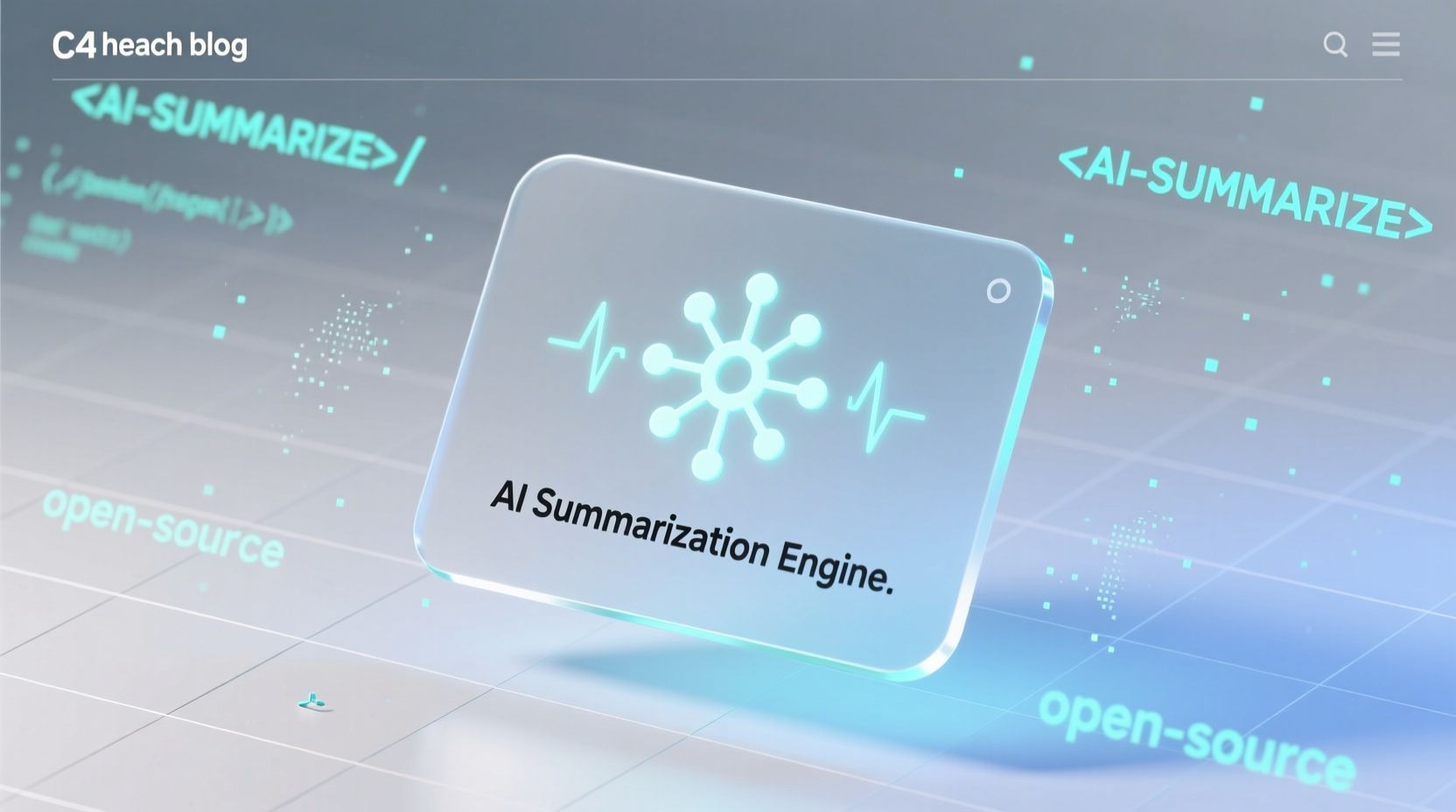
In a groundbreaking move, Flatiron Software, in collaboration with a venerable publication steeped in over a century of technology journalism, has officially released its “AI Summarization WordPress Widget” as open source. This announcement, made on April 14, 2026, marks a pivotal moment for publishers and developers seeking advanced, editorially-aligned AI tools.
What sets this particular widget apart is its emphasis on “context-aware” summarization, driven by “editorial guidance.” Unlike many generic summarization engines that merely extract key sentences or generate abstractive summaries, Flatiron’s tool delves deeper. It reads the full article and produces summaries based on specific prompts provided by writers, ensuring that the output maintains the article’s original intent and nuance. This approach is a direct response to a real-world editorial challenge: the need for reliable, high-quality summaries that respect journalistic standards rather than just condensing text.
The widget has already proven its mettle in a production environment, having been utilized by the collaborating publication for months. The results are compelling: since its deployment, the “Summary Generator plugin” (as it’s internally referred to) has shown a significant correlation with substantial increases in user engagement, time spent on page, conversions, and even revenue per user – with reported lifts not just in percentages, but multiples of baseline levels. This real-world validation provides a strong testament to its efficacy and immediate value proposition.
Crucially, the widget is available now on GitHub, complete with comprehensive documentation and installation instructions. Its open-source nature means no licensing fees, no registration hurdles, and no vendor lock-in, offering unparalleled flexibility and control to the engineering community.
Deep Technical Analysis: Architecture, Integration, and Core Functionality
The architectural design of Flatiron Software’s open-source AI Summarization WordPress Widget appears to prioritize ease of integration and operational independence. The claim of “minimal setup” and “without requiring changes to a publisher’s CMS infrastructure” suggests a well-encapsulated plugin architecture that interacts gracefully with standard WordPress hooks and APIs.
While specific underlying LLM (Large Language Model) details are not explicitly stated in the initial release information, the “context-aware” and “editorial guidance” features imply a sophisticated prompting strategy or potentially fine-tuning on domain-specific content. If the widget leverages an external LLM API (similar to other open-source plugins using Anthropic or AWS Bedrock), its open-source nature allows developers to examine and potentially swap out the backend AI service, offering flexibility in cost, performance, and compliance. Alternatively, if it incorporates a more localized, smaller language model or a specialized retrieval-augmented generation (RAG) architecture, this could impact resource requirements and latency, which are critical considerations for high-traffic WordPress sites.
The prompt-driven summarization mechanism is a key architectural decision. Instead of a black-box approach, it empowers editors with control, allowing them to define the summary’s focus, length, and tone. This likely involves a UI component within the WordPress editor that captures user input and relays it to the summarization engine, potentially via the WordPress REST API for asynchronous processing. The ability to generate summaries for “social posts, newsletters, or reader-facing content” without direct CMS changes points to a robust content abstraction layer within the widget.
From a security and maintenance perspective, the open-source model is a double-edged sword. While it enables community-driven security audits and rapid patch deployment, it also places the onus on individual development teams to stay updated with the latest releases and potential CVEs. The absence of vendor dependencies, as highlighted by Flatiron, shifts the responsibility of managing external integrations and API keys entirely to the implementer, granting greater autonomy but requiring diligent operational oversight.
Practical Implications for Development and Infrastructure Teams
- Deployment & Configuration: The widget’s availability on GitHub with full documentation simplifies deployment. Engineers can clone the repository, install it like any other WordPress plugin, and configure it via the WordPress admin interface. This straightforward process reduces friction for adoption.
- Scalability & Performance: Implementing an AI summarization engine, whether local or API-driven, introduces processing overhead. Infrastructure teams must monitor server load, database interactions, and API call rates. For high-volume sites, caching strategies for generated summaries will be paramount. The open-source nature allows for direct optimization of the code for specific hosting environments.
- Customization & Extensibility: The core benefit of an open-source solution is the freedom to modify. Development teams can tailor the summarization logic, integrate with custom post types, extend the UI, or even connect to proprietary LLM services. This extensibility fosters innovation and allows for precise alignment with unique editorial guidelines and branding.
- Security Best Practices: While the project is new, engineers should treat any new open-source dependency with due diligence. This includes conducting security audits, monitoring the GitHub repository for reported issues and updates, and ensuring that any API keys used for external LLMs are securely stored and managed (e.g., using environment variables or a secrets management service).
- Data Privacy & Compliance: The choice between local processing and external API calls has significant data privacy implications. If the content leaves the WordPress environment for summarization, teams must ensure compliance with data protection regulations (e.g., GDPR, CCPA). An open-source solution provides transparency into how data is handled and allows for the implementation of privacy-enhancing measures.
Best Practices for Implementing AI Summarization in WordPress
- Strategic Deployment: Don’t just summarize everything. Identify key content types (e.g., long-form articles, news reports, product descriptions) where a concise summary adds genuine value to the user experience or aids search visibility. Consider placement: above the fold, within a dedicated summary box, or as meta descriptions.
- Editorial Oversight is Key: Emphasize to content creators that the AI is an assistant, not a replacement. The “editorial guidance” feature of the Flatiron widget is crucial here. Implement a review process for AI-generated summaries, especially initially, to ensure accuracy, tone, and brand consistency.
- Performance Monitoring: Track engagement metrics rigorously. Monitor bounce rates, time on page, click-through rates to full articles, and conversion rates for content with and without AI summaries. Use A/B testing to optimize summary length, style, and placement. The reported “multiples of baseline levels” engagement lift for the Flatiron widget highlights the potential, but individual results will vary.
- SEO Optimization: AI summaries can significantly impact SEO, especially in the era of AI-driven search. Ensure summaries are concise, keyword-rich (naturally), and accurately reflect the article’s content. Storing summaries in custom fields can facilitate their use as meta descriptions or structured data for improved AI search visibility.
- Engage with the Open-Source Community: For engineers adopting the Flatiron widget, active participation in the GitHub repository is a best practice. Report bugs, suggest features, and contribute code. This collaborative approach strengthens the project and ensures its long-term viability and security.
Actionable Takeaways for Your Team
- Evaluate the Flatiron Widget: Immediately assess the Flatiron Software AI Summarization WordPress Widget for its applicability to your content strategy. Review the GitHub repository, documentation, and consider a sandbox deployment.
- Architectural Fit: Determine if an open-source, self-hosted AI summarization solution aligns with your existing infrastructure, security policies, and development capabilities. Compare it against commercial alternatives or API-dependent plugins.
- Security First: Prioritize a thorough security audit before deploying any new open-source component to a production environment. Ensure proper API key management if external LLMs are utilized.
- Iterate and Measure: Start with a pilot program on a subset of content. Collect data on user engagement and SEO impact. Use these insights to refine your implementation and expand its use strategically.
Related Internal Topics
- AI Content Generation: Best Practices for Enterprise Workflows
- WordPress Performance Optimization with LLM Integrations
- Securing Open-Source WordPress Plugins in Production
Conclusion: The Future is Collaborative and Open
The release of Flatiron Software’s AI Summarization WordPress Widget as open source represents a significant step forward in democratizing advanced AI tools for the publishing industry. It underscores a growing trend where specialized, production-hardened AI solutions are being shared with the wider development community, fostering innovation and reducing reliance on proprietary systems. For R&D engineers, this means greater control, customization potential, and the opportunity to contribute to a collaborative future for AI-powered content. As AI continues to reshape how we create, consume, and manage information, open-source initiatives like this will be crucial in building intelligent, adaptable, and ethically sound content ecosystems for tomorrow.