The digital landscape evolves at a relentless pace, and for R&D engineers, staying ahead of critical operating system updates is not merely best practice—it’s a mandate for operational continuity and robust security. Today, we confront a dual imperative: the imminent arrival of Ubuntu 26.04 LTS, codenamed “Resolute Raccoon,” and a fresh wave of Linux kernel vulnerabilities impacting existing Long Term Support (LTS) deployments. These developments are not just news; they are urgent calls to action demanding immediate technical assessment and strategic planning from development and infrastructure teams worldwide.
Canonical’s next LTS release, Ubuntu 26.04, is poised to land on April 23, 2026. While LTS versions traditionally emphasize stability, this iteration introduces a significant, often overlooked, change: a substantial increase in minimum system requirements, particularly RAM. This seemingly minor adjustment carries profound implications for virtualized environments, cloud deployments, and embedded systems. Simultaneously, recent critical kernel flaws in Ubuntu 24.04 LTS and 22.04 LTS underscore the perpetual need for vigilant security patching. Engineers must pivot from reactive fixes to proactive infrastructure audits and migration strategies to safeguard their systems against emerging threats and capitalize on the advancements in the new LTS.
Background Context: The Resolute Raccoon’s Arrival
Ubuntu’s LTS releases, occurring biennially, serve as the backbone for countless enterprise and production environments, offering a five-year commitment to security updates and critical bug fixes, extendable to ten or even fifteen years with Ubuntu Pro. Ubuntu 26.04 LTS, “Resolute Raccoon,” follows the well-received “Noble Numbat” (24.04 LTS) and “Jammy Jellyfish” (22.04 LTS), aiming to build upon their foundations with enhanced stability, performance, and security features. Its development cycle has focused on refining the user experience, bolstering enterprise capabilities, and preparing for future architectural shifts. The beta release was available on March 23, 2026, with the final freeze scheduled for April 16, 2026, leading up to the official release later this month.
However, this new LTS isn’t a simple drop-in upgrade. It signals a subtle but impactful shift in resource demands and a more aggressive move towards modern paradigms, such as a Wayland-only desktop experience. Understanding these underlying changes is crucial for any engineer planning adoption or migration.
Deep Technical Analysis: Unpacking the Changes
Elevated System Requirements: The 6GB RAM Mandate
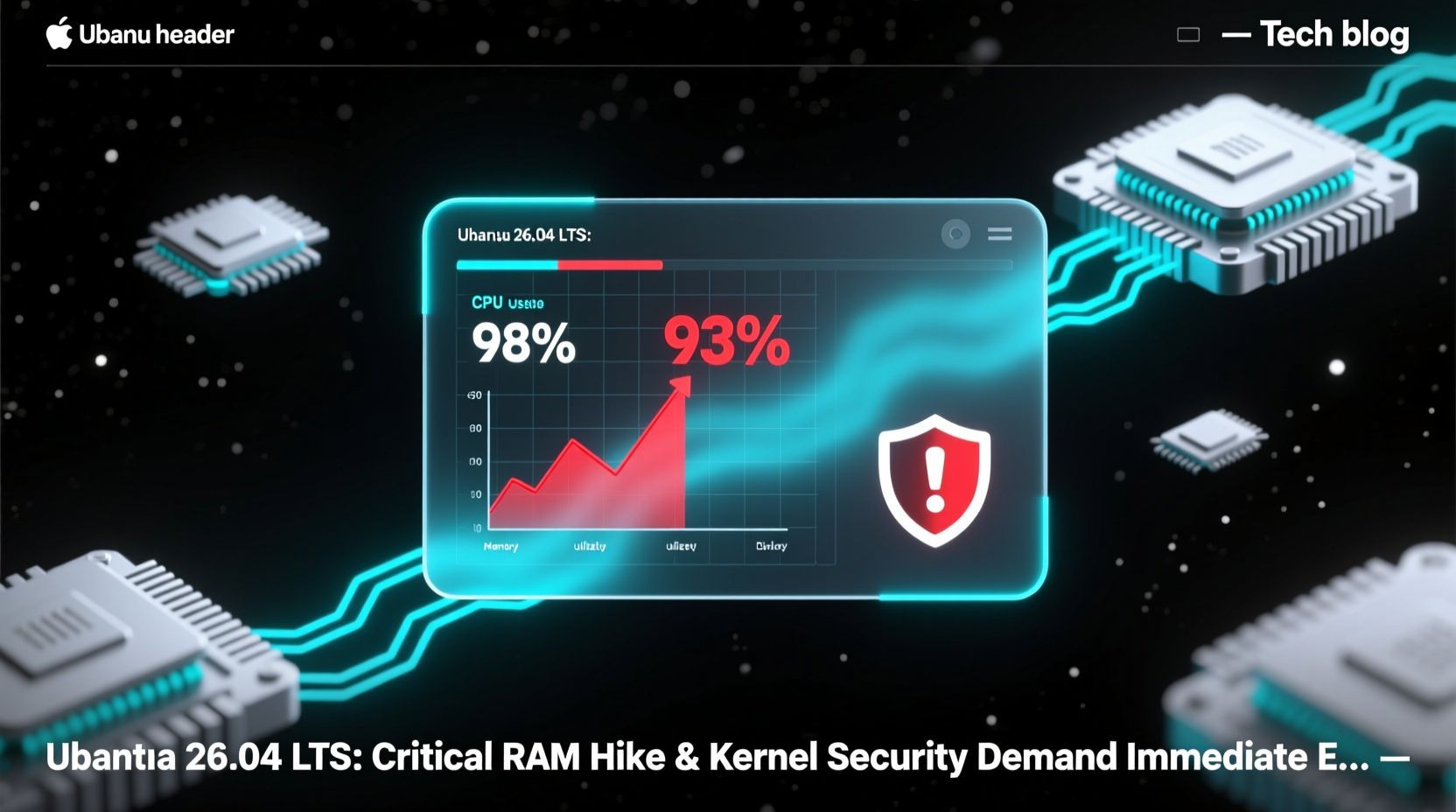
Perhaps the most immediately impactful change for many organizations is the updated minimum system requirement for Ubuntu Desktop 26.04 LTS. Canonical has raised the bar, now specifying a minimum of 6GB of RAM, alongside a 2 GHz dual-core processor and 25 GB of free hard drive space. This marks a notable increase from the traditional 4GB recommendation that has long been a comfortable baseline for Ubuntu LTS desktop installations. While seemingly modest, this 50% increase in RAM can significantly affect resource allocation and cost projections, especially in large-scale virtual desktop infrastructure (VDI), containerized environments where base images are frequently deployed, or resource-constrained edge devices.
For cloud architects, this means re-evaluating instance types. A previously sufficient 4GB VM might now struggle, leading to performance bottlenecks, increased swap usage, and a degraded user experience. DevOps teams deploying Ubuntu 26.04 LTS as a base for CI/CD runners or microservices will need to adjust container resource limits and underlying host provisioning. The rationale likely stems from the continued integration of more feature-rich desktop environments (e.g., GNOME 46 in 24.04 LTS) and increasingly complex background processes. Engineers should benchmark their specific workloads on pre-release versions to ascertain actual resource consumption, rather than relying solely on minimums.
Enhanced Security with TPM-backed Full Disk Encryption
Ubuntu 26.04 LTS continues to advance its security posture with significant progress in TPM-backed full disk encryption. Building on work from Ubuntu 25.10, this feature is nearing general availability, offering users more granular control over their encrypted systems. New capabilities include the ability to add or remove a PIN or passphrase post-installation, re-encrypt a disk directly from the Security Center, and benefit from clearer error messages and updated documentation.
This is a critical development for enterprise security. Trusted Platform Modules (TPMs) provide hardware-level protection for cryptographic keys, safeguarding against cold boot attacks and unauthorized physical access. Integrating this directly into the OS installation and management workflow streamlines compliance efforts (e.g., FIPS 140-3 certification requirements) and significantly hardens the security of data at rest, a paramount concern for sensitive data processing and regulatory adherence.
Unified Software Management: The App Center’s Evolution
Another architectural decision in 26.04 LTS is the ongoing effort to centralize software management within the App Center. Canonical is taking “initial steps to centralise software management and make App Center the single place to handle all applications, independently of the packaging format”. This includes fully managing deb packages directly within the App Center and beginning the deprecation of older system tools like software-properties, which has been part of Ubuntu since 2007. Ubuntu Pro features are also being integrated into the Security Center. This move aims to simplify the user experience and provide a more consistent management interface across traditional .deb packages and modern Snap packages.
For engineers, this implies a shift in tooling and automation. While command-line tools like apt will undoubtedly remain foundational, the GUI-driven management of software and repositories will increasingly funnel through the App Center. Scripts that directly interact with software-properties or assume its continued prominence may require updates. This consolidation is a step towards a more cohesive software ecosystem, reducing fragmentation and potentially improving security by centralizing update mechanisms.
Linux Kernel Security: Immediate Patching for 24.04 LTS and 22.04 LTS
Even as we look forward to 26.04 LTS, the present demands attention. Recent disclosures reveal critical security vulnerabilities in the Linux kernel affecting currently supported LTS versions. On April 2, 2026, Canonical released USN-8148-2, addressing “Several security issues… in the Linux kernel” for Ubuntu 24.04 LTS and 22.04 LTS, including CVE-2026-23111, CVE-2026-23074, and CVE-2026-23060. Furthermore, as of April 6, 2026, CVE-2026-23467 and CVE-2026-23470, both medium-priority kernel vulnerabilities, were published, affecting 24.04 LTS (Noble) and 22.04 LTS (Jammy) for certain FIPS-enabled kernels.
These vulnerabilities often involve privilege escalation, denial of service, or information disclosure, posing significant risks to system integrity and data confidentiality. The 24.04.4 LTS point release (February 2026) already brought the Linux kernel version 6.17 (along with Mesa graphics libraries 25.2.7) with cumulative security and bug fixes, but the newly identified CVEs necessitate further immediate action. Development and operations teams running these LTS versions in production must prioritize the application of these security patches without delay. Failure to do so leaves systems exposed to known exploits, a critical oversight in any security strategy.
Flavor Divergence
An interesting development for 26.04 LTS is the decision by some official flavors, namely Ubuntu MATE and Ubuntu Unity, to forgo LTS status this cycle due to contributor shortages. While the core Ubuntu Desktop remains LTS, this highlights the challenges of maintaining diverse desktop environments and may influence choices for users who rely on these specific flavors for long-term stability.
Practical Implications for Engineering Teams
- Resource Planning for 26.04 LTS: For any new deployments or planned upgrades to Ubuntu 26.04 LTS, infrastructure teams must immediately update their hardware and VM provisioning templates to account for the 6GB RAM minimum. Overlooking this will lead to performance issues and potential instability.
- Immediate Security Patching: Operations teams managing Ubuntu 24.04 LTS and 22.04 LTS deployments must prioritize the application of the latest kernel security updates (e.g., USN-8148-2 and patches for CVE-2026-23467, CVE-2026-23470). Automated patch management systems should be configured to deploy these fixes promptly, and systems should be rebooted if necessary to ensure the new kernel is active.
- Migration Strategy for Software Management: Development teams that automate software installations or repository management using scripts interacting with deprecated tools like
software-propertiesshould begin planning their migration to use the App Center’s capabilities or alternative command-line approaches that align with Canonical’s future direction. - Leveraging TPM-backed Encryption: Security architects should explore integrating TPM-backed full disk encryption into their standard deployment playbooks for Ubuntu 26.04 LTS, especially for sensitive workloads and endpoint protection.
- Benchmarking and Compatibility Testing: Before a broad rollout, conduct thorough benchmarking and compatibility testing of critical applications on Ubuntu 26.04 LTS, especially given the increased RAM requirements and potential underlying changes with Wayland.
Best Practices for a Smooth Transition
- Adopt a Phased Rollout: Implement upgrades and new deployments of Ubuntu 26.04 LTS in stages, starting with non-critical environments, then moving to development, staging, and finally production.
- Automate Patch Management: Utilize tools like Landscape, Ansible, or custom scripts to automate the deployment of security patches across your Ubuntu fleet, ensuring timely remediation of vulnerabilities.
- Comprehensive Documentation: Update internal documentation to reflect the new system requirements, software management workflows, and security configurations relevant to Ubuntu 26.04 LTS.
- Continuous Monitoring: Implement robust monitoring solutions to track system performance (especially RAM utilization) and security posture post-upgrade or patch application.
- Engage with the Community: Stay connected with Ubuntu community forums and official channels for ongoing discussions, known issues, and best practices as 26.04 LTS matures.
Actionable Takeaways for Development and Infrastructure Teams
For Development Teams:
- Review and update CI/CD pipelines to provision development and testing environments with at least 6GB RAM for Ubuntu 26.04 LTS.
- Test application compatibility with the latest kernel (6.17 in 24.04 LTS, and the even newer kernel in 26.04 LTS) and updated libraries to ensure seamless operation.
- Familiarize yourselves with the evolving App Center for managing dependencies and tooling, anticipating future automation changes.
For Infrastructure Teams:
- Immediately schedule and apply kernel security patches (USN-8148-2, CVE-2026-23467, CVE-2026-23470) to all Ubuntu 24.04 LTS and 22.04 LTS servers and workstations.
- Update all VM templates and cloud instance configurations for Ubuntu 26.04 LTS to meet the new 6GB RAM minimum.
- Plan for the implementation of TPM-backed full disk encryption for new 26.04 LTS deployments, especially for laptops, desktops, and sensitive servers.
- Conduct load testing and performance benchmarks on 26.04 LTS with your specific workloads to validate the new system requirements.
Related Internal Topic Links
- Ubuntu Pro: Deep Dive into Expanded Security Maintenance and Features
- Optimizing Containerized Workloads on Ubuntu: Best Practices
- Advanced Linux Kernel Security Auditing and Hardening
Conclusion: Navigating the Future of Ubuntu
The release of Ubuntu 26.04 LTS “Resolute Raccoon” marks another significant milestone in the evolution of this ubiquitous Linux distribution. While it promises enhanced stability, security, and a streamlined software management experience, the increased RAM requirement and the ongoing need to address critical kernel vulnerabilities serve as potent reminders of the dynamic nature of modern IT infrastructure. For R&D engineers, the mandate is clear: proactive planning, rigorous testing, and an unwavering commitment to security are essential to leverage the full potential of Ubuntu’s latest LTS while mitigating inherent risks. By embracing these changes strategically, organizations can ensure their Ubuntu deployments remain secure, performant, and aligned with the cutting edge of technology, ready for the challenges and opportunities of the years ahead.