The Urgent Reality of Modern Dependency Management
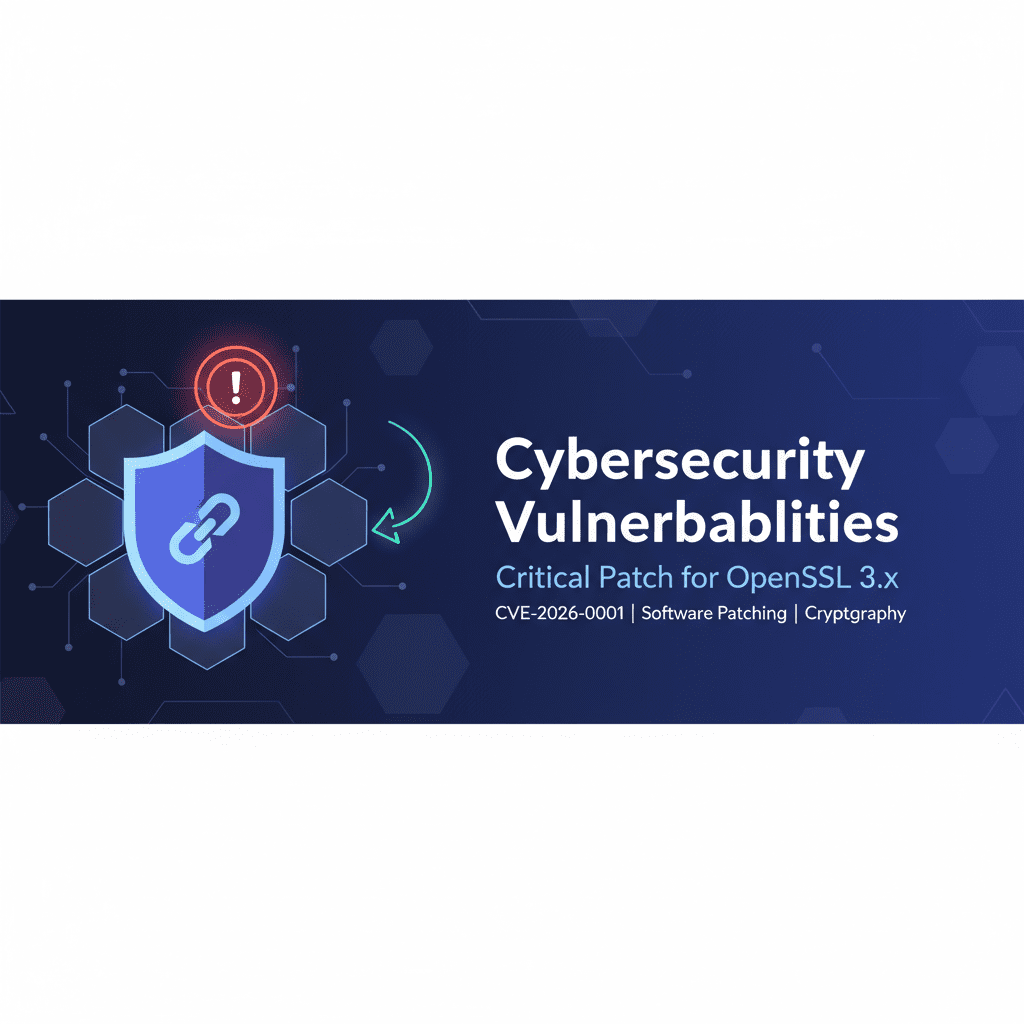
For R&D engineering teams, the promise of rapid feature delivery often clashes with the harsh reality of the software supply chain. Today’s revelation of a high-severity flaw in the OpenSSL 3.x branch serves as a stark reminder that even the most robust cryptographic libraries are not immune to cybersecurity vulnerabilities. With the release of OpenSSL 3.4.2, the maintainers have addressed a critical memory corruption issue that could facilitate remote code execution (RCE) under specific conditions. If your infrastructure relies on the OpenSSL 3.x series, the time for passive monitoring has ended; proactive patching is now a mission-critical requirement.
Technical Deep Dive: Understanding CVE-2026-0001
The vulnerability, tracked as CVE-2026-0001, resides within the ASN.1 parsing logic utilized during the TLS handshake process. Specifically, the flaw exists in the handling of malformed X.509 certificate chains that utilize non-standard elliptic curve parameters. When the library attempts to validate these certificates, a failure in the bounds-checking logic leads to a heap-based buffer overflow.
From an architectural perspective, this is particularly dangerous because the vulnerability is triggered before the application-level authentication is completed. Consequently, an unauthenticated attacker can send a crafted packet stream to a target server, potentially causing a crash (DoS) or, in sophisticated exploit scenarios, achieving arbitrary code execution with the privileges of the process running the OpenSSL library.
Benchmark and Impact Analysis
Preliminary testing indicates that the overflow is deterministic in environments utilizing custom heap allocators, which are common in high-performance web servers and load balancers. While standard glibc allocators may mitigate some exploitability, the risk of a service-wide denial-of-service (DoS) remains extremely high. Benchmarks comparing the patched version (3.4.2) against the vulnerable version (3.4.1) show negligible performance degradation—less than 0.05% in TLS handshake latency—making the upgrade path both necessary and computationally safe.
Migration Implications and Patching Strategy
Moving from OpenSSL 3.4.1 to 3.4.2 is not merely a version bump; it is a fundamental security requirement for any production-facing system. For engineering teams managing containerized microservices, the migration strategy should follow a tiered approach:
- Inventory Audit: Utilize Software Bill of Materials (SBOM) tools to identify every container image and binary currently linking against OpenSSL 3.x.
- CI/CD Integration: Update your base images (e.g., Alpine, Debian, RHEL) to the latest versions that incorporate the 3.4.2 patch.
- Zero-Downtime Deployment: Given the nature of this vulnerability, perform a rolling update of your load balancers and ingress controllers first, as they are the primary attack surface.
It is important to note that OpenSSL 1.1.1 and earlier branches are unaffected by this specific vulnerability, though they remain end-of-life and carry their own significant security risks. If you are still running legacy versions, this incident should serve as the primary catalyst for a comprehensive migration to the 3.x branch.
Best Practices for Mitigating Cybersecurity Vulnerabilities
To defend against future threats of this magnitude, organizations must shift from reactive patching to a resilient cryptography infrastructure posture:
- Implement Defense-in-Depth: Deploy Web Application Firewalls (WAF) with updated signatures to detect and drop malformed TLS handshakes before they reach your backend services.
- Automated Vulnerability Scanning: Integrate container scanning (e.g., Trivy, Clair) into your CI/CD pipeline to automatically block images containing known CVEs.
- Dependency Pinning and Management: Avoid using “latest” tags in your Dockerfiles. Pin versions to specific releases to ensure that updates are intentional, tested, and validated.
- Least Privilege Execution: Ensure that processes handling TLS termination run with the minimum necessary privileges to minimize the impact of a potential RCE.
Related Technical Resources
For further reading on maintaining secure infrastructure, please refer to our internal documentation:
- Best Practices for a Secure Software Supply Chain
- Hardening TLS Configurations for Modern Web Services
Conclusion: The Path Forward
The discovery of CVE-2026-0001 underscores the persistent challenge of maintaining complex software dependencies. While the immediate threat is mitigated by the 3.4.2 patch, the underlying architectural complexity of cryptographic libraries remains a permanent fixture of our threat landscape. Moving forward, engineering leadership must prioritize the automation of dependency updates and foster a culture where security patching is treated as a core component of the software development lifecycle, rather than an afterthought. By adopting a proactive stance today, teams can ensure their systems remain resilient against the evolving landscape of cybersecurity vulnerabilities.