OpenAI’s Symphony: A New Era for Project Management or Familiar Territory?
The rapid evolution of artificial intelligence continues to reshape industries, and the realm of software development is no exception. In a move that has sent ripples through the tech community, OpenAI has released Symphony, an open-source project that integrates AI coding agents with traditional project management frameworks. This development is not just another incremental update; it represents a potential paradigm shift, prompting immediate questions for R&D engineers and development teams: Is this a groundbreaking tool that will redefine our workflows, or a sophisticated re-imagining of existing project management paradigms? This article delves into the technical intricacies of Symphony, its implications for engineering practices, and provides actionable insights for teams looking to leverage this new frontier.
The Urgency for Engineers: Adapting to AI-Driven Workflows
For engineers and R&D professionals, the pace of technological change is not just a professional hazard; it’s a constant imperative. The introduction of tools like OpenAI’s Symphony demands immediate attention. The promise of AI-driven coding agents that can autonomously manage tasks, coupled with familiar project management interfaces, suggests a future where human oversight focuses on higher-level strategy rather than granular supervision. This transition necessitates a proactive approach. Teams that fail to understand and adapt to these evolving tools risk falling behind, facing diminished efficiency and a widening gap in their competitive capabilities. The urgency lies in understanding not just *what* Symphony is, but *how* it fundamentally alters the human-machine collaboration in software development.
Background: The Genesis of Symphony
OpenAI’s foray into project management software is not entirely unexpected, given its overarching mission to develop and deploy artificial general intelligence (AGI) that benefits humanity. While OpenAI is widely recognized for its large language models like GPT, its exploration into more applied AI solutions for productivity has been evident. Symphony emerged as an open-source project, a strategic choice that allows for community contribution and broader adoption. The core concept behind Symphony, as described on its GitHub page, is to “turn project work into isolated, autonomous implementation runs, allowing teams to manage work instead of supervising coding agents.” This is achieved by transforming project management boards, such as those utilizing Kanban-style signboards like Linear, into a “control plane for coding agents.” Essentially, every open task is assigned an agent that runs continuously, with human review focused on the outcomes. This architecture draws inspiration from the success of large language models (LLMs) that utilize tokens—words or sub-word units—to process and generate text. Symphony applies a similar principle to visual data, using “visual patches” as tokens for its transformer architecture, akin to how LLMs use text tokens.
Deep Technical Analysis: Architecture and Functionality
At its core, Symphony leverages a sophisticated architecture that bridges the gap between AI agents and project management workflows. The system is built upon the foundation of OpenAI’s advancements in transformer models, which are known for their ability to handle complex sequences and dependencies.
AI Coding Agents and Task Autonomy
The defining feature of Symphony is its autonomous coding agents. When a task is created on a compatible project management board (e.g., Linear), Symphony assigns an AI agent to it. These agents are designed to continuously work on their assigned tasks, implying a persistent operational state. This contrasts with traditional approaches where developers manually pick up tasks, work on them, and then update their status. Symphony’s agents are expected to handle the implementation details, potentially writing code, running tests, and even debugging, all with minimal human intervention until a review stage.
The Project Management Board as a Control Plane
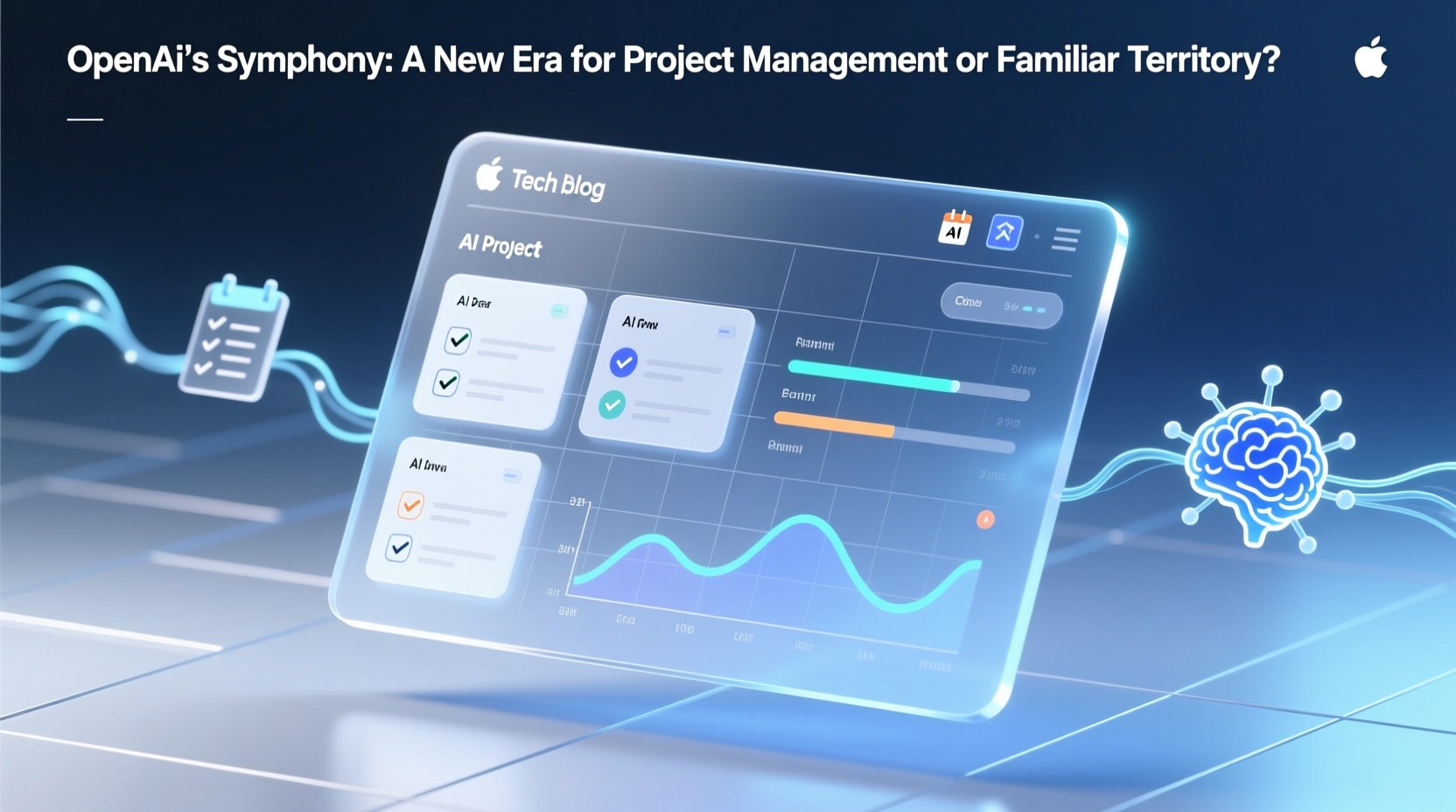
Symphony’s integration with existing project management tools, particularly those employing Kanban-style boards, is crucial. These boards are repurposed as a “control plane.” This means that the visual representation of tasks—their status, priority, and dependencies—serves as the primary interface for managing the AI agents. When a task moves from “To Do” to “In Progress,” it signals the AI agent to commence its work. When it moves to “In Review,” it indicates that the agent has completed its primary implementation and requires human validation. This approach aims to leverage familiar workflows while introducing a powerful AI backend.
Underlying Technology: Diffusion Transformers and Visual Patches
While the specific implementation details of Symphony’s agents are not fully disclosed in the public release notes, its broader technological lineage points to OpenAI’s work on models like Sora. Sora, OpenAI’s text-to-video model, utilizes a diffusion transformer architecture, processing visual data through “spacetime latent patches” that function as tokens, analogous to text tokens in LLMs. This suggests that Symphony’s agents might employ similar techniques for understanding and generating code, potentially by treating code segments as visual patches or by leveraging advanced natural language processing capabilities that are an extension of the diffusion transformer paradigm. The model’s ability to handle “isolated, autonomous implementation runs” implies a sophisticated understanding of code structure, dependencies, and execution environments.
Version and Release Details
As of its initial release, Symphony is presented as an open-source project. Specific version numbers are not prominently highlighted in the initial announcements, suggesting a focus on the conceptual framework and core functionality. However, given OpenAI’s iterative development cycles, it’s reasonable to expect regular updates and enhancements. The project’s open-source nature implies that its evolution will be influenced by community contributions and feedback, much like other prominent open-source AI projects.
Practical Implications for Development Teams
The introduction of Symphony carries significant practical implications for how development teams operate. The shift from direct coding by humans to human supervision of AI agents will necessitate changes in skill sets, team structures, and development methodologies.
Shift in Developer Roles: From Coder to Supervisor
The most profound implication is the redefinition of a developer’s role. Instead of spending the majority of their time writing and debugging code, engineers may transition to becoming overseers of AI agents. This involves defining tasks clearly, setting appropriate parameters, reviewing AI-generated code for correctness, security, and adherence to architectural standards, and providing feedback to refine the agents’ performance. This necessitates a greater emphasis on prompt engineering, strategic thinking, and quality assurance.
Impact on Workflow and Velocity
The promise of continuous agent operation suggests a potential acceleration in development velocity. Tasks that might take a human developer hours or days could theoretically be completed much faster by dedicated AI agents. However, this acceleration is contingent on the agents’ accuracy and the efficiency of the human review process. Bottlenecks could emerge if the review stage becomes a bottleneck, or if agents generate incorrect or insecure code that requires extensive rework.
Integration with Existing Tools
Symphony’s ability to integrate with existing project management tools like Linear is a key advantage. This allows teams to adopt Symphony without a complete overhaul of their existing infrastructure. The use of familiar interfaces minimizes the learning curve and facilitates a smoother transition. However, compatibility with a wider range of project management platforms and development environments will be crucial for widespread adoption.
Security and Code Quality Concerns
A critical concern with any AI-generated code is its security and quality. While OpenAI is known for its rigorous testing, the potential for vulnerabilities, logical errors, or inefficient code in AI-generated output remains a significant consideration. Teams will need robust code review processes and automated security scanning tools to mitigate these risks. The “isolated, autonomous implementation runs” could also introduce challenges in debugging complex issues that span multiple agent-generated components.
Best Practices for Adopting Symphony
For engineering and infrastructure teams considering the adoption of OpenAI’s Symphony, a strategic and phased approach is recommended.
- Start with Pilot Projects: Begin by integrating Symphony into smaller, less critical projects. This allows teams to experiment with the tool, understand its capabilities and limitations, and refine their processes without jeopardizing core operations.
- Invest in Prompt Engineering Training: The effectiveness of AI agents heavily relies on the quality of the prompts and task definitions provided. Teams should invest in training their members on best practices for prompt engineering, ensuring tasks are clearly defined, unambiguous, and provide sufficient context.
- Establish Robust Review Processes: Human oversight remains indispensable. Implement rigorous code review protocols, automated testing suites, and security scanning to validate AI-generated code. Define clear criteria for accepting or rejecting agent-generated output.
- Monitor Performance and Iterate: Continuously monitor the performance of the AI agents. Track metrics such as task completion time, code quality, bug rates, and developer feedback. Use this data to identify areas for improvement and iterate on prompt strategies and agent configurations.
- Foster Collaboration Between Humans and AI: Emphasize that Symphony is a tool to augment, not replace, human engineers. Encourage collaboration where AI agents handle repetitive or boilerplate tasks, freeing up human engineers for complex problem-solving, architectural design, and innovation.
Related Internal Topic Links
- The Evolving Role of AI in Software Development Lifecycle
- Architectural Patterns for Autonomous Coding Agents
- Strategies for Enhancing DevOps Automation with AI
Conclusion: A Glimpse into the Future of Engineering
OpenAI’s Symphony represents a significant step towards integrating AI agents directly into the core of software development workflows. By transforming project management boards into control planes for autonomous coding agents, it promises to accelerate development cycles and redefine the roles of engineers. While the technology is still nascent and its long-term implications are yet to be fully realized, the underlying principles—autonomous agents, AI-driven task management, and seamless integration with existing tools—point towards a future where human creativity and AI efficiency are deeply intertwined. For R&D engineering teams, understanding and strategically adopting tools like Symphony will be paramount in navigating the evolving landscape of software creation.