OCI Unleashes AI Compute Powerhouse with NVIDIA RTX PRO Blackwell GPUs
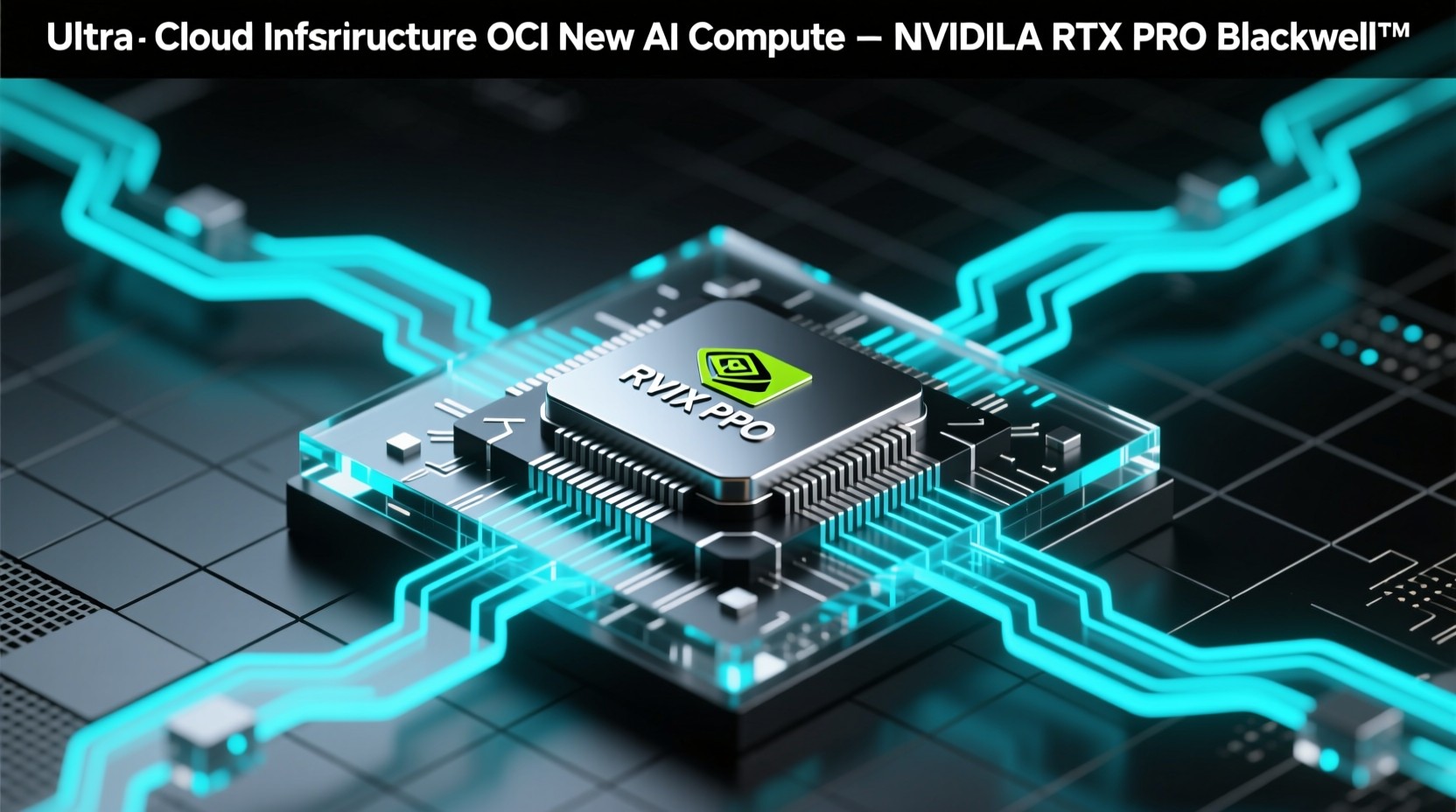
In a move that will undoubtedly send ripples through the R&D engineering community, Oracle Cloud Infrastructure (OCI) has announced the general availability of its new BM.GPU.RTXPRO.8 bare metal compute shape. This groundbreaking offering is powered by NVIDIA RTX PRO 6000 Blackwell Server Edition GPUs and Intel® Xeon® 6 processors, designed to propel the next generation of multimodal AI and visual computing workloads. For engineers and researchers pushing the boundaries of artificial intelligence, real-time rendering, and complex simulations, this announcement signifies a critical leap forward in accessible, high-performance cloud infrastructure.
Background: The Evolving Demands of AI and Visual Computing
The landscape of artificial intelligence and visual computing is evolving at an unprecedented pace. Organizations are increasingly grappling with fragmented infrastructure that necessitates separate systems for AI training, real-time rendering, and advanced simulations. This fragmentation leads to significant inefficiencies, including overprovisioning of resources, underutilization of hardware, increased operational complexity, and higher costs. The emergence of multimodal AI—applications that can process and generate insights from diverse data types like text, images, video, and sensor data—further exacerbates these challenges. The need for a unified, high-performance platform capable of handling these diverse and demanding workloads concurrently has never been more acute. Oracle’s strategic integration of NVIDIA’s latest Blackwell architecture directly addresses this market imperative, aiming to consolidate these disparate needs onto a single, powerful cloud instance.
Deep Technical Analysis: The BM.GPU.RTXPRO.8 Architecture
The new BM.GPU.RTXPRO.8 shape is meticulously engineered to deliver unparalleled performance for AI and visual computing tasks. At its core are eight NVIDIA RTX PRO 6000 Blackwell GPUs, each equipped with a substantial 96 GB of high-speed GDDR7 memory. This configuration is crucial for handling large AI models and extensive datasets, a common bottleneck in current AI development. The Blackwell architecture itself is a significant advancement, featuring enhanced Tensor and RT cores specifically optimized for AI acceleration and real-time ray tracing.
Complementing the GPUs are Intel® Xeon® 6 processors, providing robust CPU power for general-purpose computing and orchestrating complex workflows. The instance boasts an impressive 3 TB of system memory, reportedly offering up to twice the memory of comparable offerings from other hyperscalers. Storage is handled by 61.44 TB of local NVMe SSDs, providing up to four times the local storage capacity of competitors, which is vital for rapid data access during intensive processing tasks.
Networking is another key area of focus, with the BM.GPU.RTXPRO.8 offering high-performance connectivity up to 400 Gbps for front-end traffic and a staggering 1600 Gbps RDMA back-end connectivity. This enables low-latency, high-throughput communication essential for distributed training and inference across multiple instances or nodes, a critical component for scaling AI workloads effectively.
The underlying architecture is further enhanced by Oracle Acceleron, OCI’s suite of network software and architecture designed to optimize performance, bolster security, and streamline operations. This integrated approach ensures that the hardware capabilities are fully realized through optimized software and network fabric.
Practical Implications for R&D Engineers
For R&D engineers, the practical implications of OCI’s new AI compute offering are profound:
- Consolidated Workloads: The ability to run AI inference, real-time rendering, simulation, and media processing concurrently on a single platform dramatically simplifies deployment and management. This eliminates the need to manage separate infrastructure silos, saving considerable time and effort.
- Accelerated Development Cycles: With enhanced GPU power and high-speed memory, engineers can expect significantly faster iteration times for AI model training and refinement. This directly translates to quicker experimentation and faster time-to-market for AI-driven products and services.
- Cost Efficiency: By consolidating workloads and improving resource utilization, organizations can potentially reduce their overall cloud expenditure. The pay-as-you-go model for bare metal instances, combined with the platform’s efficiency, offers a compelling cost-benefit analysis compared to maintaining disparate, specialized infrastructure.
- Support for Next-Gen Applications: The Blackwell architecture is purpose-built for the demands of multimodal AI, enabling engineers to develop and deploy cutting-edge applications that combine various data modalities for richer insights and more sophisticated functionalities.
- Simplified Scalability: The high-bandwidth networking and ample system resources make scaling these demanding workloads more straightforward. Whether for training massive models or serving real-time inference requests at scale, the BM.GPU.RTXPRO.8 provides a robust foundation.
Best Practices for Leveraging OCI’s New AI Compute
To maximize the benefits of OCI’s BM.GPU.RTXPRO.8 compute shape, R&D teams should consider the following best practices:
- Workload Profiling: Before migrating or deploying, thoroughly profile existing and planned workloads to identify the optimal balance between GPU, CPU, memory, and storage utilization. This will ensure you’re selecting the right instance configuration and not over-provisioning.
- Containerization: Leverage containerization technologies (e.g., Docker, Kubernetes via OCI Kubernetes Engine) to package applications and their dependencies. This ensures portability, simplifies deployment across the BM.GPU.RTXPRO.8 instances, and facilitates efficient resource management.
- Optimized Data Pipelines: Design efficient data pipelines that leverage OCI’s high-speed networking and local NVMe storage. Pre-processing data and staging it close to the compute resources can significantly reduce I/O bottlenecks.
- Leverage Oracle Acceleron: Familiarize yourself with Oracle Acceleron’s capabilities for network optimization and security. Understanding how to configure and utilize these features can unlock the full performance potential of the instances.
- Monitor and Tune: Continuously monitor resource utilization and performance metrics using OCI’s monitoring tools. Regularly tune application configurations and OCI instance settings for optimal efficiency and cost-effectiveness.
- Explore Managed Services: For certain AI tasks, consider OCI’s managed services (e.g., OCI AI services, Data Science platform) which can abstract away some of the infrastructure management complexities, allowing teams to focus more on model development.
Actionable Takeaways for Development and Infrastructure Teams
For Development Teams:
- Evaluate your current AI and visual computing workloads. Identify which could benefit from the consolidated power of the BM.GPU.RTXPRO.8 instance.
- Begin experimenting with multimodal AI frameworks and libraries on OCI to explore new application possibilities.
- Update development environments and CI/CD pipelines to target OCI’s new GPU instances.
For Infrastructure Teams:
- Assess the impact of this new offering on your existing OCI architecture and cost models.
- Develop deployment strategies and automation scripts for provisioning and managing the BM.GPU.RTXPRO.8 instances.
- Review and update security policies to align with the enhanced capabilities and potential attack vectors of high-performance GPU instances.
- Investigate the integration points with other OCI services, such as OCI Kubernetes Engine and OCI Data Science, for a comprehensive solution.
Related Internal Topics
- Optimizing GPU Performance on OCI
- Building Multimodal AI Applications
- Deep Dive into NVIDIA Blackwell Architecture
Conclusion: A New Era for AI and Visual Computing on OCI
The introduction of OCI Compute with NVIDIA RTX PRO Blackwell GPUs marks a significant milestone in cloud computing. By offering a unified, high-performance platform for demanding AI and visual computing workloads, Oracle is empowering R&D engineers and organizations to innovate faster and more efficiently. This strategic move not only addresses the current challenges of fragmented infrastructure but also lays the groundwork for the next wave of AI-driven applications. As organizations continue to push the boundaries of what’s possible with AI, OCI’s latest offering provides the essential, cutting-edge infrastructure needed to turn ambitious ideas into reality.